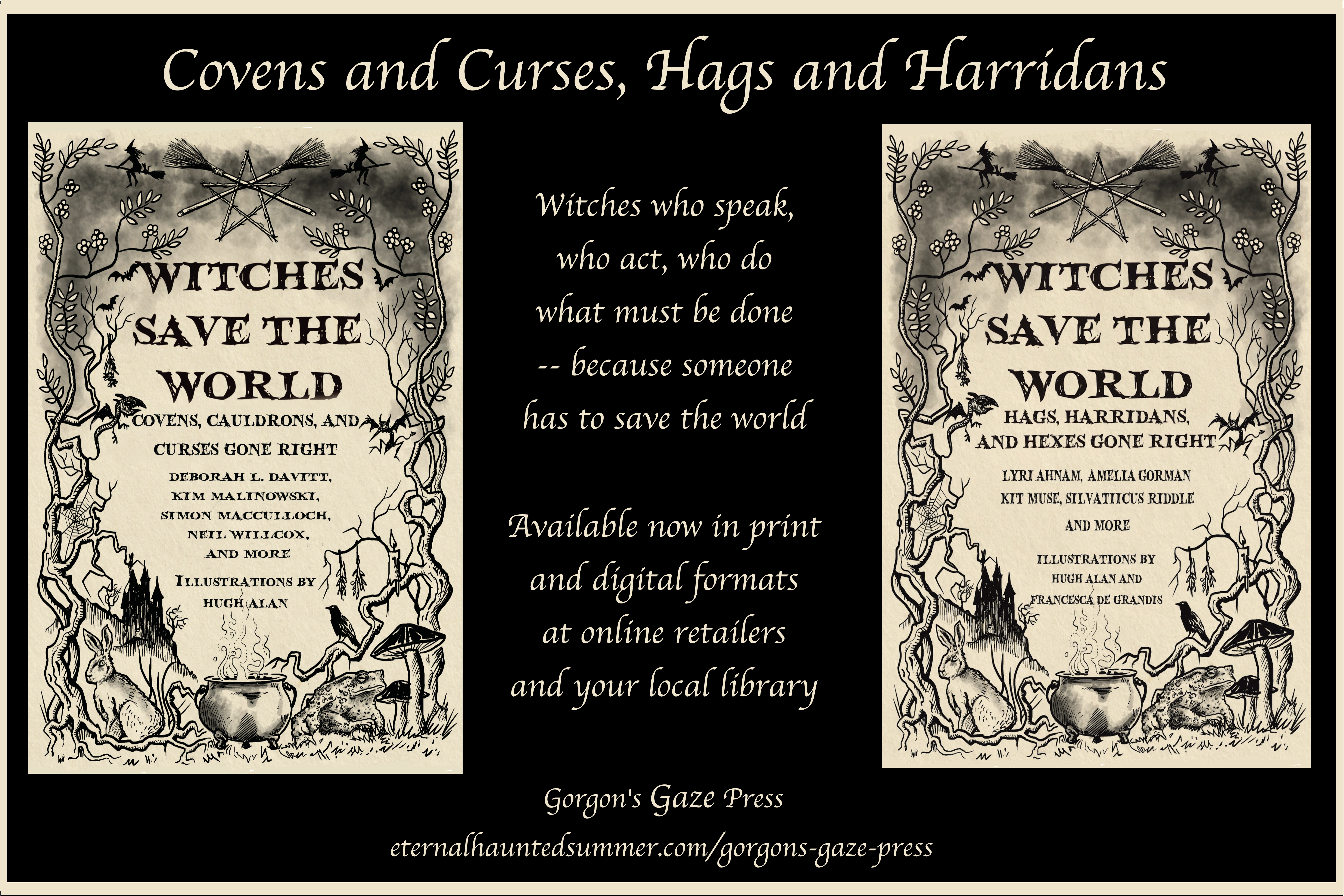
Welcome to the latest installment of the Witches Save the World Micro-Interviews! In honor of the upcoming Halloween/Samhain holiday, and in celebration of the release of Witches Save the World, Forests Haunted By Holiness will be featuring a series of interviews with the contributors throughout October.
Witches Save the World was a labor of love. Across these two volumes you will find poems, short stories, and essays celebrating the witch and their role as wisdom keeper, protector of nature, avenger of the forgotten, and defender of the oppressed. Individual poems and stories range from historical fantasy to contemporary horror to science fiction, with many questioning the nature and cost of honor, integrity, and freedom.
In concert with these interviews, one physical copy of Witches Save the World — either Hags, Harridans, and Hexes Gone Right or Covens, Cauldrons, and Curses Gone Right— will be given away at the end of the month! Two books, two winners! To enter the drawing, just comment below and share the interview on your favorite social media platform.
Ready? Let’s get started!
Forests Haunted By Holiness: What is the title of your story and can you give us a spoiler-free summary?
Molly Thynes: My short story is called “Minnesota Comfort.” It’s a period piece (and I use this term lightly, because the ‘period’ was eight months ago) taking place in Northern Minnesota during Operation Metro Surge. The new student teacher, Miss Madison Knutson, can only watch from the national news coverage all the terror taking place in her old Minneapolis neighborhoods, and, of course, confide all her worries to her mentor. Granted, Ms. Ingrid Svalstard is the only person she really can talk to about her worries, because everyone else in the small town of Glacial Ridge is her mentor at the elementary school. Everyone else in town treats the events as something to be laughed at, a point scored by their team on the game on TV.
But the fact that Madison spills all her troubles to Ms. Svalstard may have been a mistake. You see, the schoolchildren have been whispering stories about Ms. Svalstard for years, just like with her mother before her, and her mother before her, and every single woman in the Svalstard family. And all that spilled out pain, trauma, and anger finally comes to a head on the night of the Glacial Ridge Hotdish Contest.
FHBH: How did you go about writing your story? Lot of research? Or did you just wing it?
MT: I wish I could say I did a lot of deep research for the witch character in this story. I certainly had a very clear picture of who she was: someone born of an ancient Norse bloodline that has possibly been in America from the time the Vikings walked the shore. Though, honestly, I wrote this story from a very instinctual place (which is really just a much eloquent way of saying I had a lot of personal anger I was trying to get out).
In hindsight, I do see a lot of influence from other pieces of witch media in this — The Lords of Salem, The Witch, Suspiria — but any influence I did gleam from those was likely subconscious.
FHBH: What draws you to the character and theme of “the witch”? What do you find so compelling about it?
MT: This is a little bit of a tangent, but I remember hearing someone pose the question of why older women tend to be brushed aside or relocated to such second-class status in very conservative religious sects. One answer I hear stuck with me: because old women are the ones who will bear their years of hard fought wisdom to the young and beautiful, so their struggle isn’t repeated. And can you think of anything more dangerous to the patriarchy?
I think this sentiment is so heavily embodied in the character of the witch, whether she chooses to use this power for good or for evil. Actually, I believe the fact that she has that choice in the first place is what keeps bringing us back to this character.

