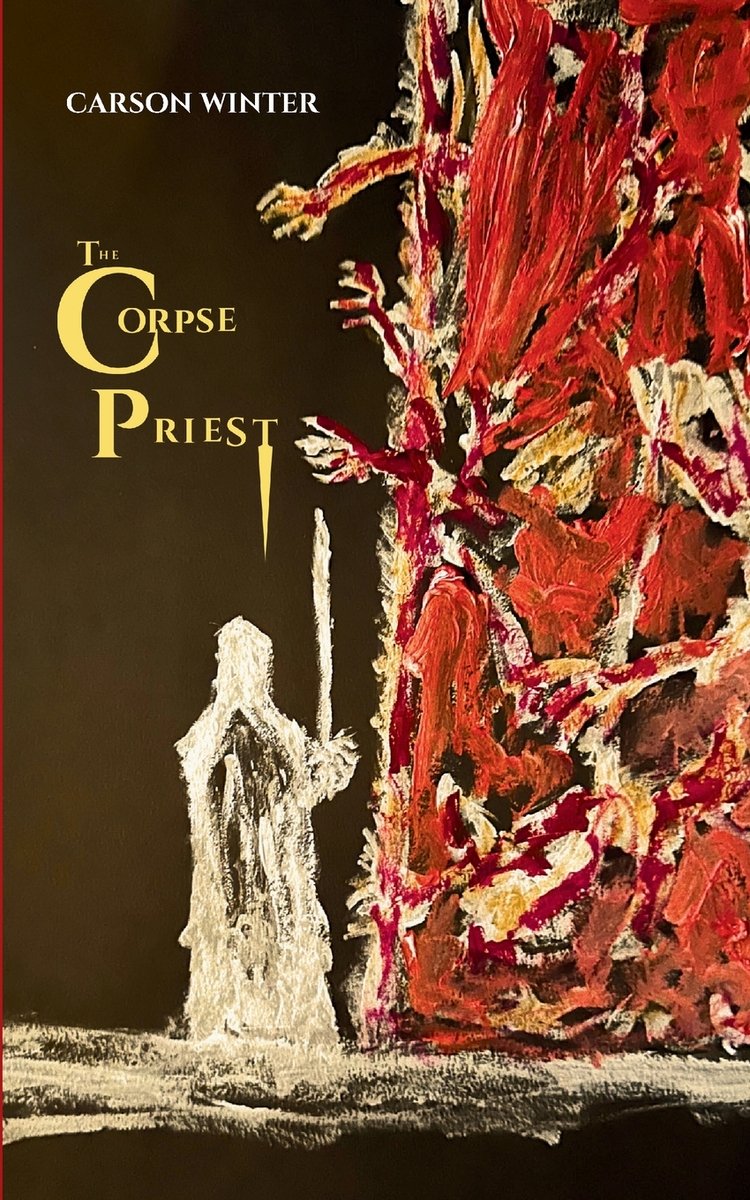
[Today we sit down for a quick interview with weird fiction/fantasy/horror author, Carson Winter. Here he discusses his new novella The Corpse Priest, which combines sword and sorcery with cosmic horror.]
Forests Haunted by Holiness: You recently published The Corpse Priest, a tale that combines sword and sorcery with cosmic horror. First, congratulations! Second, what draws you to those genres? What do you find so compelling about sword and sorcery and about cosmic horror?
Carson Winter: Thank you! I’m primarily a horror writer, so my history with cosmic horror goes way back to my early days as an explorer of the horror genre. I was always fascinated and unsettled by the idea that we, as humans, tend to view the world through an anthropocentric lens — more or less casting ourselves as the center of the universe. Cosmic horror sets out to subvert one of the most fundamental aspects of our perspective and I think when done well, is uniquely anxiety-inducing.
As for sword and sorcery, this was a more recent discovery for me. I’ve long had a love/hate relationship with fantasy fiction. There are elements of which I find absolutely delicious. For example, I love when authors build their worlds then map onto them political machinations, complex characters, and epically-scoped plots. But I also tend to bounce off in-depth worldbuilding, books-as-series, and overly alien or archaic language.
When I discovered sword and sorcery, I found an interesting niche within fantasy fiction that changed the shape of what I perceived the genre could be. In contrast to the epic fantasy I’d read, sword and sorcery was much shorter, more focused on standalone adventures, with a lot of very elegant, but minimalist worldbuilding, and practically bursting with imagination.
When creating The Corpse Priest, I was largely motivated by the gap between my home genre — horror — and my new burgeoning interest in fantasy fiction. How are they different? How are they the same? And how could I take what I love from both, and shape it into my own dark and bloody adventure?
FHBH: The eponymous main character is a priest of death. Why a priest of death as your protagonist instead of, say, a wandering bard? What does such a character allow you to explore or experience that another character cannot?
CW: When conceiving of the character of Corpse, I drew from weird horror author Thomas Ligotti and his philosophical pessimism. Throughout my time as a writer, I’ve been fascinated with Ligotti’s pessimism and my own relationship to it. To frame it reductively, Ligotti believes that life is inherently bad. I don’t necessarily share Ligotti’s belief, but it’s not one I can refute either. Our brains are machines and if one of these machines has a malfunction, it’ll affect our perception. If your brain tells you to be afraid and depressed at all hours of the day, then of course you’ll think life is terrible.
I thought it was very intriguing to have a character who shares this perspective, as it seemed very out-of-line with heroic fiction. Where other characters might seek glory or justice, Corpse is a being battling with his own views on existence. He’s melancholy, unsure, anxious, and also guilty.
I bestowed the title of Priest onto him because I thought it’d be an interesting bit of worldbuilding. Corpse comes from a tribe of philosophical pessimists who are torn between their desire to die and their fear of suicide. It made sense to me that — knowing what we do about people — this tribe would proselytize and seek to do for others what they cannot do for themselves. Hence, Corpse is a priest, although not the sort we recognize.
Corpse’s violent priesthood, where he seeks to relieve others from the curse of existence, provides a nice fulcrum for storytelling as well. It establishes the character as a warrior, but it also provides him with a past he must battle with internally as a foil to whatever external struggles he faces on his journey.
FHBH: How did you go about designing the cosmology of The Corpse Priest? What real world mythologies and spiritualities did you draw on for inspiration?
CW: The cosmology of The Corpse Priest was one of my favorite parts of the process. As much as I harp on writers getting sucked into their own world-building, I totally get it now.
The Corpse Priest is a standalone but it does not exist in a vacuum, and actually shares a lot of connections to other mythoses in my work — some published and some not. My main concern for the religions in the book was to make them thematically interesting. How could this belief be a foil to Corpse’s? What interesting conversations could come from it? How could this spur on character growth?
The people of Dross Toll believe in a Two-Headed Martyr that communes with the past and future to create the present. I liked the idea that the central tenets of their religion would surround reality itself, which parallels the antagonistic threat in The Corpse Priest.
It also provides an interesting war of ideas that also overlap. Corpse is driven by a philosophy, while Dross Toll follows a religion. While I’m not religious, I’ve long been fascinated with an observation by The Power of Habit author Charles Duhigg. The short of it is, that a successful habit or ritual requires something larger than itself. It’s why Alcoholics Anonymous demands a belief in a higher power. For some reason, faith or hope or purpose beyond ourselves elevates a simple idea into something so much stickier.
In The Corpse Priest, I wanted to play with these ideas, to have them battle it out. It also felt like an honest path to take with the story about death and our relationship to it. Not having themes on religion would do a disservice to one of humankind’s oldest coping mechanisms.
FHBH: What other projects are you working on?
CW: Right now, I have a lot of plates spinning. I’m editing two novels, shopping another, and I just started drafting a new one, too. It truly never ends, but I wouldn’t have it any other way!
I also hope to write two more Corpse novellas in the near future, as I have a fairly clear vision of where I want to take the character next as he begins his journey toward reconciling his beliefs.
FHBH: Which book fairs, conventions, or other events do you hope to attend in the foreseeable future?
CW: I rarely attend conventions at this point, but it’s something I’d like to change in the near future. I don’t have anything on the books right now, but for readers in the Twin Cities region, I often sell books at local author events. You can also find me on my weekly horror writing podcast Dead Languages.

