[Today, we sit down with author and frequent EHS contributor, Jim Johnston. Here, he discusses his new book Daniel in the Underworlds; the research that went into it; his fascination with world mythology; and his upcoming projects.]
Forests Haunted by Holiness: You recently released Daniel in the Underworlds, the first in a trilogy. First, congratulations! Second, where can readers find your book?
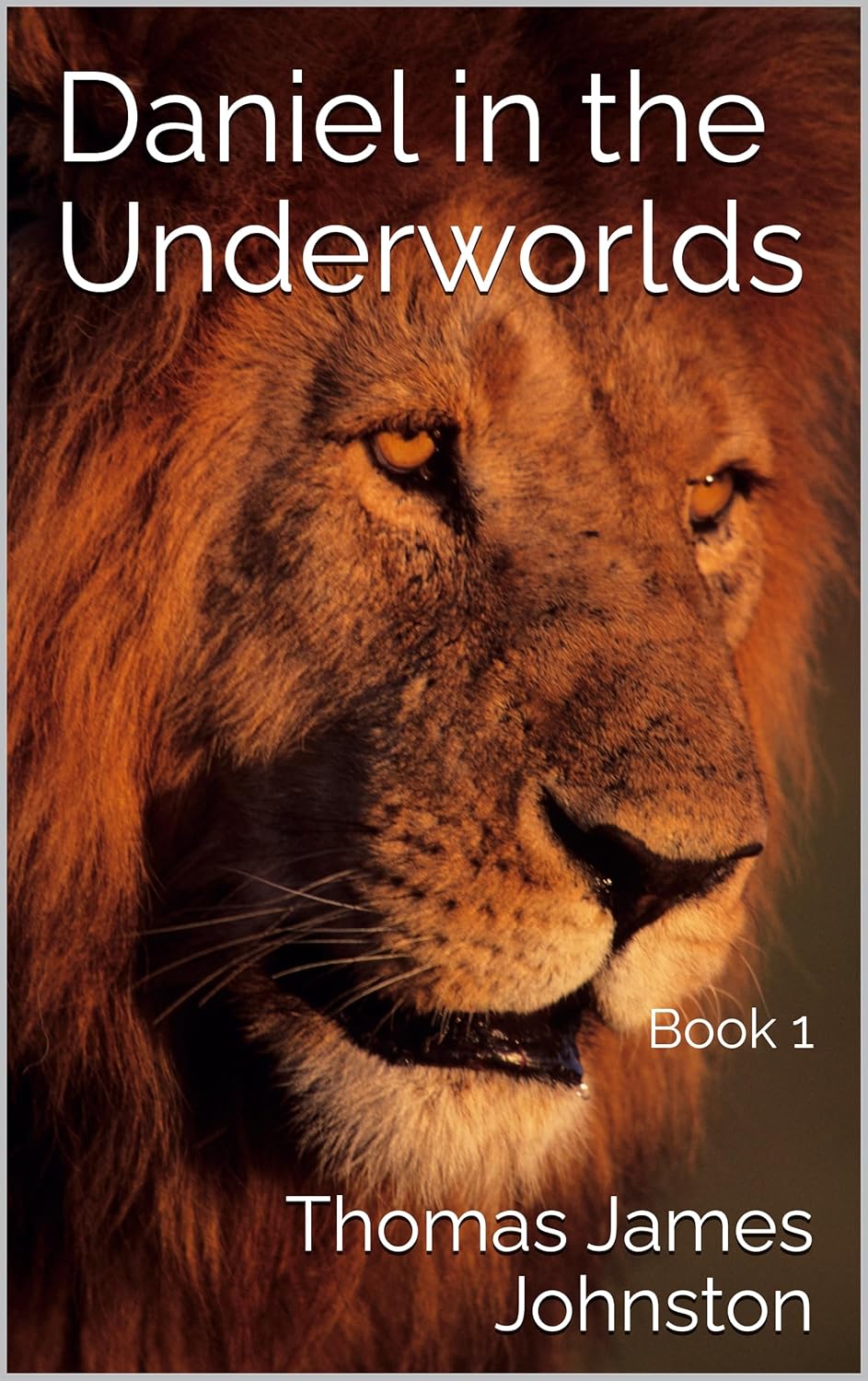
Jim Johnston: Heh, I thought it was a trilogy, but it’s now a four book series. It’s essentially one long story, but I thought that trying to keep it in seventy thousand-word chunks would make for a better reading experience. At the moment, the first book is up on Amazon KDP under my name of Thomas James Johnston, entitled Daniel in the Underworlds Book 1: The Ziggurat Beneath. I’m not going to launch it officially until sometime in April, maybe with all four books going live. I have a cover in holding place, but I have a really talented artist working on my design for a final cover. I visualize each cover being the same template, but with additional figures that emerge from the narrative.
FHBH: What sort of research went into Daniel in the Underworlds? Long hours online? Stacks of books? Lengthy discussions with scholars and students of Babylonian history and spirituality?
JJ: I wish! No, I’ve always been fascinated with all the worlds of mythology and folklore and folktales. I can remember in primary school (I live in that part of Ireland still held in the embrace of colonial Britain) reading a book about the adventures of Loki and Thor in Giant-Land. They find a weird cave and spend the night there, and when they waken in the morning (spoiler alert!) they discover that it’s really the glove of a giant (or Jotun or Ettin, whatever). That image has stayed with me.
And then in Sunday School (under the aegis of the Church of Ireland) I recognized that a lot of bible stories were similar to Greek myths. Moses in the basket had to be the same trope as Ion and a few others. Even Balder from the Norse myths had a basket advent. The flood of Noah had to be borrowed from the Babylonian creation myth, the Enuma Elish. Et cetera and so on.
As a school kid I adored the Narnia stories. My teacher read out The Silver Chair to us over several classes, so that led me to Narnia. Curiously, the huge Christ-myth of Aslan standing in for JC never really struck me, and even now when I re-read The Lion, the Witch, and the Wardrobe, it still doesn’t resonate in a Christian manner. Just dumb, I guess. And then I encountered Tolkien in my mid-teens and I was hooked. I’ve read The Lord of the Rings over thirty times ever since. I stopped once I saw the movies, but I re-read it again recently and it is still a winner for me. I am captivated by his prose and the depth of his invention. So, that opened up my interest in a deeper reading of fairy-tales, especially with Angela Carter’s books and her feminist readings.
As far as writing goes, again in my mid-teens, I was exposed to John Milton, the blind poet, author of Paradise Lost. My first sight of his two major poems “Il Penseroso” and “L’Allegro” inspired me to go home that very night and write Miltonic pastiches. It was a mixture of the richness of his lexicon and the biblical and classical allusions.
FHBH: Was there anything from Babylonian history or polytheism that you absolutely had to include? Was there anything you uncovered that we just don’t know much about, and you wish there was more information?
JJ: I’ve always been fascinated by human-animal hybrids. From the earliest of cave drawings, mixed beast- and bird-folk are the widest elements from all around the world. My favorite from childhood, of course, is the werewolf. Ireland in the dark ages was known as Wolf-Land, and has all sorts of shape-shifting creatures such as phouka and brollachans. So, the kusarikku, man-bull creatures from the Sumerian underworld, had to make an appearance, along with the scorpion-folk and the magnificent sirrush. In fact Daniel in the Underworlds was just meant to be a single episode, a longish short story, but I began to get so many other ideas that I just had to follow through. “The Lair of the Sirrush” became the first chapter, and the fall-out from that episode set off a long, long row of dominoes falling. In fact, I may not have reached the end of Daniel’s subterranean odyssey, but I had to hold off because I’ve a terrible habit of writing and writing and not thinking about sending my stories off for publication.
As for things I wish I learned more about. The Rephaim are a subtle and teasing suggestion mentioned in the bible where they are described as giants and mighty warriors. But the etymology of that name seems to come from a wider source, where they are considered to be the ancestral spirits of certain people-groups. With the long-term writing time for the composition of the various bible books, Rephaim might well have changed over the centuries. Rephaim might also refer to spirits, shades and the dead in Sheol (the Israelite term for the grave). Ugaritic texts refer to them, but they are surrounded in mystery.
FHBH: What draws you to the story and figure of Daniel? What do you find so compelling about it?
JJ: Although as a child I attended the Church of Ireland, as an adult I have never identified as a Protestant. I attended confirmation classes, but didn’t attend the final ceremony. In the north of Ireland, the Troubles were ongoing. My parents were what was termed a mixed-marriage; my mother was a Catholic and my father a Protestant. So, I didn’t really have a background to attach myself to.
The bible, however, is such a numinous and fascinating text from Genesis to Revelation, and so much of its imagery has soaked into English culture, that it is impossible to ignore. Sayings such as “by the skin of my teeth” and “the apple of my eye” all stem from the bible. Robert Graves, the author of The White Goddess, Greek Myths, and co-author along with Raphael Patai produced a book entitled Hebrew Myths, which unfortunately only covered the book of Genesis. I know Graves is a bit of a maverick, but I was drawn to his world-view on myths merely by the broad inclusion of various tropes. I have read a number of Israeli/American authors who draw on their Jewish culture, and I find it curiously satisfying to have their take on Jewish subjects. I have read books such as Major Trends in Jewish Mysticism by Gershom Scholem; the development of gematria and kabbalah.
Several years ago I planned on writing a novel about a Jewish character in 2 BCE, who happened to be the son of a scribe, but instead he became a gladiator. This is a real historical character. But since I was developing a fantasy plot, I needed a character from Jewish history to be a kind of mystical mentor. I settled for a time on Elijah, but since Elijah is still a persistent figure in modern-day Jewish religion, I went off that idea. Casting around for someone more suitable, I fell across a Wikipedia entry on the Book of Daniel, which explained that Daniel was kinda sorta based on a Ugaritic figure named Danel. The bible text was written long after the alleged time frame of the book, and contained numerous errors. Modern scholarship now believes it was written some 300 years after its supposed time-line. So, Daniel, I thought, was fair game. The miracles described in the book are pretty far-fetched, even for biblical tropes. But a suppressed part of the book gave me a useful insight. This was the chapter where Daniel solved the first locked-room mystery in literature.
FHBH: What other projects are you working on?
JJ: Now that I have opened up my KDP account, I’m planning on uploading pretty much everything else I’ve written.
Once the Daniel series is live, I have in mind a YA story set in a Norse milieu, with the protagonist a young Dwarf, living in the enchanted land of Nordymain.
I have another novel, set in pre-Christian Lapland, with shamanic tendencies and alien input. I have another series of stand-alone novels, dealing with Sir Comgall, a Christian knight who lives on a planet called Terra Sabazia in a sequestered solar system. (Saint Comgall was the name saint of the Church of Ireland venue I attended as a child.) It involves a mixture of Christian legends, Arthurian myths, medieval takes on the various lives of the saints, and is a platform for my imagination to take off and meld all these elements into what I hope will read as a gorgeous tapestry, similar to The Unicorn Tapestries of Flanders (c. 1495–1505).
I also have a light-hearted science-fantasy involving an interplanetary romance.
I have two books in a series about a boy who befriends a living gargoyle. This is an open-ended series that might just go on and on, based on a role-playing world I co-created with a friend in the 1980s. The first chapter has appeared here.
Then I have a series set in the 1980s of an American character living in Belfast, who learns occult mysticism almost by accident. At least seven books in this series, not all of them quite finished.
And (not) lastly, a book based on Grimms’ fairy tales, re-written (or re-heathenized) with all the Christian elements removed.
I also have some play texts that I might put up. And in the back matter of the books, I also hope to promote my songs with my various musical co-writers.
I have two sites. One is on YouTube. And my KDP account.

