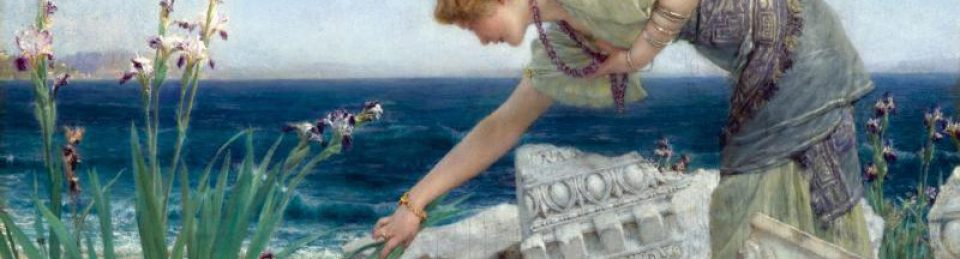
[Editor’s Note: for the Summer Solstice 2026 issue of EHS, Gerri Leen sits down with artist Mimzi Haut. Here, Haut discusses the mediums they use and their creative process, their artistic relationship with mythology and spirituality, and more.]
Gerri Leen: Please welcome Mimzi Haut to the second installment of “The Art Gallery” column at Eternal Haunted Summer!
Mimzi, your portfolio is so diverse as to subject and color ways and yet there is a unifying quality to all your work. My eyes are always drawn first to the pieces of yours that I have in installations around my house because of the detail and tremendous skill but also an ineffable quality. There’s something “alive” about your ar t– even in those that aren’t trompe l’oeil — that resists being uncanny and is instead very soothing. How do you do that? Or maybe the broader question is where does your art come from?
Mimzi Haut: Most of my paintings begin with layers of color and in many cases, texture and crackling. I like the feeling this gives, like a plastered-over fresco waiting to be exposed. There is a reference to antiquity and things hidden. There is always a visual energy to this base even before the subject manifests, sometimes in my dreams.
GL: What can you tell us about your process? How much is learned and how much intuitive?
MH: I trained in classical realism with a reverence for the Medieval Flemish altarpieces by Memling and Van Eyck. Early on I worked in that style in oil paint but have since focused on acrylic and mixed media because of the ability to layer quickly and have more control.
I am not specifically religious, but I understand the power of religious imagery and find myself drawn to ritual and arcane objects like shrines and reliquaries. My representations are certainly intuitive, but the techniques are a result of years of learning and experimentation in many mediums. My trompe l’oeil work is much less intuitive and a more technically precise visual language.
GL: One of my favorite aspects of your mixed media is the feeling of “found things” in the piece. How do you approach the creation of these pieces and does the found thing inspire the art or do you know what the art will be and then create the pieces or go looking for treasures “in the wild”?
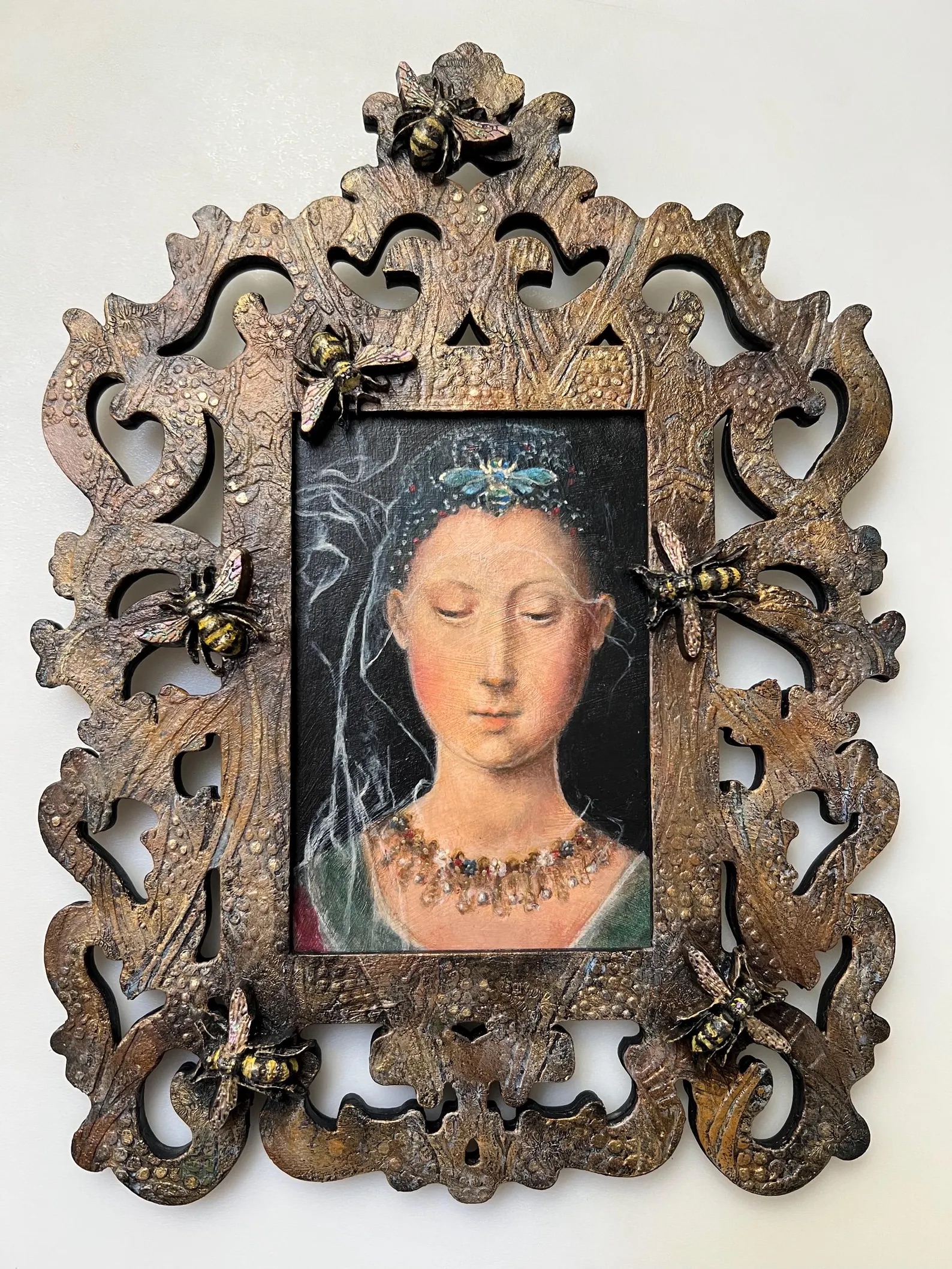
MH: I do tend to find treasures “in the wild.” I am that person picking up rusty things in the parking lot. But I also create “found items” with clay, metal, wood and broken jewelry. I think the addition of the three dimensional objects increases the sensory response to a piece and adds to the ritual aspect that I intend. Usually the art comes first and then I select or make what I call “dangles” that feel cohesive and add a curious element to the story.
GL: This is a pagan/mythology centered magazine and you occasionally address those subjects — and many of your other works are fantasy-adjacent with your use of stars, crows, bees and other natural things. I have one of your Morrigan paintings that is glorious in its restraint on the subject matter without negating a bit of the goddess’s strength. It’s one of my favorite works in the house not just in my pagan collection. How do you approach the more fantastical of your works? What are your inspirations or touchstones for mythology and fantasy art?
MH: Since I was a child I have been aware of my soul connections, and that included a fascination with mythology and its symbols throughout particular cultures and time frames. Especially intriguing for me are celestial themes and legends about the constellations like the Pleiades. I approach these fantasy pieces more like a remembering.
GL: Your hand shrines are amazing and unique. I have “Be Fearless” in my bedroom where I can touch it on the way out the door. Your recent Lover’s Eyes series is haunting. When did you start making the hand shrines, what themes are you planning next, and do you ever work with someone to customize a hand shrine?
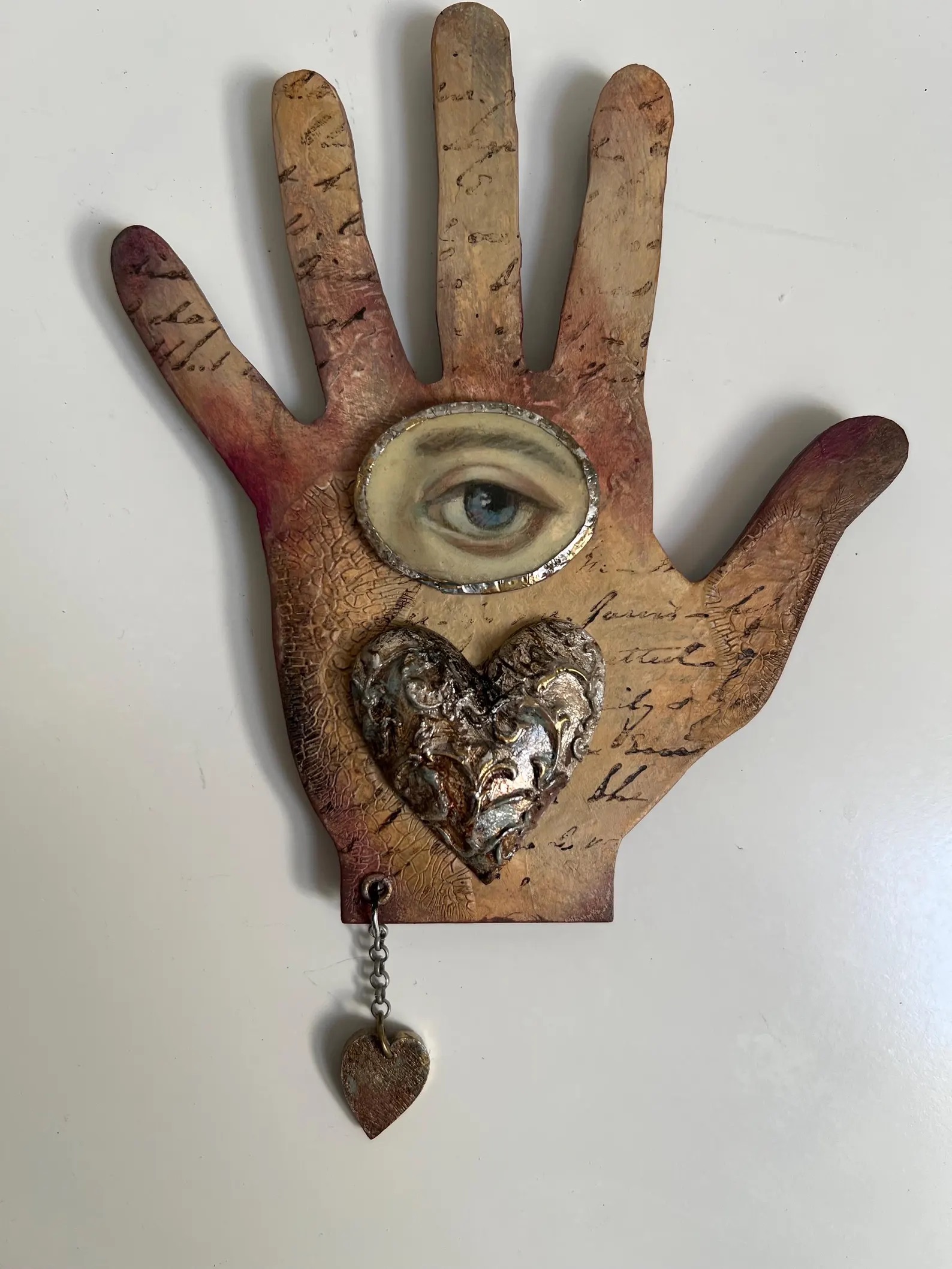
MH: My first hand shrine several years ago was an experiment in painting on a shaped panel, inspired by the importance of hand imagery throughout history as a representation of creativity, protection and blessing. I find there is enormous power in symbols and archetypes. My shrines have incorporated among other things crows, Native American talismans, medieval objects, and religious Hispanic folk art themes like Corazon Sagrados.
The Lovers Eyes were secret tokens of affection in late 18th Century France. I was drawn to the notion of art holding secrets when I did this series.
Right now I am working on two hand shrines of reliquaries with skeletal hand images. I have done a custom hand shrine, and the collector and I both totally embraced that project.
GL: As a fellow creator, I live in two paradigms. Fiction, which typically is “finished,” and poetry, which is seemingly always ripe for a little tweaking. Not that fiction can’t be revised, but I don’t reach for that option most of the time whereas I will pick at a poem frequently to make it better. How do you know when a work is done? Does your process allow you to tweak or is there a point where you cannot go back to it?
MH: I have some technical benchmarks for a painting to meet before I call it finished. On rare occasions, I let a piece “marinate” because I can’t resolve something that feels off, and I revisit it in a few weeks. Normally, I just know when a painting is done and I can sign and varnish it.
GL: You can do whimsical themes without whimsical execution, which is quite a balancing act and a hugely satisfying one in my estimation. I think especially of your teapots. A lot of this probably has to do with the precision of the art and the nature of the components compared to the whimsy of the teapot theme. What directs your style and has it changed over the years you’ve been working?
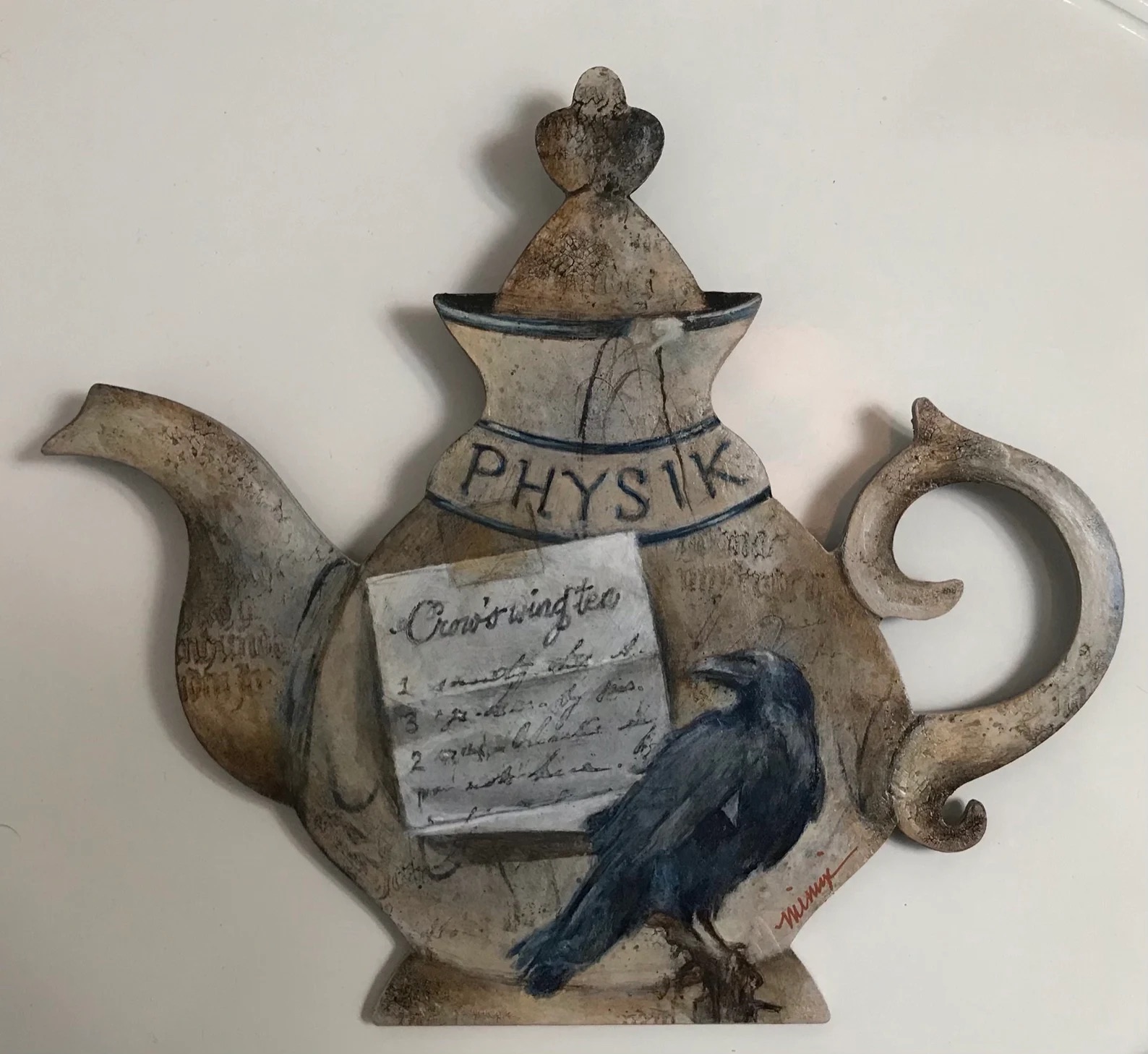
MH: The tea pots are an especially challenging shape to do without looking less than serious. I like to consider having tea as a ritual, so I treat these with that approach. Less Lipton and more magical brew.
Over the years, my work has become smaller and more intimate, more honest and comes from a deeper place where I hope viewers will connect with my energy and stay awhile.
GL: Do you tend to work on a piece until it is finished or do some sit partially done while you wait for inspiration (or “offline process the concept” as I like to say my muse is doing while I’m waiting for the next part of a story/poem)? I know when I write, I sometimes have a very good idea what I will be creating and other times it’s more “let’s sit at the keyboard and see what comes out.” Do you find the same is true for you or does one method dominate?
MH: Usually I continue working on a painting until it’s done. I create surfaces ahead and select them as I realize a clear vision of a completed piece. There may be elements I change or add but my vision is pretty clear from the start.
For a period of time I made large abstract installation pieces, which was the more “sit at the keyboard” approach. My work these days is much more intentional and direct.
GL: What is your best advice for young artists starting out? Would you do anything differently in your artistic journey?
MH: As a student at a prestigious art museum, it was such a joy and privilege to be in the presence of master works. That is where I learned to see with my heart, and not just my eyes. I wouldn’t have changed a thing.
My best advice for a young artist is to learn to see the world in that way, to learn good technique, to buy the best materials you can, and to be confident and authentic.
GL: I imagine that after seeing your gorgeous work, some will be wondering if you ever do book covers. Is that a possibility?
MH: I would certainly consider doing a book cover. Contact me at the links below.
Links
Instagram: @mimzihaut
Facebook: https://www.facebook.com/mimzi.haut
Etsy Store: https://www.etsy.com/shop/MimziArt

