[Today we sit down with witch and author, Sam Wise. Here, Wise discusses their new book on queer witchcraft, the research that went into it, and their upcoming projects.]
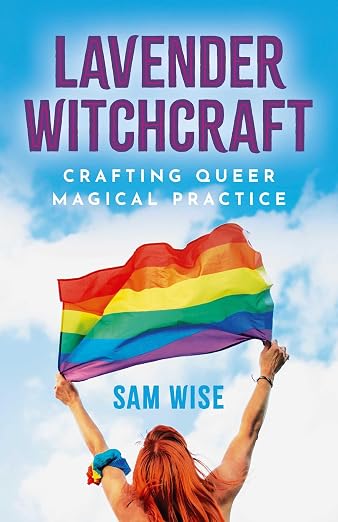
Forests Haunted by Holiness: Your new book Lavender Witchcraft is due out later in August. First, congratulations! Second, why a book about “crafting queer magical practice?” Why do you feel that such a book is necessary?
Sam Wise: As a queer witch, I really wanted to write the book I needed when I was first starting out in my practice. A lot of the resources I encountered as a new witch had a huge focus on the masculine/feminine binary and on heterosexual dynamics. Even in newer books, there was a lot of “sacred womb” and “pussy power” language. That all felt very alienating for me as someone who has a very complicated relationship with gender, is attracted to multiple genders, and has never wanted to be part of a stereotypical hetero dynamic. It left me questioning if there was really a place for me in these spaces. Thankfully, I was lucky enough to find some great queer, witchy community and was eventually able to develop a practice that worked with my identity instead of against it, but it took a long time and a lot of emotional and intellectual labor. In writing Lavender Witchcraft, I hope I’ve made the way a little easier for the queer witches coming after me.
My other big motivation was that there is a real lack of trans-affirming resources for witches and pagans. While I am not transgender myself, I have several trans loved ones I am very close to, and I’ve seen firsthand how often they are excluded from magical spaces. We’re living in a time when transphobia is becoming more widespread and more vocal, and unfortunately I have seen that cross over into witchy spaces. Too many witches who are otherwise very open-minded and inclusive think it’s okay to exclude someone from a ritual based on their gender history. I wanted to push back against that and to show transgender folks that they are sacred and magical and that they have a place in magical community.
FHBH: What sort of research went into Lavender Witchcraft? Tall stacks of books? Lengthy discussions with queer witches?
SW: Oh, goodness. So much research! I did a lot of reading for several years, even before I was officially working on a book on queer witchcraft. I read everything I could get my hands on, from books to academic papers to out-of-print zines. I tried to prioritize sources written by queer authors whenever possible, although I also read plenty of stuff written by straight folks. I did a lot of research into witchcraft and occultism, but also into queer history and culture. A lot of it was actually borrowed from libraries, either physically or digitally, which is great because if I owned a physical copy of everything I read during research for this project, I’d have to buy more bookshelves!
A lot of the research for this book was experiential, by which I mean I was learning by being in community with other queer witches. I was talking to people about their practices, their experiences, what worked for them and what didn’t. It was especially important to me to talk to people whose identities are different from mine, because I wanted to make sure I was doing justice to those identities in my work. I was also learning and growing as a community organizer, doing experiments and figuring out what did and didn’t work for my specific community. That type of research isn’t always reflected in the final book because you can’t exactly add it to a bibliography, but I think it’s at least as important as the reading.
FHBH: What piece of information — history, folklore, magic — did you absolutely have to include in the book? And why?
SW: The information about the history of queer spirituality and magic is really important to me, and that history is kind of the backbone of the book. It was very important to me that I show that queer people have been around for a very, very long time and that we’ve always been an important part of spiritual and magical communities. I wanted to disprove the idea that being queer or transgender is a new thing by showing that similar identities can be traced back to the very beginnings of human civilization.
When you look at history, there’s this very old idea that people who exist outside their culture’s gender and sexuality norms are keepers of magical power. They become bridges to the spiritual, and they often acted as spiritual guides for their communities. I think that connection between queerness and magic has gotten lost, and I really wanted to help bring it back. I want to remind other queer people that we’ve always been here and have always had a sacred role to play.
FHBH: The book includes a number of practical exercises. Can you give us an example of such an exercise? And who are they intended for?
SW: One of the exercises is creating a planetary essence, which is something I use in my own practice almost every day. I love working with the energies and powers of the planets, and the essences are an easy way to do that. Basically, it’s like making a tincture, but instead of using alcohol to preserve a plant for medicine, you’re using it to capture the energy/essence of a planet for use in magic. There’s a chart in the book that shows readers which plants, stones, colors, and metals are associated with each planet, and instructions that show them how to use those associations to make an essence. I also include alternative options for people who can’t have alcohol, and other adjustments for those who need them.
I use the essences the same way I would use a tincture — I take a few drops orally to help me embody the qualities of a specific planet. I might use Essence of Venus before going on a date or Essence of Mercury before a job interview, for example.
I’ve done my best to create exercises that can be used by anybody, regardless of their background or skill level. Everything is intentionally kept secular, so it can be incorporated with whatever existing spiritual or religious practices someone may have. I also include “accessibility adjustments,” which are recommendations of how to modify each exercise for different bodies and abilities. I’ve tried to make everything as inclusive and accessible as I possibly can.
FHBH: What other projects are you working on?
SW: I am physically incapable of working on just one thing at a time, so my plate stays full.
I have a podcast called The Lavender Witch, where I talk about a lot of the topics that are covered in the book and have conversations with other queer witches and pagans. If people want to get a taste of what Lavender Witchcraft is all about while they’re waiting for their preorder to come in, the podcast is a great place for that.
I’ll also be doing an in-person book launch event here in Atlanta on September 19th at 7:30 P.M. EST. It will be at Charis Books & More, which is the South’s oldest independent feminist bookstore and has been a staple of the queer community here for decades, so working with them has been a real dream come true. People can follow me (@samwisethewitch) or Charis Books (@charisbooksandmore) on Instagram for updates as we get closer to the event.
I’m also in the early stages of working on a new project for Moon Books. I don’t want to give too much away, but I can say that it’s a book focused on a single deity and has a lot of shared themes with Lavender Witchcraft and my other work. I’m in the research and drafting stage for that right now, so it will definitely be a while before folks see it on shelves, but I’m beyond excited about it!
Other than that, the main thing I have going on right now is teaching. I’ll be leading a workshop at the Critical Thinking Witch Con during the first weekend of September and I’m co-teaching a path at Worldwide Witch Camp in November.

