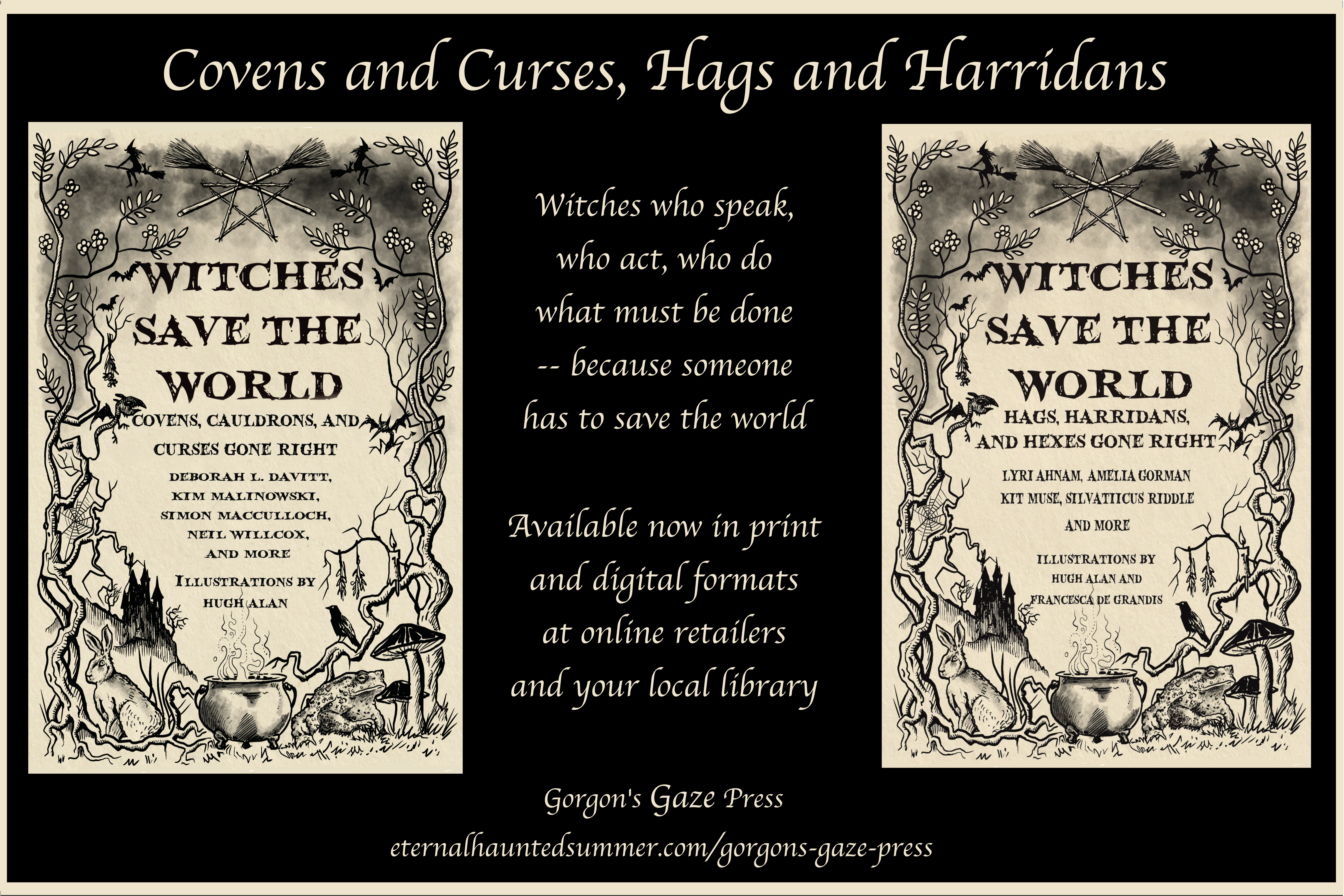
Welcome to the latest installment of the Witches Save the World Micro-Interviews! In honor of the upcoming Halloween/Samhain holiday, and in celebration of the release of Witches Save the World, Forests Haunted By Holiness will be featuring a series of interviews with the contributors throughout October.
Witches Save the World was a labor of love. Across these two volumes you will find poems, short stories, and essays celebrating the witch and their role as wisdom keeper, protector of nature, avenger of the forgotten, and defender of the oppressed. Individual poems and stories range from historical fantasy to contemporary horror to science fiction, with many questioning the nature and cost of honor, integrity, and freedom.
In concert with these interviews, one physical copy of Witches Save the World — either Hags, Harridans, and Hexes Gone Right or Covens, Cauldrons, and Curses Gone Right— will be given away at the end of the month! Two books, two winners! To enter the drawing, just comment below and share the interview on your favorite social media platform.
Ready? Let’s get started!
Forests Haunted By Holiness: What is the title of your poem and can you give us a spoiler-free summary?
Simon MacCulloch: My poem in Witches Save the World is entitled “Mystic”. It is one of a series of poems I have written based on classic horror tales of the nineteenth and twentieth centuries. “Mystic” takes as its jumping-off point Arthur Machen’s The White People (1899), which was accurately described by E.F. Bleiler as “probably the finest single supernatural story of the century, perhaps in the literature”. T.E.D. Klein summed up the story’s uniqueness when he said: “Most other tales in [the “transcendental” or “visionary” supernatural] tradition … merely describe encounters with the dark primeval forces that reign beyond the edge of civilisation; “The White People” seems an actual product of such an encounter, an authentic pagan artefact…” My poem cannot claim as much, but simply imagines how the young woman whose notebook forms the core of Machen’s story might choose to sum up her short but extraordinarily intense life, in a spirit of triumphant defiance.
FHBH: How did you go about writing your story? Lot of research? Or did you just wing it?
SM: Naturally I re-read “The White People” when writing the poem and shamelessly pillaged some of its remarkable imagery.
FHBH: What draws you to the character and theme of “the witch”? What do you find so compelling about it?
SM: The witch represents a tradition of arcane power. As such she is the repository and channel for the human potential for good or evil at its most concentrated. She reflects my best desires and my worst desires. She allows me to choose between love and hate in the certainty that my choice will make a difference. Through her I can save or damn myself, and the world. (And like me, she is fond of cats.)
Witch enthusiasts may also enjoy the recent Hippocampus Press anthology Witches and Witchcraft, which includes my poem “Burnt Ghost” (but be warned — that one’s nasty).
And if you like Arthur Machen, you may also like H.P. Lovecraft, in which case my sonnet sequence The Eyes of Azathoth, due in October from Jackanapes Press, may be of interest.

