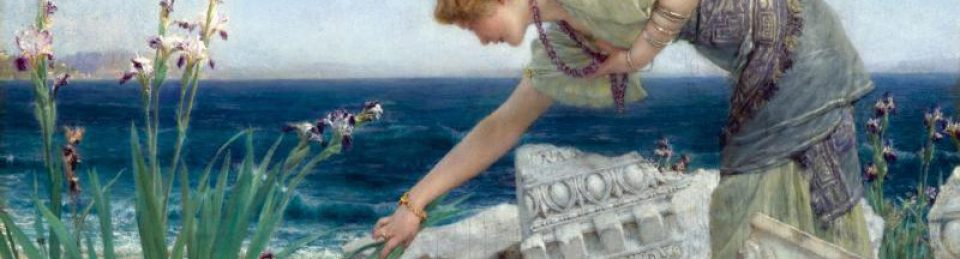
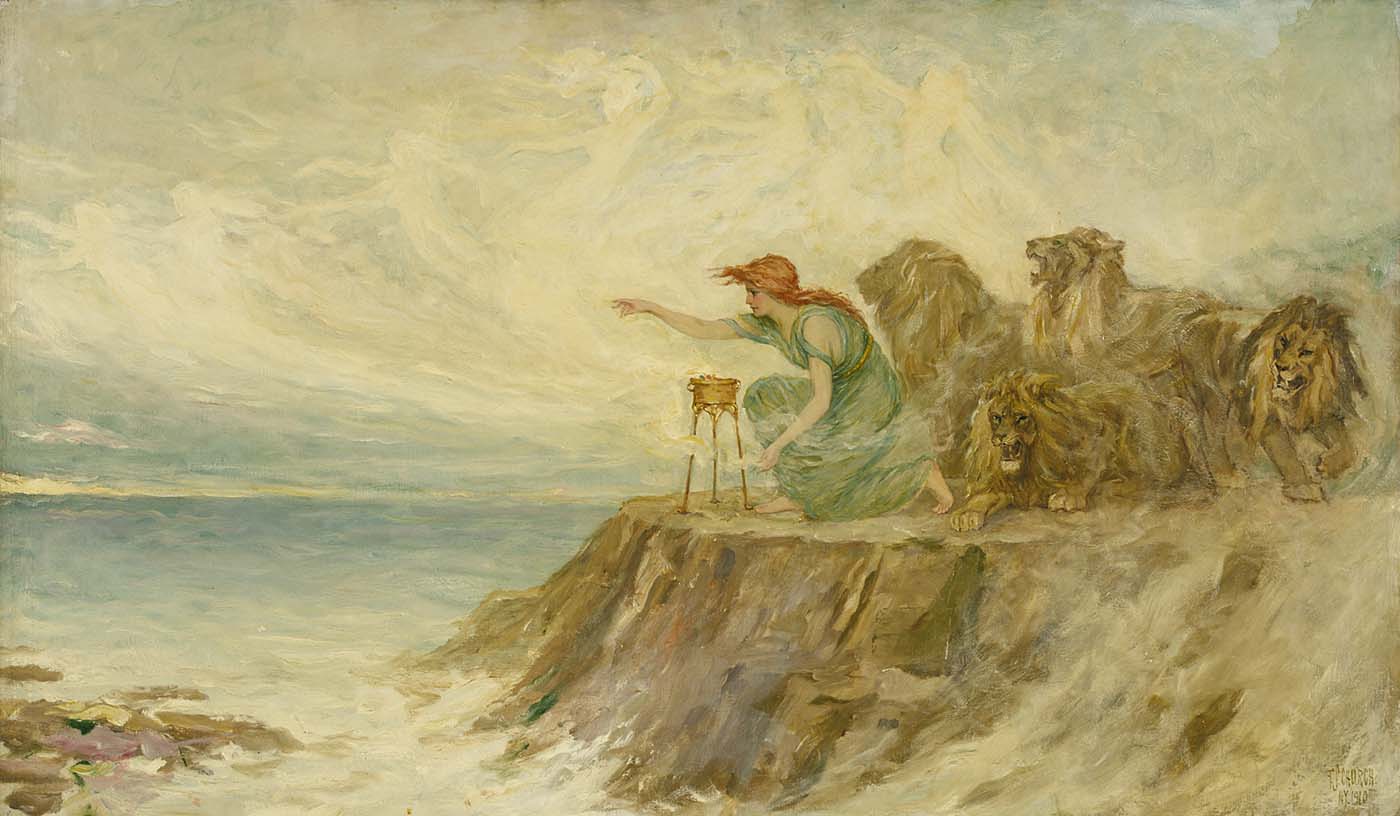
[Our Special Feature today comes courtesy of Dr. Neile Kirk. Here, Dr. Kirk discusses two of the most famous witches (or demigoddesses) from Ancient Greek tradition. This essay is timely for two reasons: a new adaptation of The Odyssey was recently released in theaters; and Gorgon’s Gaze Press, just released the two volume anthology Witches Save the World. Please share your thoughts about Dr. Kirk’s essay, the film, and the anthologies in the comments below!]
The Greek goddess and witch Κίρκη (Kirke), known in Latin under the name of Circe or Circa, was in some accounts the daughter of the sun god Helios and the sea goddess Perse, and was the sister of King Aietes of Kolchis. This was in the western part of what is now the Republic of Georgia. In other versions, she is the daughter of Aietes and Hekate, the goddess of magic and witchcraft. This would make Kirke the sister, instead of the aunt, of Aietes’ daughter, the witch Medeia. In any event, unlike Aietes and Medeia, Kirke seems to have always been something of an outsider to Kolchis, usually living on an island of her own. This seems to fit in with my impression that while Medeia might be the witch who has had the most written about her, Kirke is the second most written-about witch.
For the Greeks, the impression of Kolchis was bound up with the image of its wealth in gold. The Greeks are often regarded by historians as having invented the mythological figures of the Kolchian King Aietes, his sorceress daughter Medeia, and the Thessalian Jason who, with his comrades on the ship Argo, sailed there in order to take away the Golden Fleece. But regardless of the historical reality or otherwise of such people as Aietes and Medeia, there is no doubt that the image of Kolchis as a source of gold was thoroughly based in reality. Among other things, the later testimonies of the historian Strabo from the Roman imperial age bear witness to the rich gold mines there. It is also of importance that he noted that the mountain streams of Svanetia carried gold bearing sand (Монгайт, Третьяков 1956:228).
Medeia’s witchcraft was critically important for Jason’s attempt to steal the Golden Fleece, which was guarded by a dragon. With the use of her magic to send the dragon to sleep, Jason was easily able to remove the Golden Fleece from the oak tree where it had been hanging (Grimberg 1959:39). The story of the dragon guarding the Golden Fleece has left its impression on many historians through the ages, including Karl Marx who refers to it in the context of gold mining in ancient Kolchis (Marx:1878/1879).
Kirke’s role in some versions of the Argonaut story is to purify Jason and Medeia after they had murdered Medeia’s brother Apsyrtos. A generation later, Kirke turns some of Odysseos’ men into pigs. The god Hermes gives Odysseos a magic herb which gives him immunity against Kirke’s magic. Once she has been overcome by Odysseos, Kirke undoes the effects of her mischief and actually helps Odysseos. This includes giving him advice about how to consult the wise man Teiresias in the land of the dead (Cancik & Schneider 1999:487). Odysseos followed Kirke’s helpful advice and voyaged to the land of the dead. There he successfully sought further advice from the shade of the dead seer Teiresias on how to get home (Lindskog 1908:104).
I am struck by the combination of hostile and helpful roles played by Kirke and by Medeia. Medeia helps Jason in Kolchis and they get married. But later, in Greece where she is an outsider, they break up and she murders their children!
The highly respected lexicographer Elof Hellquist tells us that the Swedish word medicin, and such words as German Medizin (and so English medicine), are derived from Latin (ars) medicina. This refers to the art of the medicus (healer), a word based on the verb medēre (to heal), which is related to Avestan vī-mad-, likewise meaning ‘healer’. It seems to be also related to the name of the ancient mistress of magic, Medeia (Hellquist 1980:640).
Notwithstanding the critical importance of Medeia’s role as a witch in the story of the Golden Fleece, there was a version in which Aphrodite, the goddess of love, gave Jason the power of erotic binding spells. Thus, in this version of the story, it was Jason’s witchcraft which enabled him to bring the Kolchian witch Medeia over to his side in the first place, in this way turning her into an outsider (Graf 2019:120).
As well as featuring in the various stories about the Jason’s quest to seize the Golden Fleece from Medeia’s native Kolchis, the Greek playwright Euripides’ wrote a whole play Μήδεια about her. For that matter, there has even been a number of remakes of Euripides’ Μήδεια. Already in classical times, the Roman politician, writer and Stoic philosopher Seneca set the scene with his Latin play Medea in about 50 CE.
The Swedish historian Axel Persson was impressed by how modern Euripides’ tragedies were. He was particularly struck by the fact that such a modern-seeming piece as his Μήδεια had been first performed as far back as 431 BCE (Persson 1950:328).
The reputation of Mede(i)a did not fare all that well among many of the Romans. The second century CE Latin poet Juvenalis even regarded the deeds “de Colchide torva” (of the fierce Colchian) as a byword for monstrous crimes (Sapota 2002:95).
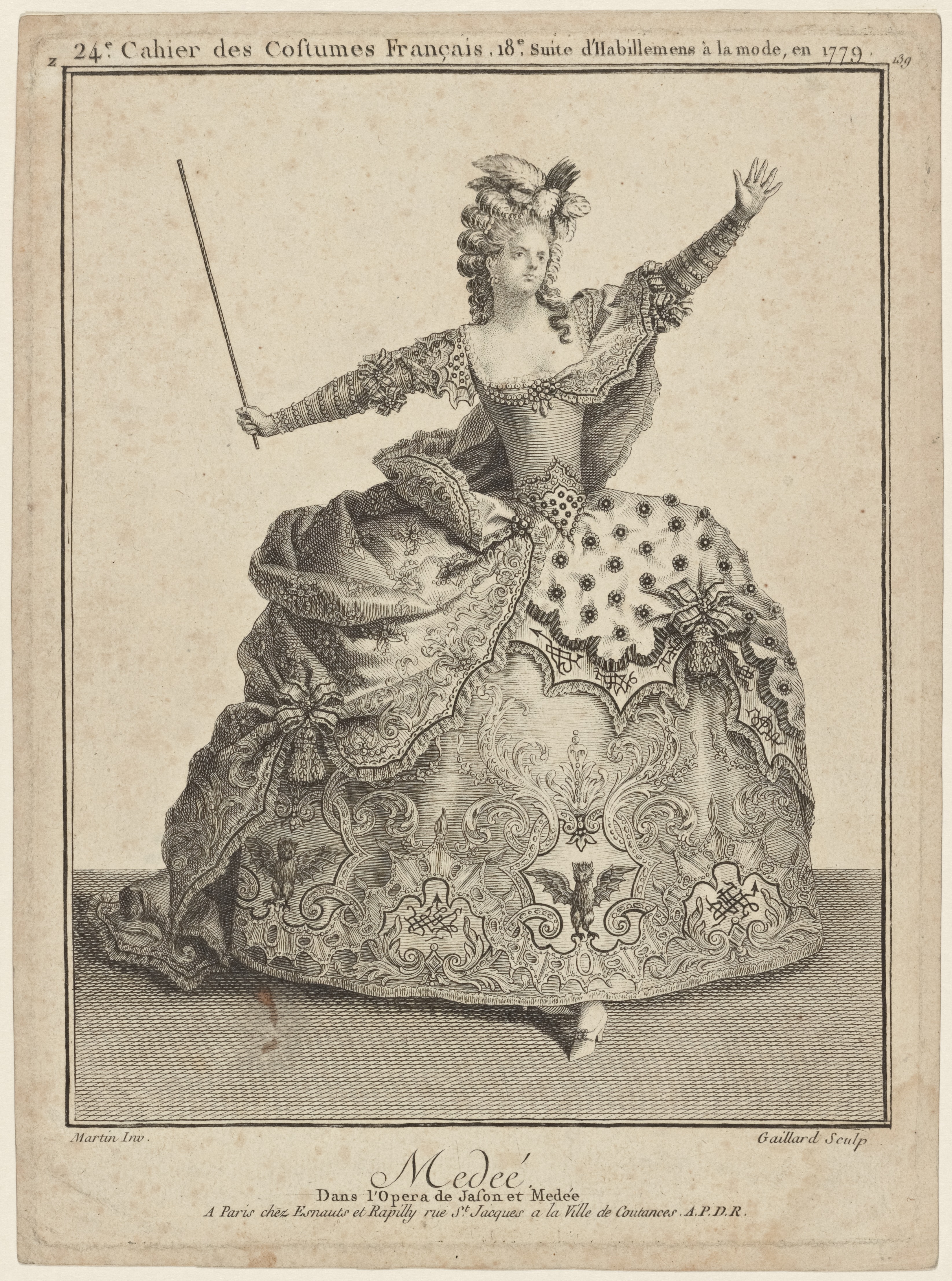
The late first century BCE Latin poet Ovid does not seem to have had a particularly positive view of Medea. For instance, in his Metamorphoses he has her saying “deteriora sequor” (I pursue the worse) (Risberg 1933:39)!
The Romans did not forget about Medeia’s and Kirke’s relative Hekate, who turns up as Hecate in one of Horace’s satires, in her capacity of a frightening goddess summoned by a witch called Canidia (Andrén 1988:45).
Seneca’s contemporary, the multifaceted scholar Plinius, typically referred to in English as Pliny the Elder, refers to a gemstone media which was named after “Media” i.e. Medea (Mayhoff 1967:460). He also makes reference to a gemstone which he refers to as circos i.e. Greek κίρκος (Mayhoff 1967:451). I don’t think that you will be surprised that manifestations of this Greek word crop up in one way or another in scholarly discussions of the etymology of Kirke’s name.
The modern scholar Christa Maria Löffler has regarded Kirke as one of the “bird mother goddesses” on account of her name being the feminine form of the Greek noun kirkos, which designates a kind of falcon (Löffler 1983:346). Perhaps closer to a Kolchian insider view, the Georgian researcher Gordesiani also thought that the name Kirke could be connected with Greek κίρκος (kirkos – circle) and its homonym κίρκος (kirkos – falcon), the latter derived from the idea of the bird of prey’s circling motion. This could also be connected with the Kartvelian root *gor/gr which occurs in Kartvelian words relating to the idea of a circle, such as grgoli (ring, circle) (Гордезиани 1972:185). This linguist also suggests Kartvelian etymologies for the names of other members of Kirke’s family, which could make a lot of sense for the ruling family of Kolchis. After all, the Kartvelian languages, such as Georgian, have a much longer history in Georgia than has Greek. It is hardly controversial that there has been some borrowing of vocabulary in both directions between Kartvelian languages and Greek over millennia. For that matter, there are even now still some Greek-speaking minority groups in Georgia.
No less a linguistic authority than the Swedish Academy explains that, in principle, personal names give no information about the characteristics of the people bearing those names. For example, people called Björn, Sten and Ulf are not especially wild or hard people in spite of the etymologies of their names (Hultman 2003:71). It seems fair to say that the meanings of the Swedish common nouns björn (bear), sten (stone) and ulf (wolf) are not now a factor here.
It is similarly possible that the etymologies of the names of the witches Kirke and Medeia are not of great significance for the stories of their deeds. This contrasts with the name of their divine relative Helios. This is the god who is Medeia’s grandfather, as well as being either the grandfather or father of Kirke. The name of Helios unequivocally means ‘sun’ in Greek, and he was indeed viewed as the personification of the sun. Accordingly, he is referred to in Latin as Sol.
As the knowledge of Greek became largely lost in western Europe after the fall of the Western Roman Empire, Latin accounts were effectively the sole source of continued knowledge about Kolchis, Kirke and Medeia, or rather Colchis, Circe and Medea. On the late thirteenth century Hereford map, Colchis is referred to as “Colchorum provincia” ie. province of the Colchians. And there is the helpful explanation: “Hic est regnum Colchos. Hic fuit aries qui habuit aureum vellus, quem Jason cum aliis argonautis rapuit. Rex istius terre dicebatur Oeta.” So we are told that here is the kingdom of Colchis, where the Golden Fleece was kept until Jason and the other Argonauts took it away. The king of Colchis is named as having been Oeta ie. Aietes (Денисов 2023:494). But his daughter Medea does not seem to have been thought of as worth featuring.
On the other hand, the progressive medieval political writer Christine de Pisan, who wrote in Latin and Old French, did treat of Medea and presented her as a positive figure.
During the Renaissance, the story of the Golden Fleece itself enjoyed something of a renaissance. One of the first century CE versions had been written in Latin by the Roman poet Valerius Flaccus. Whatever its other merits, it suffered from being incomplete. The sixteenth century editor of a printed edition of Valerius Flaccus’ Argonautica, the Italian poet Giovan Battista Pio, was not flustered at all by this problem. He came to the rescue by writing a continuation in Latin verse and published the whole thing as a complete work (Zissos 2014:362).
Literature aside, there may seem to be more continuity between the gods and witches of Classical antiquity and those of later times than was really there. This partly because many Christian writers routinely generalized from their Classical education to refer to pagan deities, other supernatural beings and witches in all sorts of contexts and places with Classical proper names such as Hekate and Diana and common nouns such as lamia (a vampire-like female monster) and striga (witch).
It is quite typical that the medieval Historia Norwegiae, a history of Norway written in Latin, says that the Swedes sacrificed King Dómaldi “deae Cereri” (to the goddess Ceres). In this passage the name of the Roman goddess Ceres is taken to refer to the Norse goddess Freyja (Sundqvist 1997:158).
None of this is surprising. When early Christianity first confronted the culture of antiquity, it had to translate its doctrines into the language of the philosophy of the time and elaborate arguments for the bases of Christian dogmas. In this process, Christianity made its mark on philosophy. Many thinkers of late antiquity and the Middle Ages strived to create a synthesis of the teachings of Christianity and a number of the philosophical doctrines of pagan antiquity (Marc-Wogau 1955:203).
Something similar also occurred even with something as far removed from the official positions of the Christian churches as magical practices. This sometimes led to bizarre situations. For example, in some Icelandic spell books, spirits to be invoked include both Judaic names and those of Norse gods, aggregated as demons. In one spell book, they were even regarded as living together in Valhöll i.e. Valhalla (Pagani 2025:256).
Interest in witchcraft, including its ancient manifestations has continued well into modern times, and sometimes in unexpected places. The greatest novel written in the twentieth century about witches is clearly Мастер и Маргарита (Master i Margarita – The Master and Margarita). The author, Mikhail Bulgakov, completed the novel in 1940. Unfortunately, he died in the same year from the same kidney disease which had killed his father. Novels on supernatural themes were hardly going to be a big publishing priority in the Soviet Union, and it was not until 1966 that his widow managed to see it through to its first publication as a serial in magazine instalments.
The title heroine Margarita is a Russian, married to a high ranking official, who becomes a witch – as does her maid. Her lover, the Master – we are not told his real name, is a historian and novelist. The Master’s novel about Jesus of Nazareth and Pontius Pilate is recounted in segments within the novel Мастер и Маргарита. Naturally, the Master’s/Bulgakov’s novel about Pilate was far from being the first literary treatment of this theme. For instance, in the twelfth century there appeared an anonymously written poem in Latin about the supposed life of Pontius Pilate. Around about this time there also appeared a prose variant in Latin and an incomplete German poem on the same theme (Грабарь-Пассек 1972:410).
In the course of the Master’s novel within a novel, Pontius Pilate speaks to Jesus of his participation in the battle at “Идиставизо, в Долине Дев” (Булгаков 1986:23) (Idistaviso, in the Valley of the Maidens). As we shall see, this authentic place name, often amended to the form Idisiaviso, has played a role in theories about Germanic supernatural beings.
In Old Norse, there are dísir (dís in the singular) and in Old Saxon there are idisi (idis in the singular). There is evidence that dísir were worshipped as divinities in pagan Scandinavia. In Old Norse sources the cult of the dísir was typically referred to as dísablót. Such place names in Norway and Sweden that begin with dís-, and often end with –vin (meadow), have been compared with the continental Germanic place name, which has been amended slightly to Idisiaviso, in Tacitus’ Annales. The ending -viso is compared with modern German Wiese, which means ‘meadow’. On the other hand, I had better point out that some classicists do not accept this amendment, which seems to have been first suggested by Jakob Grimm. Instead, some such as Ivan Svalenius, leave the place name as Idistaviso, (Svalenius 2003:43) as found in the manuscripts which have come down to us. Here idis- remains as part of the place name, although it is unclear what -taviso would mean. Either way, it looks like the reference in Bulgakov has some real historical backing. Let’s look more closely at the evidence for these magic divinities.
The place name Dise offerkälla in the Swedish region of Skåne is regarded as a recollection of the former cult of the dísir in that area (Lindroth 1931:42).
The Norse goddess usually known as Freyja is also known as Vanadís, which makes sense, given that she belonged to the tribe of gods called Vanir. We have already seen that the Historia Norwegiae refers to her as Ceres receiving the king Dómaldi as a sacrifice. There was also a tradition according to which another king, Adils, died in “Diana’s” temple. According to an account by the medieval Icelandic historian Snorri Sturluson, the king died a violent death in the dís-hall (dísarsalr).
The dísir often seem to be helpful, particularly with childbirth and on the battlefield. The fertility aspect may point to a connection with the Indian dhīṣanās. In the battlefield context, the appearance of idisi in the continental Germanic First Merseburg Charm as victory-granting magical powers seems particularly connected. It is far from accidental that Old Norse ímundísir (battle-dísir) are associated with Odin (Ström 1958:101-103).
The Merseburg Charms were found in the Merseburg Cathedral in Germany in 1841. On the basis of linguistic analysis, these copies are believed to have been written down by an unknown East Frankish Christian cleric (Пуришев et al.1962:25).
The address to the gods and the archaic style tend to support the suggestion that the Merseburg Charms, whose manuscripts date from the late ninth or early tenth centuries, represent authentic instances of magic formulae of the ancient Germanic people (Гухман, Семенюк 1983:43). The First Merseburg Charm features the idisi as powerful supernatural beings who should help the spellcaster escape from bondage. The Second Merseburg Charm has no less than four goddesses and two gods, to whom the spellcaster is appealing to heal a lame horse. And get a load of this: a Christian adaptation of this spell turned up in a witch trial in 1685 in Stavanger! In this Swedish spell for healing a lame horse, “Vaar Herre Jesus” (Our Lord Jesus) replaces the Germanic gods and goddesses Phol, Uodan, Sinthgunt, Sunna, Friia and Volla as the divinity being appealed to in order to get the job done (Jackson 2009:35).
In any event, the Idisi clearly have something in common with Valkyries. And for their part, Valkyries have their own connections with magic. One Valkyrie is actually called Göndul cf. Old Norse göndull (magic wand) (Mitchell 2003:118). There is furthermore a Norse poetic reference to Freyja as Göndul (Tolley 1995:69).
So we see that the situation with witches, as with so much of our pagan heritage, is quite complex. I think that it is fair to say that we have inherited a huge amount from the very early classical times of Kirke and Medeia, who retain their popularity as characters in literature. In addition, a great deal has come from the non-classical paganism of the Germanic peoples, though some of this is already attested in such classical sources as the writings of the Roman historian Tacitus. Moreover, the Germanic and classical figures often get mixed together in the Middle Ages.
I can say with certainty that the theme of witches and their deeds continues to fascinate and inspire us right into the twenty-first century – the volume you are reading is an example of this.
REFERENCES:
Andrén, A. 1988 Horatius, satire och epistler i urval. Originaltexter och översättningar (Paul Åströms förlag, Göteborg)
Cancik, H. & Schneider, H. 1999 Der neue Pauly: Enzyklopädie der Antike (Band 6) (Verlag J. B. Metzler, Stuttgart)
Graf, F. 2019 Greece pp. 115-138 in: Frankfurter, D. (Editor) Guide to the Study of Ancient Magic (Koninklijke Brill NV, Leiden)
Grimberg, C. 1959 Menneskenes Liv og Historie (Bind 3 Hellas) (J. W. Cappelens Forlag, Oslo)
Hellquist, E. 1980 Svensk etymologisk ordbok (Första bandet) (LiberLäromedel, Lund)
Hultman, T. G. 2003 Svenska Akademiens språklära (Svenska Akademien, Stockholm)
Jackson, P. 2009 Guden i trädet: Till tolkningen av Hávamál 138-145 pp. 138-145 Arkiv för nordisk filologi Vol. 124
Lindroth, H. 1931 Våra ortnamn och vad de lära oss (Bokförlaget Natur och Kultur, Stockholm)
Lindskog, C. 1908 Grækenland pp. 77-200 in: Rolfsen, N. (Hovedredaktør) Verdenshistorien i Skildringer og Livsbilleder (Første Bind) (Gyldendalske Boghandel – Nordisk Forlag, København)
Löffler, C. M. 1983 The Voyage to the Otherworld Island in Early Irish Literature (Volume 1) (Institut für Anglistik und Amerikanistik Universität Salzburg, Salzburg)
Marc-Wogau, K. 1955 Filosofiska diskussioner (Rabén & Sjögren, Stockholm)
Marx, K. 1878/1879 https://megadigital.bbaw.de/M0012515. Abgerufen am 26.02.2026
Mayhoff, C. (edidit) 1967 C. Plini Secundi Naturalis Historiae Libri XXXVII (Vol. V) (Stutgardiae in aedibus B. G. Teubneri)
Mitchell, S. A. 2003 Gandr-Göndul än en gång pp. 117-123 in: Delsing, L.-O. et al. (Redaktörer) Grammatik i fokus. Festskrift till Christer Platzack den 18 november 2003 (Volym 1) (Institutionen för nordiska språk, Lunds universitet, Lund)
Pagani, R. L. 2025 The Mediterranean Origin of the Galdrastafir: Tracing the Transmission of the Learned European Magical Tradition into Icelandic Popular Lore pp. 241-269 in: Gísli Sigurðsson og Margret Eggertsdóttir (Ritstjórar) Gripla XXXVI (Stofnun Árna Magnússonar í íslenskum fræðum, Reykjavík)
Persson, A. W. 1950 Grekerna pp. 235-411 in: Maiander, H. (Redaktör) Folkens historia genom tiderna. Illustrerad världshistoria (Första delen) (Saxon & Lindströms Förlag, Stockholm)
Risberg, B. 1933 Ovidius Metamorfoser. Urval för latingymnasiet med förklaringar och ordlista (P. A. Norstedt & Söners Förlag, Stockholm)
Sapota, T. 2002 Mythological Imagery in Juvenal’s ‘Satires’ pp. 87-95 in: Styka, J. (Editor) The Myth in the Ancient Literature (Księgarnia Akademicka Wydawnictwo Naukowe, Kraków)
Ström, F. 1958 Diser col. 101-103 in: Karker, A. (Dansk redaktør) Kulturhistorisk leksikon for nordisk middelalder fra vikingetid til reformationstid (Bind III) (Rosenkilde og Bagger, København)
Sundqvist, O. 1997 Runology and history of religions. Some critical implications of the debate on the Stentoften inscription pp. 135-174 in: Elmevik, L. & Peterson, L. (Redaktion) Blandade runstudier 2 (Institutionen för nordiska språk, Uppsala universitet, Uppsala)
Svalenius, I. 2003 Tacitus Annaler I-V. Annales. Ab excessu divi Augusti. Från latin till svenska. Med ett kapitel om Tacitus och Vilhelm Ekelund av Paul Åström (Paul Åströms förlag, Sävedalen)
Tolley, C. 1995 Vǫrðr and Gandr: Helping Spirits in Norse Magic pp. 57-75 Arkiv för nordisk filologi Vol. 110
Zissos, A. 2014 Interpres operis alieni? Giovan Battista Pio’s Continuation of Valerius Flaccus’ Argonautica pp. 361-380 in: Heerink, M. & Manuwald, G. (Editors) Brill’s Companion to Valerius Flaccus (Koninklijke Brill NV, Leiden)
Булгаков, М. А. 1986 Мастер и Маргарита: Роман (Издательство “Художественная литература”, Москва)
Гордезиани, Р. В. 1972 Αἶα в древнейших греческих источниках pp. 178-186 in: Грабарь-Пассек, М. Е. et al. (Редакционная коллегия) Античность и современность: К 80-летию Федора Александровича Петровского (Издательство “Наука”, Москва)
Грабарь-Пассек, М. Е. 1972 Средневековая поэма о Понтии Пилате pp. 410-417 in: Грабарь-Пассек, М. Е. et al. (Редакционная коллегия) Античность и современность: К 80-летию Федора Александровича Петровского (Издательство “Наука”, Москва)
Гухман, М. М., Семенюк, Н. Н. 1983 История немецкого литературного языка IX-XV вв. (Издательство “Наука”, Москва)
Денисов, А. О. 2023 Отображение античных реалий в регионе Чёрного моря на средневековых картах pp. 471-501 in: Подосинов, А. В. (Ответственный редактор тома) Древнейшие государства Восточной Европы. 2023 год: Черноморский регион в античности и раннем средневековье: проблемы исторической географии (ГАУГН ПРЕСС, Москва)
Монгайт, А. Л., Третьяков, П. Н. (Редакция) 1956 Очерки истории СССР. Первобытно-общинный строй и древнейшие государства на территории СССР (Издательство Академии Наук СССР, Москва)
Пуришев, Б. И. et al. (Редколлегия первого тома) 1962 История немецкой литературы в пяти томах (Том первый) (Издательство Академии Наук СССР, Москва)
[Dr Neile Kirk’s most recent publications have appeared in Aothen, Eternal Haunted Summer, Newmyths.comand Utopia Science Fiction Magazine.]

