“I owe the discovery of Uqbar to the conjunction of a mirror and an encyclopedia.” –Borges
A human life is a cosmology: an integrated, organic totality that either reinforces or hinders healthy living and personality development. Jung and others have said much about the advantages of becoming conscious of one’s life in mythological terms. It is neither helpful nor healthy to over-identify with any particular myth or mythological construct. A person who truly believes himself to be Zeus may find greater problems than keeping Hera happy and maintaining order on Mount Olympus. However, the person who can achieve a sound and reasonable balance between ordinary practical actions and a more expansive and integrated symbolic consciousness, informed and infused by patterns and pictures and the variegated personae of the mythological universe — such a person will reach hitherto unheard of, perhaps undreamed of, heights in the realization of human potential. This is the self-discovery of the inner cosmos in sync with the life of the world.
The mythologically conscious and poetically fashioned human is in effect a kind of myth, a mythological creature, hero figure in a theatrical, and cosmological, narrative. Such a human embraces a sense of destiny without succumbing passively and idly to the forces of fate. Such a human takes control in the face of the mysterious and inscrutable, exhibiting courage and fortitude before the unknown: Theseus in the Labyrinth, Orpheus in Hades, Psyche on her self-collecting, love-awakening quest. This is almost nothing short of a miraculous achievement, the realized self, the individuated personality, the awakened and self-conscious human being. Yet the miracle happens. It is absolutely possible to make the myth manifest, and to live mythologically — to live, as it were, the waking dream — provided a person can maintain perspective on the limits imposed from outside the mythological universe (i.e., the everyday world of ordinary mortals), which is a way, in fact is the only way, of achieving self-control and psychic health, which are two ways to describe the same experience of wholeness and integration, of being centered. This if anything is what philosophers have meant in various ways about being present and mindful and in the moment as it presents itself to our waking awareness. Mythology in this sense is mindfulness of the poetic potentialities of the cosmologically integrated psyche. This is what psychology once most fundamentally concerned its practice with. It is another word for care of the soul.
Years ago, I came across a book by the Russian philosopher Nicolas Berdyaev (1874-1948) titled The Destiny of Man (1931). In chapter three of that book, Berdyaev discusses problems of ethics and philosophical anthropology. One remark in that chapter has particularly stayed with me: “Man is not a fragmentary part of the world but contains the whole riddle of the universe and the solution of it.” I read that statement to mean that human consciousness uniquely allows not only for thought and reflection on philosophical mysteries such as the nature of existence. It does that, of course, but it also enables the thinker to accommodate a very wide range of ideas and symbols concerning the nature of existence and the human being’s situated role within the vast infinitude of the cosmos. What is perhaps most striking is that Berdyaev suggests that the riddle of human existence — and by extension that of the cosmos as such — can be solved. I don’t think he means it can be solved in any kind of propositional or philosophical sense. I think rather that the solution is more a kind of alchemical act of uniting opposites and contradictions and expressing that unity in a creative act. This each person will have to make sense of in a way that uniquely befits what is most uniquely and creatively human about that person. No task is more vital, or more difficult.
Rilke rightly noted that the writing of poetry is a deeply difficult act. In his famous letters to Franz Kappus, Rilke urged the young poet to look inward and not to shun aspects of the inner life and that ultimately that is what the poet must reconcile, make peace with, and use to any meaningful and productive purpose. Rilke also famously mentioned that it takes a lifetime to write truly meaningful and original verse — that at the end of a life lived with passion and attention one might be able to write something like “ten good lines.” Whether one is to take that number literally or not, the point stands that poetry is something very serious and that any would-be poet should indeed treat the matter with great respect and realize that good poetry is not simply emotion or memory or passion or even a philosophical force that propels a poet to solve the riddle of the self and the mystery of existence, be they ultimately the same linked puzzle or not. “Almost everything serious is difficult,” Rilke wrote, “and everything is serious.” Nothing in the great poet’s view was more serious than the writing of poetry. By such grand standards, the writing of poetry is a moral act that not only expresses but depends on psychic and existential integrity. Poets may indeed be at least as much as others riddles to themselves but as poets, they have a particular charge to render some solution to the enigma that is the human soul forced to contemplate the mysteries of existence and what it means to be a conscious being in the midst of an incomprehensibly vast and complex cosmos.
The human world has certainly shown itself no less strange or incomprehensible now than it did in the days of Berdyaev or Rilke. But to invoke another great soul in the quest for solving the riddle of human existence, Jorge Luis Borges, librarian mystic and master of the labyrinth, described all of poetry and literature as a “guided dreaming” in which the traveler and the guide must at some point merge and find that they begin from and ultimately arrive at the same destination. That destination may in the end be utter bewilderment at the vast complexity of the universe and the fact of its ultimate insolubility (except insofar as the contemplation of that insolubility may be the only true “solution” that the human mind may be afforded), but the great point here is that literature and poetry do allow for many productive avenues in navigating the dream. All is, at the end of the day, an exercise in controlled fantasy. Every poet is therefore and not incidentally a mythologist, a shaman, a druid, an alchemist, a time traveler and cosmologist — a god, a king, and in all ways that matter most vitally, a fool. To assume the mantle properly takes patience, practice, conversion, a resigned weariness at the absurdity and tragedy of the world — and the desire to create, and affirm, another.
The novel, contra Kundera, is in fact “the author’s confession.” It is also, certainly, “an exploration of human life in the trap in which the world has become.” Such work at the same time confesses (announces, pronounces) the author’s essential inability to make sense of that trap, however much he may have made a study of the conditions that led to its construction. The author doesn’t escape the trap, either, not actually and not even in the author’s mind. Every author, indeed, must serve a life sentence. What he does is to set forth novel conditions (in both senses of the word “novel”) for the only real escape that humankind has ever been allowed, which is to say the escape of the imagination, short-lived, circumscribed, and fantastical as it is.
Walt Whitman, that quintessential American poet, proclaimed himself to be “large” and to “contain multitudes.” The Kunderan poet knows himself to be a “riddle” and knows that riddle as an unbearable lightness. That riddle, at the end of the day, may or may not contain any solution to anything other than what to have for dinner. But that solution is a vital matter and no less serious than that of finding the best word and the right word to make any other word in any poem make any sense at all.
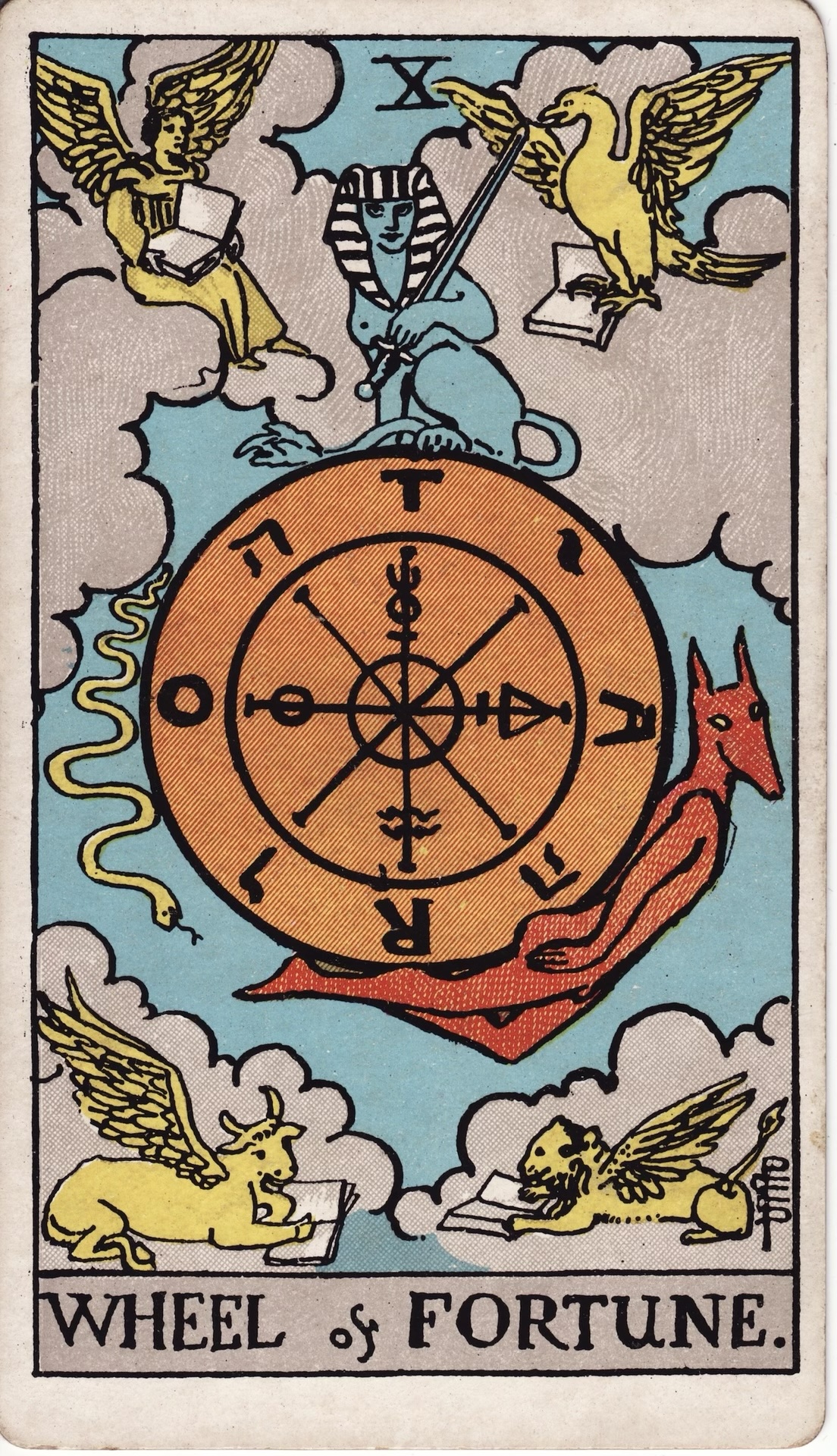
There are some riddles that poetry can’t solve. For everything else, there’s a Tarot card.
[Christopher Greiner is a writer and a poet. His work has appeared previously in Eternal Haunted Summer, The Fairy Tale Magazine, and Indie Shaman, among other places. He is a contributing reviewer at Facing North. He continues to ponder the riddle of words.]

