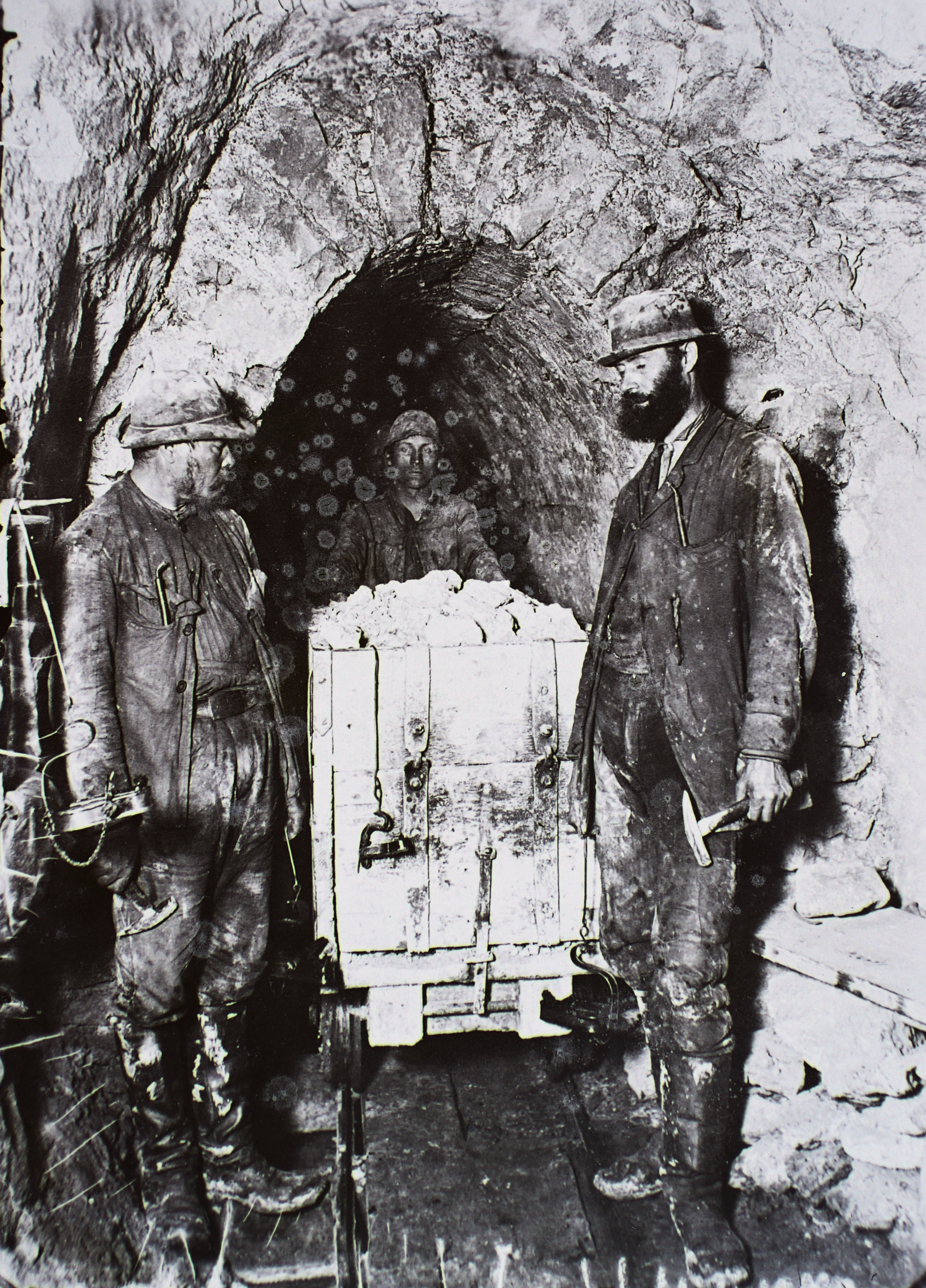
Ploutos was the Greek god of wealth and the ruler of the realm of the dead. The main connection between the two domains was clearly the mining of riches from beneath the ground. Why such mining would have associations with suffering is clear from the famous description, by the first century BCE. Greek historian usually known by the Latin name Diodorus Siculus, of slavery in real underground gold mines: “One cannot see these unfortunates (in the gold mines between Egypt, Ethiopia, and Arabia) who cannot even have their bodies clean, or their nakedness clothed, without pitying their miserable lot. There is no indulgence, no forbearance for the sick, the feeble, the aged, for woman’s weakness. All must, forced by blows, work on until death puts an end to their sufferings and their distress.” (Marx 1990:204). This is the quote from Diodorus which was used in the first English translation of Karl Marx’ Das Kapital published posthumously in 1887.
On the other hand, gold mining was not seen everywhere as hellish and in the early first century CE. Diodorus’ fellow-Greek Strabo went so far as to specify that with the Iberians it was not Hades but Ploutos who governed the subterranean spaces (Brunaux 2013:20)! Strabo had in mind the large-scale alluvial gold mining which went on among the Celts of Iberia as well as Gaul. There was recognition that different areas of the Earth’s surface have different features, and so do different subterranean regions.
Some of the earliest on the road research about Gaulish gold mining was done by Poseidonios of Apameia (in Syria) around 100 BCE. A lot of our information about Poseidonios’ work has come down to us through quotation by the Egyptian Greek Athenaios, to whom we’ll return later. Poseidonios was highly regarded as a Stoic philosopher (Kahlos 2006:29) and the famous Roman political figures Marcus Tullius Cicero and Gnaeus Pompeius were among the many who studied at his school on the island of Rhodes (Корлэтяну 1974:29).
Since Poseidonios was a Stoic philosopher, it is no surprise that much of his presentation was ideologically motivated. And not just in the context of mining and economics. For instance, the theory of συμπάθεια [sumpatheia] in language, which claimed a connection between the sounds of a word and its meaning, originated in the first century BCE. This theory was connected with the Stoic philosophical principle of universal sympathy formulated by Poseidonios (Тронский 1973:45, 175). He even applied this doctrine of connection of everything with everything else to explaining the role of the Moon in the tides of the sea (Protopapadakis 2012:293).
On a pleasingly less esoteric level, based on his travels Poseidonios has the distinction of having been the first to inform us about κόρμα [korma], the Gaulish beer which has honey added to it (Lambert 1995:191). As well as being related to words for ‘beer’ in other Celtic languages, this Gaulish word has a more distant relative in Russian korm (fodder) (Matasović 2009:217).
I am struck by the fact that quite a few Gaulish words to do with alluvial gold mining have survived through Vulgar Latin into modern French and, in some instances, have been borrowed further into other languages. Among them, Gaulish grava (sand) survived into Old French as gravele, which was borrowed into English to give us our modern word gravel (Holthausen 1917:74). Gaulish grava occurs in modern French as gravier (gravel, sand), which has travelled into Russian where it occurs as гравий (gravij – gravel). This word has in its turn been borrowed further into Ukrainian as гравій (Мельничук 1982:580). The original Gaulish word has modern Celtic relatives such as Welsh gro (gravel) (Горяев 1896:78). Another Celtic language, Breton, which has the word graé, gave Old French the word groë (pebble, gravel) (Grandsaignes d’Hauterive 1947:338). More distant modern relatives include such Germanic words as English grit and Norwegian grjot (Bjorvand & Lindeman 2000:321).
The word caillou (pebble), which comes up a lot in French discussions of alluvial gold mining, is from Gaulish caliavo (Greimas 1992:93). A thoroughly unglamorous but necessary French word which crops up in the context of alluvial gold mining is boue (mud) which came from Gaulish bawa (Greimas & Keane 1992:70). In a similar vein, French glaise (clay) continues Gaulish glisa, which is attested in the compound word glisomarga (clay marl) recorded by the first century CE Roman writer Gaius Plinius Secundus, typically referred to in English as Pliny (Dauzat et al. 1979:343). Pliny also records the Gaulish word marga (marl) by itself, which survives in French as marne, and in another compound word acaunomarga (“intermixto lapidae terrae” i.e. stony marl) (Delamarre 2008:180).
Pliny also tells us of a Celtic word talutium, which referred to a slope indicating the presence of a gold deposit (Lambert 1995:199). This word survives as French talus, which still means a slope, though without any necessary association with gold.
By the way, Pliny was influenced by Poseidonios, upon whose work he draws in the Naturalis Historia (Paparazzo 2011:109).
The Gauls have even been the source of some of the most general mining terminology in use today: Gallo-Latin mina, related to Celtic words such as modern Welsh mwyn, yielded French mine, which has come into many European languages. The derived Medieval Latin noun minerale and adjective mineralis have given rise to further terminology and been taken into many modern languages (Мельничук 1989:477).
One Gaulish word we can’t go past in the context of treasures of the underworld is bedo (grave, ditch), which survives as French bief, and seems to be attested in the Celtiberian word arkatobezom (silver mine) (Matasović 2009:59-60).
Long after the death of Gaulish, French has continued to borrow some words from the Celtic language still spoken in France, namely Breton. For instance, Middle French bijou (jewel) was borrowed from Breton bizou (ring for the finger) (Zink 1990:117). As Latin documents from the time make clear, Celtic speakers from Britain – hence the term Breton – arrived in considerable numbers in the part of Gaul known as Armorica, particularly during the fifth century CE. They were fleeing Irish and Saxon invaders, and the Roman authorities encouraged them to settle in Armorica (Abalain 2000:12).

Apart from Ploutos, Hades – Greek Ἅδης – was the other name for the Greek god of the underworld and also for the realm over which he ruled (Svenska Akademien 1932:26). We don’t have this situation in English, but within the Germanic languages we do have our English word for the place hell related to Old Norse Hel, who was the goddess of death (Torp 1919:208). Another form of Hades’ name was Ἅιδης [Haides] and this gives us the clue to its apparent derivation from ἀ- (a– – un-) and εἴδω (eido – I see) (Горбачевич 1991:88). Even if this supposed derivation was only a folk etymology, it did influence the associations people made with the name. The idea was that the underworld is dark and that Hades was invisible. Θάνατος (Thanatos – Death) was a separate deity, the son of Νύξ (Nuks – Night) (Chantraine 1956:23). Since the name Ploutos is directly associated with wealth, it makes sense for Strabo to make his somewhat lighthearted contrast between the two names of the underworld god in Greek.
Marx writes that “Modern society, which, soon after its birth, pulled Plutus by the hair of his head from the bowels of the earth, greets gold as its Holy Grail, as the glittering incarnation of the very principle of its own life.” (Marx 1990:116) Marx seems to have liked the imagery of the Grail story, since he also referred to it in his co-written earlier book Die groβen Männer des Exils (The great men of the exile). The Grail – a word derived from Latin gradalis – was supposed to have been a kind of cup with magic power cut from a large emerald (Marx & Engels 1960:334, 636). He footnotes the point about Plutus with a Greek quote from Athenaios’ Δειπνοσοφισταί (Deipnosofistai – Banquet of the sophists) to the effect that greed hopes to pull Ploutos himself from the bowels of the earth. The specific context for the greed comment in Δειπνοσοφισταί was the deep and dangerous Athenian silver mines at Laurion, which were contrasted to the easily mined gold in the lands of the Gauls. The background information came from the writings of such scholars as Strabo and Poseidonios.
Athenaios was a Greek writer from Naukratis in Egypt who was active around about 200 CE, when both Gaul and Egypt were integral parts of the Roman Empire. His work gets cited as a source for an amazing variety of features of ancient thinking, including such technical matters as Classical theories about the relationship between features of the sound systems of the Greek and Latin languages (Тронский 1962:144). In any event, the English text of Marx’ work uses the Latinized form Plutus while the footnote, being in Athenaios’ original Greek, obviously uses the Greek spelling of the name. This correctly reproduces what we find in the text of the third German edition of 1883 of the first volume of Das Kapital, which served as the basis of this first English edition (Marx 1989:152).
One modern Hellenist comments on the same Greek phrase from Athenaios that Marx quoted that “Here, as often, Ploutos (“Wealth”) is confounded with Pluto, god of the Underworld.” (Athenaeus 2008:60) But there really does not seem to be any reason to regard them as separate deities in the first place.
As well as simply adapting the Greek name of the god of the underworld as Plutus or Pluto, the Romans sometimes also called him Dis, which is just a shortened form of dives, meaning ‘wealth’ in Latin. So Dis is simply a translation of Greek Ploutos. He was typically referred to as Dis Pater i. e. ‘Wealth Father’. Julius Caesar reported that the Gauls claimed to be descended from Dis Pater. This is a typical instance of Caesar’s usual practice of referring to foreign deities by what he thought of as their Roman equivalents. Caesar’s report is consistent with the theory of linguists who connect the name of the Celts with the Indo-European root meaning ‘to hide’ which also occurs in such words as Latin oc-culo and Old English helan (Matasović 2009:199). This is also the root found in our Germanic word hell, a word which was originally pagan but which was adapted by the Christians for their own purposes.
The underworld under the rule of Hades even had its own rivers, one of which was called Akheron. While that’s a place I’ve never been to, I have visited another gold bearing river called Acheron – the Latin form of the originally Greek name – in Victoria. It received this name from British pastoralists, and gold was discovered there in 1870.
It seems fair to say that the actual work involved in gold mining, as with many other labor processes, did not inspire admiration from everyone in the Classical world – far from it! This was because of the associations between work and slavery in the ancient world. Even grammatical features of the languages can give us an indication of this. One highly regarded (rightly in my view) and widely used – over generations in the nineteenth century – Greek grammar tells us that the Greek noun τὸ ἀνδράποδον (to andrapodon – the slave) was grammatically neuter because the slave was treated as an object and not as a person (Buttmann 1833:54).
REFERENCES
Abalain, H. 2000 Histoire de la Langue bretonne (Editions Jean-Paul Gisserot, Quintin)
Athenaeus (Edited and translated by S. Douglas Olson) 2008 The Learned Banqueters Books VI-VII (Harvard University Press, Cambridge, Massachusetts)
Bjorvand, H. & Lindeman, F. O. 2000 Våre arveord: etymologisk ordbok (Novus forlag, Oslo)
Brunaux, J.-L. 2013 Poseidonios, la Gaule et son économie pp. 15-23 Revue de Nord Vol. 5 (No. 403)
Buttmann, P. 1833 Griechische Grammatik (In der Myliussischen Buchhandlung, Berlin)
Chantraine, P. 1956 Études sur le vocabulaire grec (Librairie C. Klincksieck, Paris)
Dauzat, A., Dubois, J. & Mitterand, H. 1979 Nouveau Dictionnaire étymologique et historique (Librairie Larousse, Paris)
Delamarre, X. 2008 Dictionnaire de la langue gauloise: Une approche linguistique du vieux-celtique continental (Editions Errance, Paris)
Grandsaignes d’Hauterive, R. 1947 Dictionnaire d’ancien français: moyen age et Renaissance (Librairie Larousse, Paris)
Greimas, A. J. 1992 Dictionnaire de l’ancien français: Le Moyen Âge (Larousse, Paris)
Greimas, A. J. & Keane, T. M. 1992 Dictionnaire du moyen français: la Renaissance (Larousse, Paris)
Holthausen F. 1917 Etymologisches Wörterbuch der englischen Sprache (Bernhard Tauchnitz, Leipzig)
Kahlos, M. 2006 “Barbaariset riitit ja oudot menot.” Antiikin roomalaisten näkemyksiä kelttien uskonnosta pp. 26-33 Studia Celtica Fennica III
Lambert, P.-Y. 1995 La langue gauloise: Description linguistique, commentaire d’inscriptions choisies (Editions Errance, Paris)
Marx, K., Engels, F. 1960 Die groβen Männer des Exils pp. 233-335 in: Marx, K. & Engels, F. Werke Band 8. (Dietz Verlag, Berlin)
Marx, K. 1989 Das Kapital, Kritik der politischen Ökonomie. In: Marx, K. & Engels, F. Gesamtausgabe (MEGA). Zweite Abteilung “Das Kapital” und Vorarbeiten. Band 8. (Dietz Verlag, Berlin)
Marx, K. 1990 Capital. A critical analysis of capitalist production. Text. In: Marx, K. & Engels, F. Gesamtausgabe (MEGA). Zweite Abteilung “Das Kapital” und Vorarbeiten. Band 9. (Dietz Verlag, Berlin)
Matasović, R. 2009 Etymological Dictionary of Proto-Celtic (Koninklijke Brill NV, Leiden)
Paparazzo, E. 2011 Philosophy and Science in the Elder Pliny’s Naturalis Historia pp. 89-111 in: Gibson, R. K. & Morello, R. (Editors) Pliny the Elder: Themes and Contexts (Koninklijke Brill NV, Leiden)
Protopapadakis, E. D. 2012 The Stoic Notion of Cosmic Sympathy in Contemporary Environmental Ethics pp. 290-305 in: Гаҕански, К. М. (Главни уредник) Антика, савремени свет и рецепција античке културе Зборник радова (Друштва за античке студије Србије, Београд)
Svenska Akademien 1932 Ordbok över svenska språket (Elfte bandet) (A.-B. Ph. Lindstedts Univ.-Bokhandel, Lund)
Torp, A. 1919 Nynorsk etymologisk ordbok (Forlagt av H. Aschehoug & Co. (W. Nygaard), Kristiania)
Zink, G. 1990 Le moyen français (XIVe et XVe siècles) (Presses Universitaires de France, Paris)
Горбачевич, К. С. (Главный редактор) 1991 Словарь современного русского литературного языка (Том I) (Издательство “Русский язык”, Москва)
Горяев, Н. В. 1896 Сравнительный этимологическій словарь русскаго языка (Типографія канц. Главнонач. гр. ч. на Кавказѣ, Тифлисъ)
Корлэтяну, Н. Г. 1974 Исследование народной латыни и ее отношений с романскими языками (Издательство “Наука”, Москва)
Мельничук, О. С. (Головний редактор) 1982 Етимологічний словник української мови (Том 1) (Видавництво “Наукова думка”, Київ)
Мельничук, О. С. (Головний редактор) 1989 Етимологічний словник української мови (Том 3) (Видавництво “Наукова думка”, Київ)
Тронский, И. М. 1962 Древнегреческое ударение (Издательство Академии Наук СССР, Москва-Ленинград)
Тронский, И. М. 1973 Вопросы языкового развития в античном обществе (Издательство “Наука”, Ленинград)
[Dr Neile Kirk’s most recent publications have appeared in Aothen, Eternal Haunted Summer, Newmyths.comand Utopia Science Fiction Magazine.]

