[Today we sit down for a quick interview with author and sculptor, Dave Stone. Here, he discusses his new book Dragons of the Deep; the research that went into the book; and his upcoming projects.]
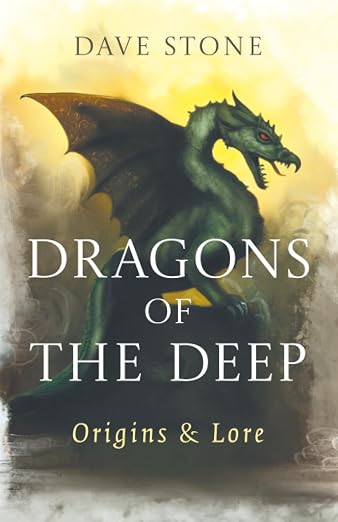
Forests Haunted by Holiness: You just published Dragons of the Deep: Origins and Lore through Moon Books. First, congratulations! Second, how did this book come about? Why a book about dragons?
Dave Stone: Well, firstly I have to give you a bit of a back story here. I carve stone artefacts, and have run a humble craft business for many years now called Stone Mad Crafts. Operating out of Scotland, I carve and collect hundreds of obscure Celtic, Norse and other ancient designs. During the early years of trying to sell my wares, I realised it was good to know a little about the designs. So, for decades now I’ve been researching and trying to find out what many of the motifs mean. Of course, sometimes this search is difficult. Not a lot was recorded in writing about the significance of old designs from the Northern European tradition. However, what I became puzzled with was the amount of serpents and dragon-like motifs that filled ancient art. So, that’s the back drop – this stuff was a long time brewing in my head.
Then, about ten years ago, I was travelling in Greece and Turkey and began looking into some of the mythology of the sites I was visiting. Huge serpents and dragon-like beings reared up from the past. I noticed that many of the tales are similar, and seem to follow a certain pattern. This perked my interest and so, I began to tentatively research. And the more research I gathered, the more astounded I became.
FHBH: What sort of research went into Dragons of the Deep? Tall stacks of books? Long hours at the library? Discussions with folklorists and historians?
DS: At first I was pretty naive in my researches. Most of this was done through libraries (both online and off). Borrowing books through the Internet Archive also helped, and I also delved into articles via Academia.edu. Researching for non-fiction was completely new to me. I just amassed mountains of information, filling file after file on my iMac with information. At some point I began to sift through and sort my research into groups, following definite patterns that I was finding.
For example, one of the earliest dragon myths comes from Sumeria, and tells of Tiamat, Queen of Dragons who is bested by a Storm god named Marduk – but there are many other examples of this battle between a Storm god and Dragon mother – it appears in the myth of Thor fighting Jormungandr, the World Serpent, and it appears in Celtic myth and Grecian legends. Mysteriously it even appears further afield.
This became the theme of one of my chapters and the research fell into line and began to make more sense once I’d made these groupings. But there was so much more. For example, why are dragons so often associated with females? More sections were born, eventually becoming distinct chapters in the book.
I also realised early on that much dragon lore runs parallel to ancient serpent lore. In fact many dragons have wormy style names, würm for example. So I had to bring these things together, and provide a chapter on the relevance of serpent lore as regards dragons, too.
The book took a long time because at first, there was only so much time I could devote to it. But as I sifted through my mountain of research it became a bit of an obsession.
FHBH: Which historical or folkloric tidbit did you absolutely have to include in the book, and why?
DS: Oh, this is such a difficult question because I’m inclined to say everything was relevant to the story that I am telling of the dragon and what it means. But, if I was to choose one section that had to be in the book, it is the section entitled What the Dragon Knows. It is where serpent and dragon lore come together and it is also a call-back to some of the earliest myths. It provides a very esoteric meaning to much of this lore. A lore grounded deep in human history. In that particular section we visit Ningishzida, an ancient Dragon Prince, and how his mythos ties in with the symbol of mediation and balance; the caduceus. It’s deep.
FHBH: There are so many myths and folktales about dragons from all over the globe. How did you decide what to include and what to leave out? Was there anything you only very reluctantly excluded, but might include in a future volume?
DS: There was so much I wanted to include. There are still so many stories that keep turning up, too. But, it was the patterns that underpin the stories that flow through Dragons of the Deep. Many tales that are explored are those of ancient origins. There are some lovely, more modern tales that are beautiful, but wouldn’t have been appropriate for the book. Believe it or not, I have a special place in my heart of the childhood song Puff the Magic Dragon. That might make people giggle a bit, especially if they’re familiar with the song. It’s a child’s nursery rhyme, but there is something very lovely about it. It always struck a chord with me when I was little … perhaps it was this harmless little song that inspired my love of dragons deep down at an early age.
FHBH: What other projects are you working on?
DS: I am currently playing around with a piece investigating Togail Bruidne Dá Derga (The Destruction of Da Derga’s Hostel) – an old Irish tale that is amazing and quite unsullied by Christian censorship in many respects. Alongside that I write a weekly Substack post (Eternal Echoes) and carve a steady stream of stones.

