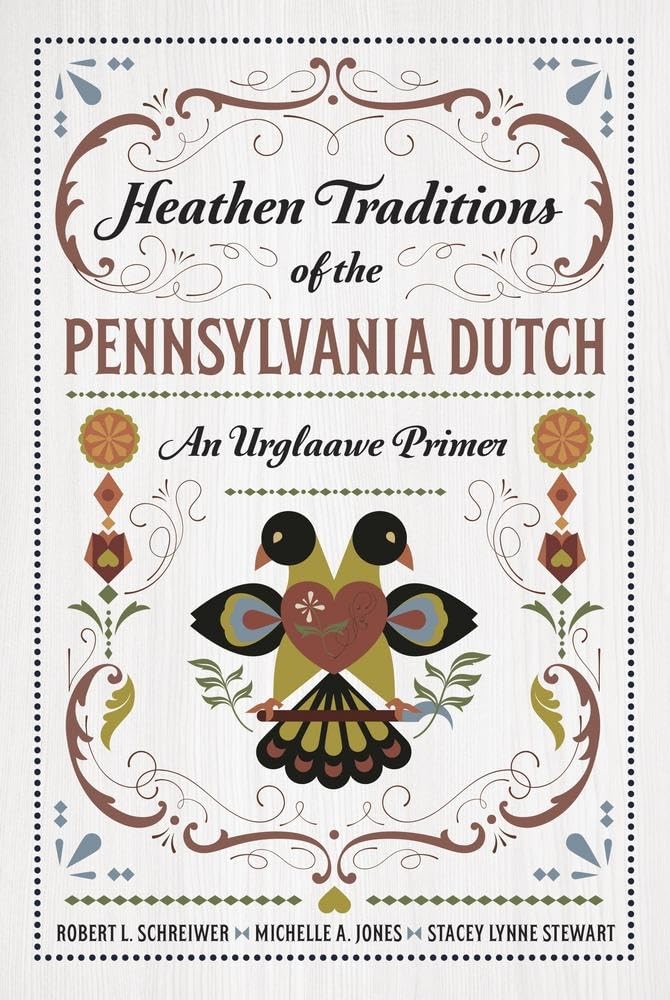
Title: Heathen Traditions of the Pennsylvania Dutch: An Urglaawe Primer
Publisher: Llewellyn
Authors: Robert L. Schreiwer, Michelle A. Jones, and Stacey Lynne Stewart
This book is an introduction to the religion Urglaawe, a sect of heathenry based in Pennsylvania Dutch (Deitsch) culture. Schreiwer is the founder of Urglaawe as a modern organization, although the traditions it encompasses are older. The three coauthors are Braucherei and Hexerei, that is, practitioners of magical systems that are separate from but associated with Urglaawe.
Although Pennsylvania Dutch culture is based within a specific ethnicity, this book makes it clear right away that Urglaawe is open to anyone of any background. The book draws a distinction between the words Dutch, which once had a wider meaning in the English language which encompassed Germans and other northern peoples, and the specific words Deitsch and Deitsche. Deitsch means the culture or language of the Pennsylvania Dutch, and Deitsche is the people.
The publisher, Llewellyn, provided an ARC for me to review. The press release provided indicates that this book is the first to present “the stories, philosophies, and practices of Urglaawe (Or-glaw-veh)”.
The book covers Urglaawe’s worldview, gods, herbalism, tools, runes, calendar, and rituals, including both regular observances and rites of passage and life cycles. There is a guide to pronouncing Deitsch words as an appendix, in addition to the usual supplementary materials in the back.
I have previously worked with Schreiwer on another publishing project, the short fiction anthology No Horns On These Helmets, of which I was contributing editor, published by Sky Warrior Books. Schreiwer’s story “The Legend of Delbel the Butzemann” was a traditional Deitsch tale which Screiwer translated; that was the first time that traditional folk tale was published in English.
This primer is informative, but not didactic. It’s written in a natural style rather than an academic style. It’s suitable for general readers. There is a lot of vocabulary to learn, but it’s presented in context, explained, repeated, and glossed in the glossary in the back, so it’s as easy to learn as possible.
Like other heathen religions, Urglaawe is orthopraxic rather than orthodoxic. Urglaawe is largely based on a living tradition, the folk culture of the Deitsche. Many of the Urglaawe ways are drawn from braucherei and hexerei, two forms of folk magic which the Urglaawe see as having preserved ancient ways and lore. Urglaawe does include some reconstruction, drawing from other heathen religions, but the core is built around Deitsch culture.
The section on the World-Tree illustrates a principle of how mythic materials work across time and cultures: the symbol remains the same while the words, concepts, and stories change. In Norse mythology, the World-Tree has nine worlds. The Urglaawe World-Tree also has nine worlds. The symbol of the World-Tree with nine worlds is the same. Everything else is different. One of the big differences is that our world is called Midgard in Norse mythology, and it is one of the nine worlds hanging like fruit on the branches. All the worlds are outside. In Urglaawe, our world is called Mannheem and is located in the Heartwood, on the inside of the Tree.
The principle is illustrated in other parts of Urglaawe that have both similarities and differences from other heathen traditions. For example, Norse mythology, Urglaawe, and modern European fairy lore all have a Wild Hunt and a Hunter. The Hunter’s name, species, and story are all different.
There are many similarities and differences between Urglaawe and other heathen cultures and religions, both historical and modern. The stories of how the universe came to be, how humans were created, and which gods and goddesses are included in the pantheon all have both similarities and differences.
The chapter on herbs is mostly new to those from outside the Deitsch culture. The traditional medicinal uses are largely the same as other traditional herbalism books which draw from European herbalism. The cultural, spiritual, and magical information is all different, and therefore worth reading.
The sections on magic, such as hex signs, runes, and other practices, all have information unique to this culture. The book includes myths of the gods, recipes, holidays that are similar to other heathen holidays and also holidays specific to this culture such as Moving Day, which is celebrated on April 1st. As a holiday that celebrates the marginalized, it shares some similarities with modern heathen and pagan April 1 traditions of Loki’s Day. I wonder if there has been cross-cultural influence between the Urglaawe and modern heathen traditions such as Asatru, to result in this similarity despite Urglaawe not having Loki in their pantheon. It’s also interesting to see the similarities and differences between Urglaawe and other modern heathen traditions in rites such as marriage, death, renouncing xianity, etc. The extensive appendices cover words for important concepts, names of gods, holidays, words often used in ritual or magic such as runes, colors, etc.
This book is informative, interesting, and easy to read. It’s an excellent introduction to its subject. I recommend it for anyone who wants to learn about Urglaawe specifically or the Deitsch culture generally.
[Reviewed by Erin Lale.]

