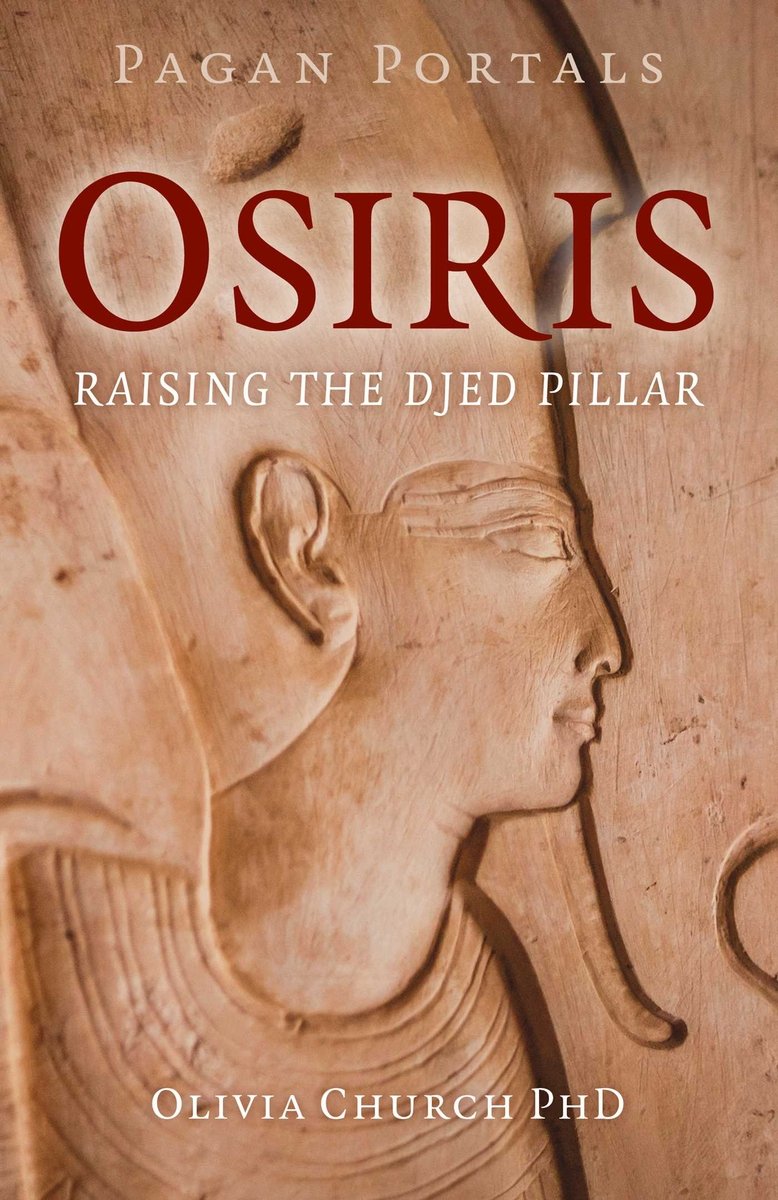
[Today we sit down for five quick questions with Olivia Church. Author of the recently released Pagan Portals: Osiris, Church here discusses what went into writing the book, why she wrote it, and her upcoming projects.]
Forests Haunted by Holiness: Why a book about Osiris? What draws you to that God in particular?
Olivia Church: Of all of the Gods belonging to the ancient Egyptian pantheon, I have always been drawn to Wesir (Greek Osiris) the most. On the surface, he is perhaps one of –- if not the most widely recognisable and well-known, and so as a young girl interested in Egypt, and then an adolescent new Pagan, he was an immediate face to turn toward.
I am fascinated by the dichotomy of his luscious, fecund, ever-rejuvenating life-giving powers, and his chthonic, solemn, and mournful presence as Lord of the Underworld. He provokes in me a feeling of deep unease and reassuring paternal comfort, and feels profoundly manifest in the world around me. Though a God rising from the soil of the Nile Valley, I feel him in the damp earth of my own homeland, thousands of miles away. That is not something I could ignore! He just feels like such a safe, fatherly presence to me.
I wanted to write a book that brings Wesir’s Egyptian and North African origins to the forefront whilst also showing how he transcends time, culture, and geography, inviting readers to learn more about him, the natural cycles he embodies, and their own place in that cycle.
FHBH: If someone is interested in developing a devotional relationship with Osiris, how would you recommend they begin? Are there particular rites that have to be observed, or offerings made, et cetera?
OC: I personally feel strongly about connecting to Wesir through nature and lived experience, so in addition to learning about his historical context and the Egyptian landscape –- ancient and modern –- I would recommend digging into some damp soil! Honestly, contemplating how life can emerge from the darkness of that soil, and how all life returns to it in the end is a great place to start. The ancients recognised and named the miracle of this cycle by watching it unfold in their landscape. We can do the same, thousands of years later and thousands of miles away. Observing and hearing from modern Egyptians on how they engage in this cycle within Egypt is also very informative.
If you want to formalise this into devotional ritual, then giving offerings of wine, beer, non-alcoholic grape juice, bread, grains, incense, and speaking his name –- Wesir (‘Oo-seer’) -– is a great way to show respect to his past and present. Speaking the name and feeding the ka of a God through offerings was central to ancient Egyptian ritual, and he will recognise you doing this in honour of him and the ancestors who came before us.
FHBH: What sort of research went into Pagan Portals: Osiris? Large stacks of books? Long discussions with other devotees and scholars?
OC: I always start by combing through many historical books and accessing digital articles wherever possible -– from my own collection and university libraries (which I thankfully still had access to when writing this book, though now my access is limited). As an Egyptologist, making historically reliable information accessible to those without access to academic sources is very important to me; this knowledge belongs to everyone. As a Pagan myself, I believe we should learn what we can about the ancient origins of our Gods and Goddesses and the people who first named them, and from there, we can then create our own ways to honour them. I always start with historical books and articles and include other insights as I discover them. I have some very knowledgeable Pagan friends who often share interesting ideas with me which sometimes make their way into my books (credited, of course).
FHBH: If you could correct one misconception about Osiris, what would it be, and why?
OC: I think that all interpretations can be valid, and don’t necessarily need historical precedent in order to be true. There is a common misconception that Wesir was/is a fertility and earth God, though modern research seems to indicate that to the ancients he was primarily a funerary and afterlife deity. But I don’t think that this needs to be corrected in popular/Pagan conceptions of him.… How he shows up to us today is just as valid as how he appeared to the ancients.
FHBH: What other projects are you working on?
OC: I am working on a book about Lilith -– which is very much out of my comfort zone! This entity has an absolutely fascinating history and modern-day reception, so there is a lot to wade through. Outside of this I have been involved in a couple of museum exhibitions, doing my bit to make Paganism and its engagement with history and archaeology more visible amongst scholars and members of the public.

