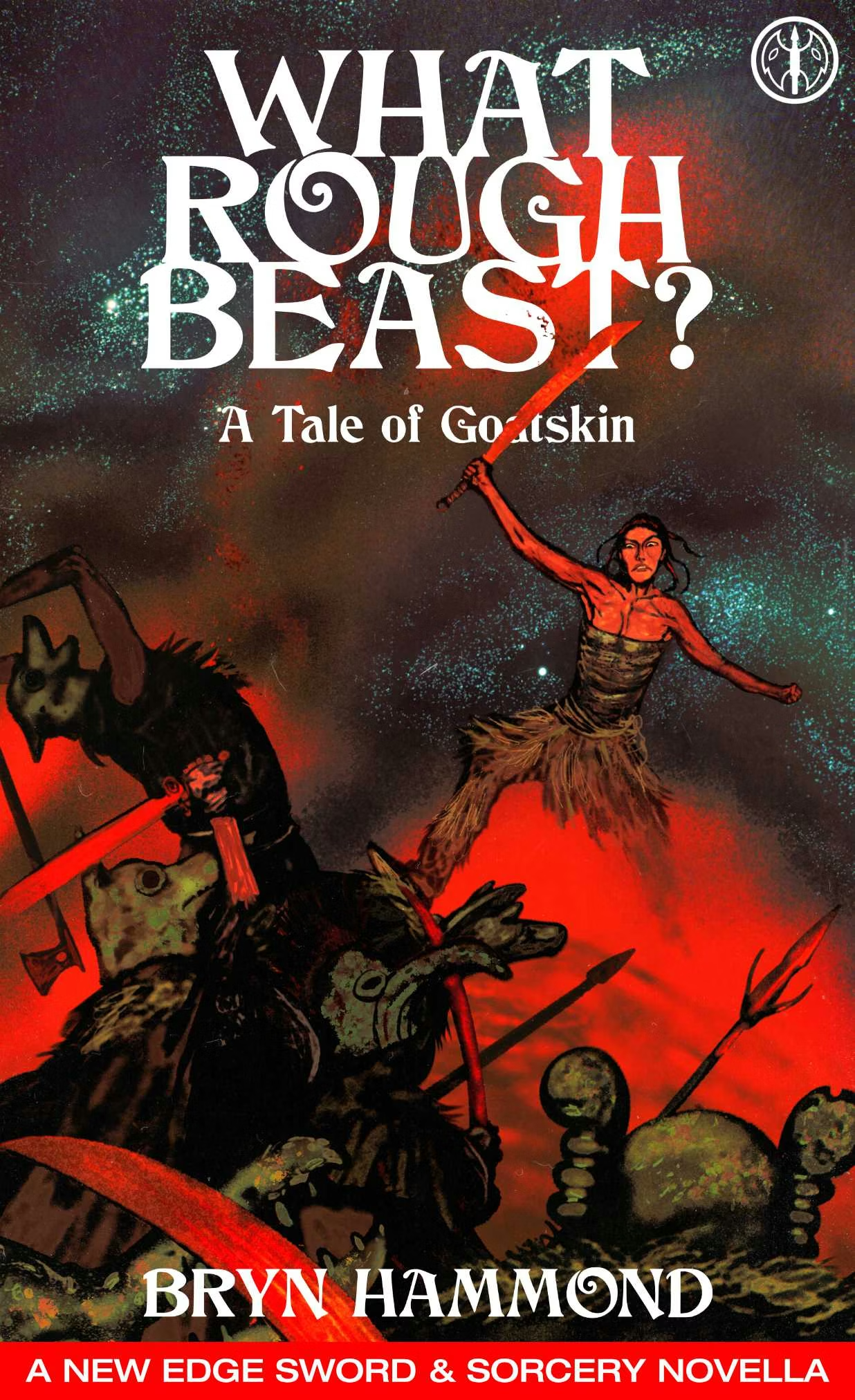
[Today we sit down with Bryn Hammond, author of the forthcoming What Rough Beast? Here, she discusses her love of sword and sorcery, her fascination with the nomadic cultures of the Central Asian steppes, and how she incorporates their religious traditions and folk practices into her stories. She also offers advice to other authors who are considering the self-publishing route.]
Forests Haunted By Holiness: Sword and sorcery has been around for almost a century. What would you like to see more of in the future? How would you like to see the genre grow? What do you think the genre should keep?
Bryn Hammond: For my own part, there are three things I’m in sword & sorcery for, and I’ll list them: outsider heroes, who don’t end up reconciled with power; short-sighted or private stakes, that give a realism; a weirdness that remains unexplained, for that existential uncertainty. These things are what makes it meaningful for me, so obviously I want to see them pursued.
I’d like it to continue to lean into different writing styles. I think sword & sorcery is hospitable to styles otherwise found ‘archaic’ or more elaborate than is in fashion, because it’s a smaller subgenre more closely in touch with old practitioners, and they include a few idiosyncratic stylists.
Of course, I like the particular thing that I’ve been doing, that at this point I have to call historical sword & sorcery, because it is so anchored in specific cultures, and my reasons for writing are tied up with those cultures. I’m always keen to see other people’s rendition of that. We’ve probably moved past the hodgepodge of Robert E. Howard and Conan’s historical world, we probably want to use historical cultures – actual cultures – with more care now.
But just as much I like the wild fantastical, and especially in its far-future iterations – which is this year’s special issue of New Edge Sword & Sorcery, Timeworn Terra. My most formative influence as a young writer was Viriconium – and besides, I have another S&S character waiting for my attention, who lives on one of these retro-futuristic earths.
I like sword & sorcery’s serial characters and story cycles, that more often than not work in standalone. This way, you get the familiarity of world and attachment to a character, the resonance as each story acts upon the others, and yet you don’t need a rigorous schedule of 1-6 books in a series or whatever. You can have much of the value of an in-depth novel, but do it in shorts.
In short, I like a range, and I’d like to see S&S continue to test itself and reinvent itself. Not just revisit the old in new dress and with updated attitudes, but to let sword & sorcery be new – not nostalgic – while still itself. That’s the challenge. That’s what matters most to me.
FHBH: Your new novella, What Rough Beast? A Tale of Goatskin is due out from Brackenbury Books in June. First, congratulations! Second, how did the novella come about? Did you approach Brackenbury Books or did they come to you?
BH: Cheers. I have a previous novella with Brackenbury Books, Waste Flowers, and What Rough Beast? is a follow-up – although like every Goatskin tale it’s a standalone, you don’t have to read in sequence. They grew out of my work in New Edge Sword & Sorcery Magazine; Oliver Brackenbury, editor at both, has pulled out a few characters and/or authors from the magazine to try out with novellas.
FHBH: Goatskin’s adventures take place on the steppes of Central Asia, when the “civilized” cultures of cities and empires are moving in and putting pressure on the indigenous nomadic peoples. First, what draws you to the cultures of Central Asia? What do you find so compelling about them?
BH: It goes back too far to be explicable to me: I have my teenage notebooks with lists of Turkish and Mongol words, and a note to self to find The Secret History of the Mongols. Soon I got sidetracked onto Arab nomadic peoples, and learnt Arabic instead (I’ve since forgotten it). Decades later, I did search out The Secret History of the Mongols, first in the gloriously old-fashioned and over-literal translation by Cleaves, and I fell head over heels. I’d spent the previous ten years on novels about and a translation of Beowulf (none of these finished), and the Secret History, with its artistry and ethos in the deep tradition of steppe epic, kicked Beowulf aside.
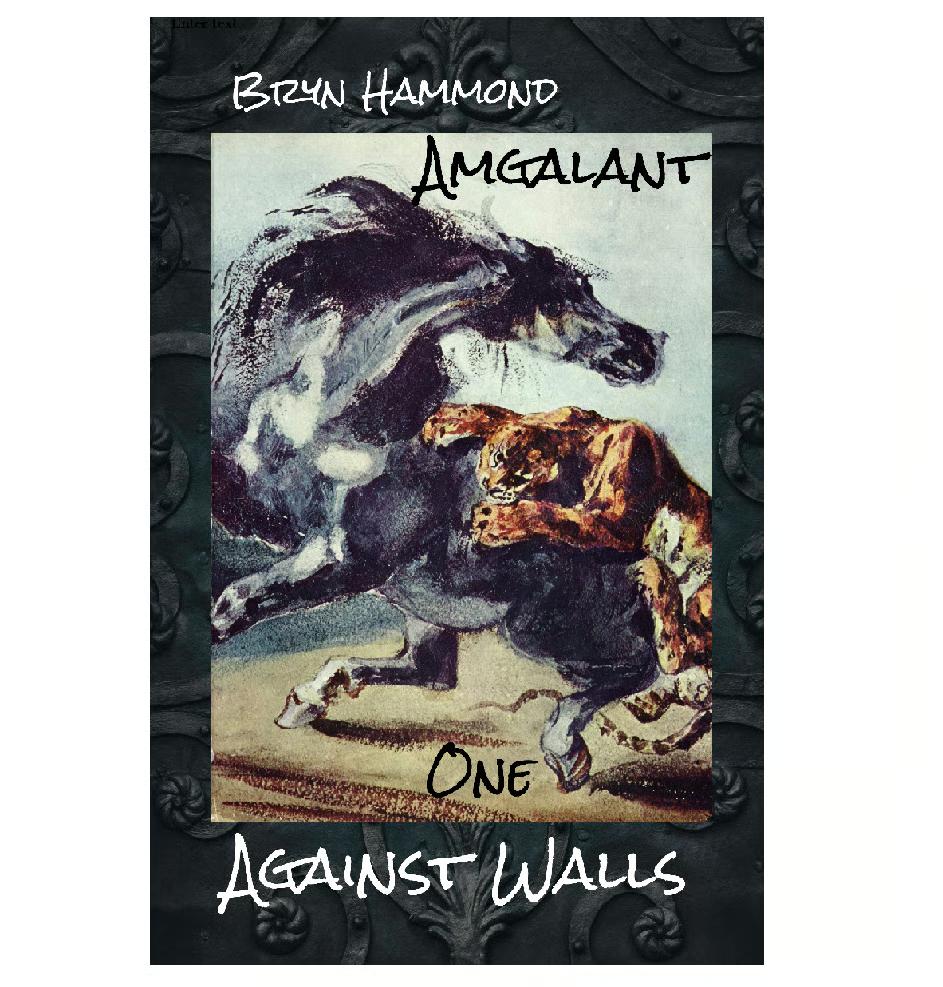
So I wrote Amgalant, a two-novel set, a rendition of the Secret History, that does try to look at the whole history of the steppe’s nomadic peoples in conflict with the self-titled civilizations. It does this utterly from a nomadic point of view – I don’t both-sides the matter, because the histories we derive from those scribal civilizations have been enormously one-sided.
FHBH: This conflict between nomadic and sedentary cultures is starkly illustrated in your short story “A Day in Irighaya” and in the short stories in A Visit From the Scythians. In those tales, religion in particular is a flashpoint. What real-world examples did you draw upon when crafting these stories, and the conflicts that drove them?
BH: Of the four tales in A Visit from the Scythians, the title story is a bit of a farce, that pieces together quotes from actual ancient poets and historians and early scientists, largely on the subject of gender, from the west and the east ends of the steppe.
Two, ‘Ill Spirits’ and ‘Spirit Writing’, look at practices that I find meaningful and moving; the second has to do with the politics of religion too, a forest people caught in the Chinese tribute system and its religious responsibilities. The fourth is more fantastical, but is based on the indigenous peoples of Siberia under pressure by Russian settlers and their advance troops, the Cossacks.
As for ‘A Day in Irighaya’, that was concerned with city gods who oust an older style of god, on the site a city is built; the new gods are conceived as human, the old gods are cast as demon and animal. Its canal-versus-river conflict came from Mark Elvin’s eye-opening environmental history of China, The Retreat of the Elephants. I even tell the story of the last elephants in it.
FHBH: When crafting your stories, how do you go about working spiritual components into the narrative? Do you start with a particular sacred tale or practice, and build the story around it? Or start with the story first and find a spiritual practice or belief that fits the narrative?
BH: Quite often, yes, I have absolutely started with a practice that I wanted to hang a story around. A spiritual or spiritual-adjacent idea. For instance, ‘A Grief-Note of Vultures’, an early Goatskin tale, was an early try at putting into story how spirits work in Mongol and adjacent cultures. I joined that together with an actual fresco where conquest of indigenous peoples west of China was celebrated or excused or possibly apologised for, in art.
What Rough Beast? is very much in this vein. Its cult was much informed by a chapter on ‘Were-Animals and Modernity’ in Shamans and Elders by Caroline Humphrey and Urgunge Onon. Urgunge Onon relates his experiences of shamanic beliefs in clash with modernity in early twentieth-century Manchuria. But shamanic religious cultures have been in clashes with, and persecuted by, the so-called world religions, for centuries before that; and so I let his incidents and understandings infuse my tale set in the less-documented thirteenth century.
And as I do, I jumbled with that the extraneous matter of Paul Klee’s handmade puppets. I read an essay on these, ‘Of Angel and Puppet: Klee, Rilke, and the Test of Innocence’ and was fascinated, so I smashed it together with ‘Were-Animals and Modernity’ to create my cult in What Rough Beast?
Now, the portrayal of cults in sword & sorcery past – dark cults in dark corners of the worlds – has been pretty Heart of Darkness-type stuff, often very suss. That too was in my mind.
FHBH: Spiritual beliefs and practices appear in every genre of fantasy. But whereas many authors use them only as window dressing, you fully incorporate those elements into the lives of your characters. What was your favorite bit of real-world lore or practice to use in your stories? And do you have any advice for other writers who would like to do the same?
BH: There’s a reviewer who has called my Goatskin tales ‘anthropological sword & sorcery’, and he’s not wrong. Anthropology has its troubles, and certainly has been ill-used in sword & sorcery’s past. But when I was a historical novelist, I learned that historians weren’t going to give me the thick description I needed, and that ethnography can be a strong help to cross that gap. Nowhere more so than in people’s religious lives – how beliefs operate on the ground, in daily life. So I read a lot of anthropology, and widely, not just what I scraped up on Mongols: often a stray incident from another culture gave me an insight to understand an unexplained fragment about Mongols. If I hadn’t done that, I’d have written a much thinner book, with far less to offer on people’s actual lives.
So if you’re writing medieval or before, and you want to write a lifelike culture, I cannot too highly recommend you wander about in ethnography, even when it doesn’t seem to directly shine light on your field.
FHBH: Where else can fans find stories of Goatskin and Sister Chaos?
BH: Special mention to ‘A Home God Sewn of Fur and Bristle’ for its religious themes; this is going be in an anthology from Scylla Publishing, Who Am I? A Sapphic Spec Fic Anthology of Identity and Purpose. Look for that in September.
I keep a place in the cockles of my heart for ‘Sister Chaos’ in New Edge Sword & Sorcery #1, for its movement of resistance in towards the centre from the margins; also, What Rough Beast? does enlarge upon this story.
I have two Goatskin tales in search of homes that are set in the Great North Forest, that is the Siberian taiga, and have to do with the underworld.
Otherwise, you can find a Goatskin timeline on my website with publication details.
FHBH: You self-published the collection, A Visit From the Scythians. Do you have any advice to offer writers who are considering the self-publishing route? Mistakes to avoid? Things they absolutely must do?
BH: Scythians is a little collection with two reprints. Self-publishing is great for that, and even better for authors who have decades of back catalogue and their rights in hand, to get out-of-print work back into circulation.
When I had my huge two-part novel Amgalant ready to go, in 2012, I was quite naïve, I’d lived under a rock – my head down writing – and wasn’t much on socials. I knew nothing, and nobody. As soon as I found out about self-publishing I was enthused and straight away took that road. Its independence, and disassociation from capitalism, called to me.
A wiser head told me at the time, I wasn’t likely to get Amgalant published any other way. She was right: in historical fiction, the joke was, agents read your rarely-seen setting and asked ‘do you have any Tudor?’ It’s true that Mongols became big, but that was a boy’s own hack-and-slash (including of the culture) and nobody expected a work like mine on the subject of Mongols. Besides, my second main was gay.
In short, self-publishing was and remains a great option for unusual books, and perhaps your only option, when what you are doing isn’t seen as commercial or doesn’t fit a groove. Don’t languish in a folder: get your work out there.
FHBH: Which book fairs, conventions, or other events do you hope to attend in the foreseeable future?
BH: I’m presently in a regional town in Australia and don’t have travel prospects (A for affordability). Find me online.
FHBH: What other projects are you working on?
BH: We’re wrapping up a novelette for New Edge Sword & Sorcery #8, that is my love letter to Turkic and Mongol epic poetry.
I’m at work on a third novella. If Goatskin’s search for her own meanings in What Rough Beast? goes to your heart, you’ll be happy with this one.

