
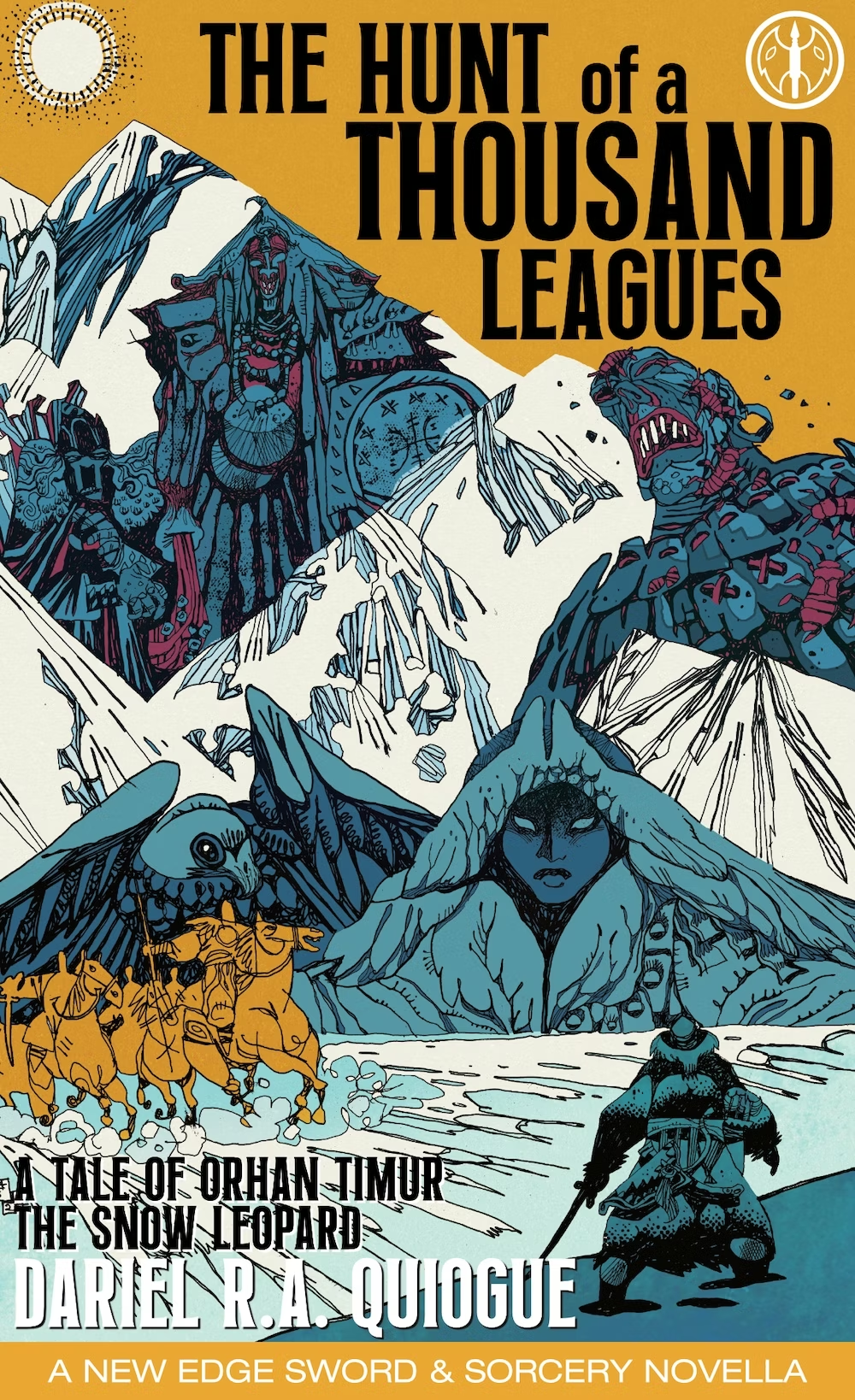
[Today we sit down for a quick interview with author and game designer, Dariel Quiogue. Here, he discusses his forthcoming sword and sorcery novella The Hunt of a Thousand Leagues; the research that went into it; and his process for writing exciting tales that combine historical fiction and fantasy.]
Forests Haunted by Holiness: You describe yourself as a “lover of swashbuckling tales set under alien skies.” What draws you to these sorts of stories, as both a reader and a writer? How and why do you find them so compelling?
Dariel Quiogue: One of my first science fiction reads was Edgar Rice Burroughs’ A Fighting Man of Mars, part of his Barsoom series, and I read it the same year Star Wars came out. Can you blame me for emerging with my brain permanently warped? <grin> I guess part of it comes from my natural curiosity and a highly visual imagination, plus every kid’s taste for adventure stories. When I read fiction, I usually want to be taken far away from the world I know — different rules, different vistas, different cultures. Since I write primarily for myself, I try to do the same with my own fiction.
FHBH: Your new sword and sorcery novella The Hunt of a Thousand Leagues is due out soon from Brackenberry Books. First, congratulations! Second, how did the novella come about? Did you approach Brackenberry Books or did they come to you?
DQ: Thank you! The novella was a commissioned work, following on the success of Brackenbury Books’ first round of novella releases which included my novella Walls of Shira Yulun. A third novella is currently in production by the way.
FHBH: The central character of The Hunt of a Thousand Leagues is Orhan Timur, known as the Snow Leopard. Who and what were the historical inspirations for Orhan Timur? What sort of research went into his creation, and the development of the fantastical world he inhabits?
DQ: Orhan Timur came about as I was creating a story inspired by the Terracotta Army found in the tomb of Emperor Qin Shih Huangdi. I knew I wanted some kind of outlaw to be the main character, and since the tomb’s located not too far from the border, I thought it would be appropriate to have the outlaw be of steppe nomad origin.
As I built up the concept, I thought I’d make him a reversal of Chingis Khan; Chingis had a blood brother, or anda, named Jamuqa, who later became his rival and enemy. In our world, Chingis eventually defeated Jamuqa; I decided to flip the story around and have Orhan Timur defeated by his rival Jungar, turning Orhan into a hunted fugitive. The idea was to have a series character that I could write many stories about, and the fugitive with a vendetta angle promised to be an engine that would deliver many possible adventures and complications. The Hunt of a Thousand Leagues taps directly into this backstory.
To lay the background for Orhan, I researched Mongol history and culture, as well as, depending on each story, aspects of Persian, Indian, and even Russian history. I like my sword and sorcery to feel historically grounded, so I can dig quite deep for details I feel important to the current work. It helps that I’ve been a sort of fan of the Mongols and their Timurid successors for a long time before ever writing the Orhan stories.
FHBH: Where can readers find more adventures of Orhan Timur?
DQ: Several Orhan Timur stories have appeared in issues #0, #2 and #4 of New Edge of Sword and Sorcery, in The Best of Heroic Fantasy Quarterly Volume 1, in the debut issue of Swords Against, and the novella Walls of Shira Yulun. Also look out for the upcoming reissue of my first collection, Swords of the Four Winds, which contain the first five Orhan Timur stories I wrote.
FHBH: You have written and published novellas and short stories. When you come up with a new idea, do you know which format it will be? And, from a craft standpoint, do you have different approaches to writing a short story versus a novella?
DQ: I think in terms of layers and I guess I could call them vectors, things that push or pull my main character. A simple idea is good for a shorter story, multiple layers and vectors call for a longer treatment. Or it can go the other way around, if I know a longer work is called for then I try to build more layers.
For example, when I was developing the ideas for Walls of Shira Yulun, I knew it would be a siege – Brackenbury Books editor Oliver and I had already agreed on that during pre-production, since the idea of having the free-ranging nomad Orhan trapped like a rat appealed to us. So to make it a rich novella I tossed in multiple villains and threats, a troubled romance, even a bit of social and historical comment, particularly on how hellish war can be for the ordinary person.
As for the craft, I think the best way to learn to write is to read. So for Walls I boned up on fantasy and some science fiction siege stories: Tim Willocks’ The Religion, and reread David Gemmell’s Legend, Poul Anderson’s Fire Time, and The Lord of the Rings for the Helm’s Deep section; also Pressfield’s Gates of Fire. I studied their pacing, the way they intercut between characters and plot threads.
I’m a pantser, so I don’t make exact plans on what I’m going to do or how, I just try to internalize insights from my sources, then try to come up with cinematic moments that I can spin into scenes. Whatever the length of a fiction piece, it’ll always be a chain or mosaic of scenes, so I concentrate on that level. One at a time, one or two scenes a day.
FHBH: Which book fairs, conventions, or other events do you hope to attend in the foreseeable future?
DQ: None really. The ones I’m interested in happen outside my country, and airfares are pricey specially given the lousy exchange rates we have here.
FHBH: What other projects are you working on?
DQ: As I mentioned I’m planning to rerelease my first collection, Swords of the Four Winds, this time with added stories and hopefully more interior art. Once I’ve turned in the next novella, I’ll be writing the stories for Swords of the Four Winds Volume 2, a project I’ve been wanting to do for a long time. I’d also like to do more sword and planet (Swords of the Four Winds 1 and 2 are all sword and sorcery), I actually consider S&P my ‘home’ genre, the one I’m most excited to write.

