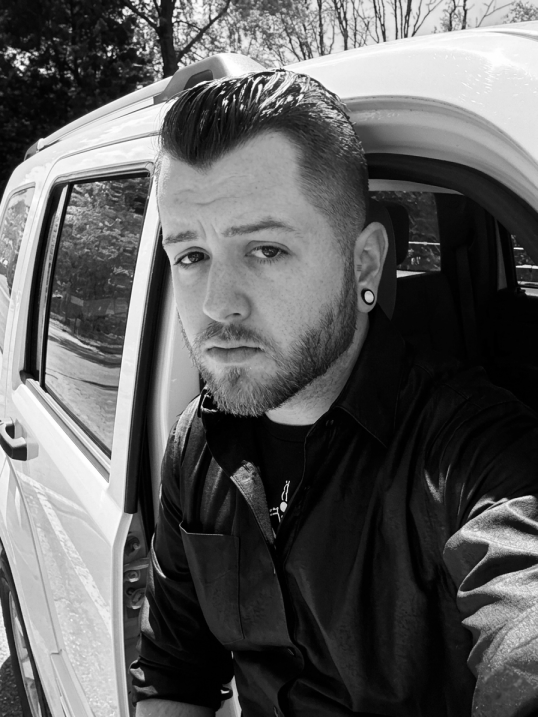
[This issue, we sit down with poet and essayist, Silvatiicus Riddle. Here, he discusses his new poetry collection, the importance of poetry in the world today, and his upcoming projects.]
Eternal Haunted Summer: You recently published a poetry collection, In Your Dreams: A Chapbook of the Extraordinary. First, congratulations! Second, what led you to creating this collection? And where and how can readers find it?
Silvatiicus Riddle: Thank you. I felt that a chapbook of my work was long overdue. This book, in particular, was created as a heartfelt ‘thank you’ to the readers and followers of my work. In particular, I wanted to show additional appreciation to my readers on my Substack, The Goblin’s Reliquary, where I publish both essays and poetry.
Something that is important to me, and I mention it in my note at the end of In Your Dreams, is accessibility. Perhaps half of my published work to date is only available in magazines, where they must be purchased in order to read my writing, to hear my stories. That’s understandable — because truthfully, how much is free anymore, and when it is, we often take a sacrifice in quality. Paywalls exist for a reason. But, for many people that is exactly what paywalls are — a wall between them and something that might make a difference in their lives.
There is something that is most poignant right now, more-so than at any other point in recent memory, which is the near-requirement to prioritize needs and essentials over certain comforts and luxuries. If someone needed to choose between a co-pay at a doctor’s office, their children’s lunch, or a magazine of stories, they are going to make the choices in favor of what is most pressing. I don’t blame them; I make those same decisions every day. But, I’m also an old-school punk. And for me, in the spirit of the punk zines of old — the choice was clear: make this chapbook FREE and accessible to anyone that wants to read it, with the option presented only at the end of the book, whether or not they wish to toss a coin my way. I know I may not be able to do that with every book that I write, but it was important for me to lay the foundation of my own real-world principles for all to see with my first book. You don’t get another opportunity to do that again for the first time — present who you are in one hand, and proffer the spectre of magic with the other.
A direct link to the article with my chapbook is here.
EHS: In the introduction to In Your Dreams, you assure the reader that “we will find our way through” and that our soul “draws endlessly toward beauty.” What beauty do you find in writing and sharing poetry? How does it help you find your way through, and how can it help others?
SR: The world recently lost the writer Jane Yolen, author of more than four hundred books, and preeminent figure within the world of written Fantasy. In her book, Touch Magic, she says: “In fantasy stories we learn to understand the differences of others, we learn compassion for those things we cannot fathom, we learn the importance of keeping our sense of wonder. The strange worlds that exist in the pages of fantastic literature teach us a tolerance of other people and places and engender an openness toward new experience. Fantasy puts the world into perspective in a way that ‘realistic’ literature rarely does. It is not so much an escape from the here-and-now as an expansion of each reader’s horizons.”
For me, that’s where the beauty is in writing stories and poetry: keeping wonder and awe alive. But, so, too, empathy and compassion. All of which has found itself in a renewed cross-hairs; a persistent press to stamp it out, to deaden people to the plight and lived experience of others, to animals, the plants and mineral kingdoms, the water, the earth itself. Stories feed people. Poison chokes the plant, but the roots of a human will absorb anything you lay upon them. You have many people now fed with the lie that only the superficial desires of the mind and body are worth saving, all else is fodder to feed to the god of capital. But, it is the wisdom keepers, the artists and storytellers who keep the balance. Every story told, in earnest, is like a thread woven through the heart of people, pulling them back from the existential drift that comes with being alive during times like this. Every line of every poem is new air rushed to the lungs of compassion and empathy. It is our art, our creative soul, that lifts the tired head, and draws the eye toward beauty; and every tale told is translated by the heart into a final, lingering promise: “Remember.”
EHS: In Your Dreams includes six poems, all varying in length and style. Did you write the poems specifically for this collection? And which was the most difficult, but ultimately most satisfying, to write?
SR: Of the six poems, two of them had never been published before. But, out of the four remaining, three of them were not readily available, either due to having been published in an older book, or because the original magazine had gone defunct. My absolute favorite pieces of this collection are: “Sing The Song of Sunflowers”, and “In Which One Partakes in Their Own Disappearance, on The Eve of Halloween.”
The former literally came to me in a dream, word for word. Because it was short, I could remember it easily upon waking.
The latter, however. was surely the most difficult for me to write. I had written it back in 2020, when I was just coming through the end of several rather serious physical and mental health issues. A relationship that I had been in for a decade was also ending. My heart was shattered, my body was broken, my mind couldn’t make sense of reality for nearly an entire year — liminality was a place where I began and lived every day. In many ways, that time of my life was almost like an initiation. At that point, I had not written anything in years. And then, one day, I sat down at the top of the staircase, on the landing of my little apartment, and I wrote the first several lines of that poem (“Soon, I will slip into the time of apples …”). Something opened in me that year; it was like the process of transmutation in alchemy — one thing became yet another. There was a clarity to my vision, both within and without. And the first thing to come through, born of that pain and liminality was almost amusing in its synchronicity, and welcoming in its familiar darkness and nostalgic comfort: Halloween.
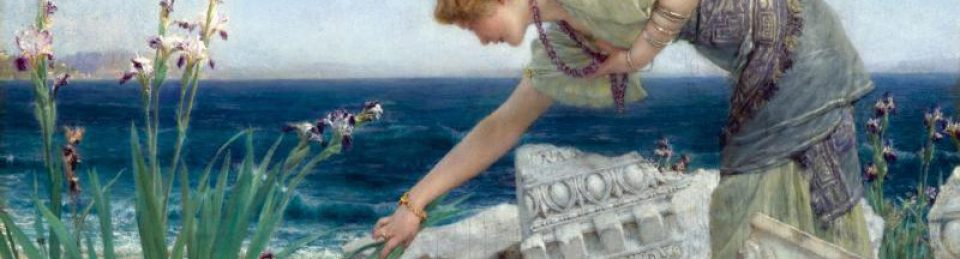
EHS: Your poems are filled with lyrical, almost painterly, imagery, with lines such as “dewdrops on black spider-silk” and “field mice drop wreaths of tansy and clover at your feet.” Where do these phrases and images come from? Do you take long walks? Disappear into books of artwork? Watch the stars?
SR: I think one of the most beautiful things someone had ever said to me was that my writing is “incantatory” — it echoes the sound or process of ritual and spellwork. I like that. I genuinely hope someone, somewhere might use my words to invoke something that they need, a necessary shift in their lives.
I read a lot of stories and poetry. I study actual folklore, particularly those related to Ireland and Scotland; the old Fairy Faith lives in my blood. But, in addition, I find and collect a lot of art. If I could eat art, I would; it nourishes me in a way that I think the spirit finds most preferable: through symbol. In food, we talk about bioavailability. I think art feeds the unseen, the ineffable, and the other, in much the same way. I’m never bored — there’s so much to know and to learn. We can study forever, and we can always dream new worlds. Combining folklore, art, history, my own glimpses of pain and beauty? From that, words come. May they always find me.
EHS: What other projects are you working on?
SR: I feel like I’ve always got something in the works. Whether it is drawing from the backlog of yet-unfinished poems and short stories, to essays at The Goblin’s Reliquary, or working on my first novella, which is a historical dark fantasy that takes place in Coney Island during the 1940’s.
I’m just grateful that I get to continue doing what I love. Writers are like The Magician of the Tarot, some candle is always burning; some handful of heaven is always being stolen away, glimpses offered to passersby — reminding them that there’s more to life than hurrying on; that what is essential to their very being is made up of stories, and that it is through stories we remember that there is nothing at all impossible; not long ago, we were all once gods, too.

