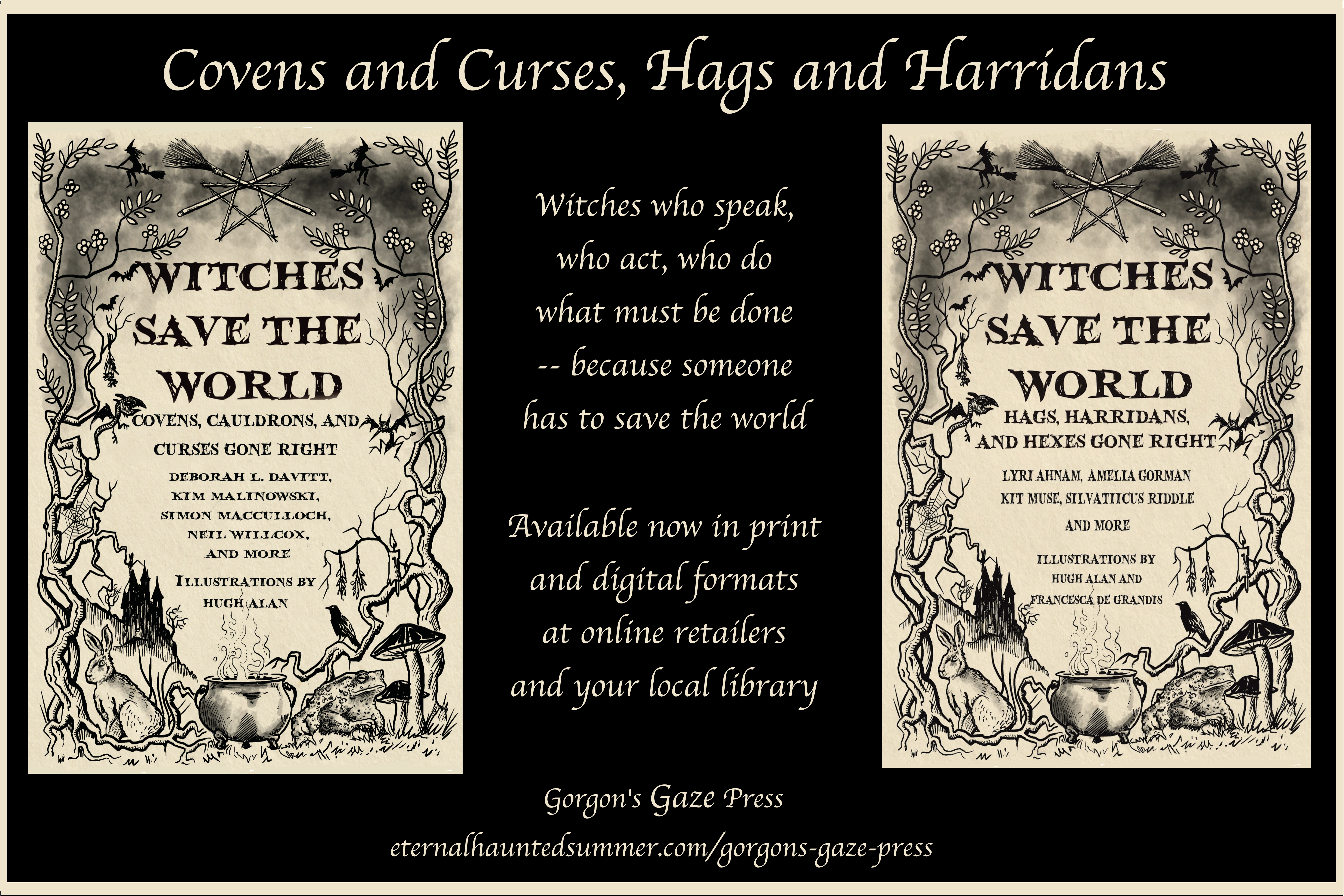
Welcome to the latest installment of the Witches Save the World Micro-Interviews! In honor of the upcoming Halloween/Samhain holiday, and in celebration of the release of Witches Save the World, Forests Haunted By Holiness will be featuring a series of interviews with the contributors throughout October.
Witches Save the World was a labor of love. Across these two volumes you will find poems, short stories, and essays celebrating the witch and their role as wisdom keeper, protector of nature, avenger of the forgotten, and defender of the oppressed. Individual poems and stories range from historical fantasy to contemporary horror to science fiction, with many questioning the nature and cost of honor, integrity, and freedom.
In concert with these interviews, one physical copy of Witches Save the World — either Hags, Harridans, and Hexes Gone Right or Covens, Cauldrons, and Curses Gone Right— will be given away at the end of the month! Two books, two winners! To enter the drawing, just comment below and share the interview on your favorite social media platform.
Ready? Let’s get started!
Forests Haunted By Holiness: What is the title of your story and can you give us a spoiler-free summary?
Peter Medeiros: “The Black Trowel” is a story about a very ambitious college student and witch’s apprentice who has to wrestle with the friction between doing the right thing for our neighbors and satisfying personal ambitions … magical and otherwise.
FHBH: How did you go about writing your story? Lot of research? Or did you just wing it?
PM: I’ve done a lot of research into magic over the years, most notably the wonderful Magic: A History by Chris Gosden. The magic in the story, however, is fairly simple, and relies on objects of power, a la a magic staff or wand.
FHBH: What draws you to the character and theme of “the witch”? What do you find so compelling about it?
PM: I think that Grady Hendrix has a lovely little essay as an afterward to his recent Witchcraft for Wayward Girls, and I share a lot of his feelings: basically, that witches hold so much literary potential because they can mean so many contradictory things. Are witches a symbol of female anti-authoritarian power? Or is the idea of the witch most notable for the horrific crimes that have been committed in the name of rooting out witchcraft?
Also, a lot of my students are also young women, and I think that Gen Z is deeply aware of the sexist underpinnings of our society. (When I was a young person in the 90s and 2000s, I shared the somewhat rosy view that sexism was in retreat, that progressive ideals would win the day … we just had to wait for the nasty old buggers in charge to die off. Embarrassing to admit now, but true of lots of disappointed progressives, I’d wager.)
Young women today, in my experience, are clear-eyed about the uphill battle we face when we fight sexism … and they know that, as Audre Lorde famously writes, “the master’s tools will never dismantle the master’s house.” In other words, they are looking for alternative source of power; they know that getting more women in the proverbial board room isn’t going to stop, say, a Supreme Court that has been bribed by the Heritage Foundation to destroy women’s rights. In the literary realm, witchcraft can stand in as a metaphor for many kinds of alternative, and gendered, power.

