[Today we sit down for a quick interview with author Andrew Anderson. Here, he discusses his new book about Herne the Hunter; the research that went into it; and his upcoming projects.]
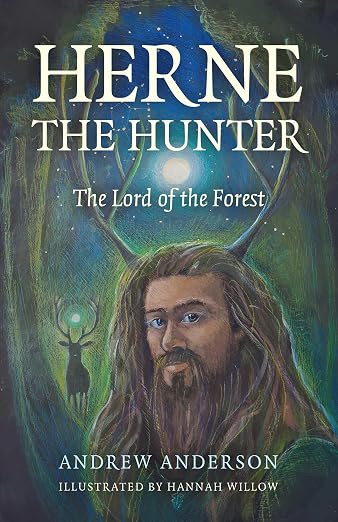
Forests Haunted by Holiness: You have a new book about Herne the Hunter that was just released in late in August. First, congratulations! Second, why a book about Herne? What drew you to this subject?
Andrew Anderson: I had just finished writing The Magic of Cats and was casting around for another subject. It was like Herne came and tapped me on the shoulder and asked me to consider writing about him! He seemed to be everywhere – he was in TV shows I watched, almost out of context, and in the books I picked up to read, as if he was trying to draw my attention. I also found a lovely set of Herne prayer beads which I ordered, too. I decided to explore a bit further, to see if there were any other books on Herne and, to my surprise, there really wasn’t. So, I decided to do some preliminary work and discovered that the first mention of Herne was in Shakespeare’s play The Merry Wives of Windsor. Well, I live in Stratford-upon-Avon and, at that stage, could see Shakespeare’s birthplace out of my window. It was the final piece of the puzzle – the fact that I could bring my love of Shakespeare as well as my love of Herne to the project meant that it just felt right. That’s when the hard work started!
FHBH: What sort of research went into Herne the Hunter? Big stacks of books? Lengthy discussions with scholars and devotees?
AA: I very quickly began to realise that there was a huge amount of affection for Herne the Hunter among the pagan community. A lot of my friends would talk about him very warmly, so I knew I had to write a book which had that deep sense of love and respect at the heart of it. This could not be an academic exercise – it had to be an exhilarating ride through Herne’s history! And then I realised that I couldn’t possibly include every version of Herne or every mention in every TV show or novel – I just wouldn’t have the space! What I had to do was really focus in on the important bits, the things that made Herne the horned god we know today. So, each chapter covers a century, and each century has one focal text – for the seventeenth century, for example, it is The Merry Wives of Windsor; for the twentieth century, the TV show “Robin of Sherwood”. Other works do get mentioned because I need to contextualise the main text within its period. So, for the twentieth century, I explored where Richard Carpenter got the idea of Herne as a god of the forest from and that, in the same year, Herne was also in another popular children’s TV show, “The Box of Delights”. I’ve tried to link in as many of the important texts as possible while really shining a light into one specific work per chapter
FHBH: What fascinating historical or folklore tidbit did you absolutely have to include? Something you couldn’t wait to share.
AA: The thing I found which everyone else seems to have overlooked is actually about Herne’s Oak. There is a Shakespearean from the nineteenth century called Charles Knight, who was born in Windsor and whose family had been there for generations. He once quoted Shakespeare slightly incorrectly, referencing the “tree with great ragged horns” in Windsor Great Park, to which Shakespeare introduced the world. What he is implying is that, far from the horns being on Herne’s head, they actually belonged to the tree! If you look at early sketch of Herne’s Oak, it certainly looks like it has horns! This could give us a really interesting insight into the folklore that existed in Windsor before Shakespeare wrote his play – or it could just be a slip of the tongue! Whichever way you take it, it certainly shakes our idea of who Herne may be.
FHBH: There must have been things about Herne that you didn’t include in the book. Can you give us an example? And do you plan to share that information in another book?
AA: The initial plan was that it would include ways to honour Herne – such as rituals, offerings, prayers. However, I found so many interesting things that I had to leave that element out. I don’t think that’s going to be another book on Herne as I’m already working on my next topic!
FHBH: What other projects are you working on?
AA: I edit OBOD’s magazine, Touchstone, so am always working with writers, poets, and artists on content for upcoming issues. There are twelve issues a year, so I’m now turning my attention to the autumn and winter months. This summer I was installed as the Scribe of the Order, taking over from the wonderful Stephanie Carr-Gomm, so I have lots of going on. On top of all that, I have just started writing my fifth book, which is on Druidry. So, I am never bored!
 Eternal Haunted Summer