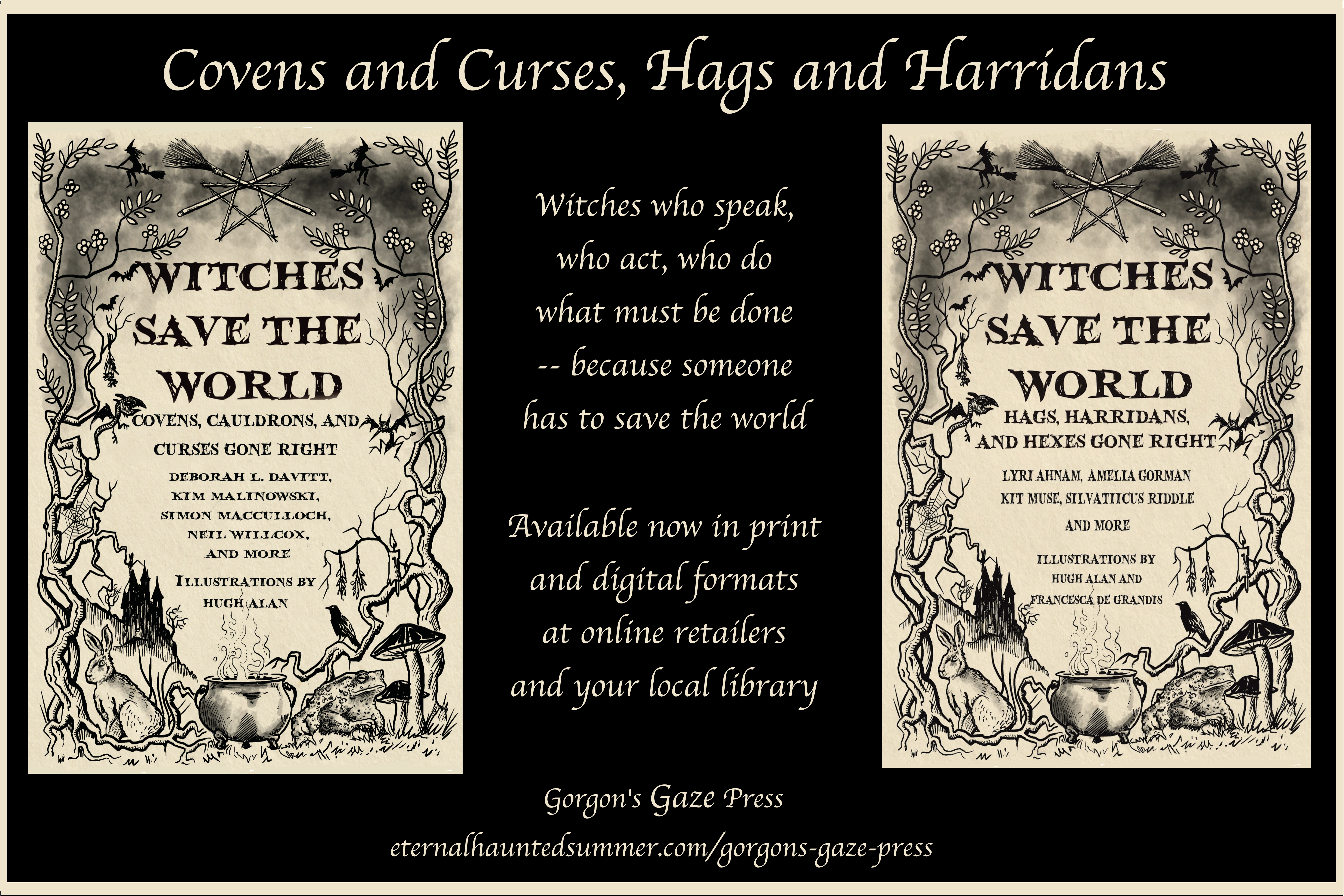
Welcome to the latest installment of the Witches Save the World Micro-Interviews! In honor of the upcoming Halloween/Samhain holiday, and in celebration of the release of Witches Save the World, Forests Haunted By Holiness will be featuring a series of interviews with the contributors throughout October.
Witches Save the World was a labor of love. Across these two volumes you will find poems, short stories, and essays celebrating the witch and their role as wisdom keeper, protector of nature, avenger of the forgotten, and defender of the oppressed. Individual poems and stories range from historical fantasy to contemporary horror to science fiction, with many questioning the nature and cost of honor, integrity, and freedom.
In concert with these interviews, one physical copy of Witches Save the World — either Hags, Harridans, and Hexes Gone Right or Covens, Cauldrons, and Curses Gone Right— will be given away at the end of the month! Two books, two winners! To enter the drawing, just comment below and share the interview on your favorite social media platform.
Ready? Let’s get started!
Forests Haunted By Holiness: What is the title of your poem and can you give us a spoiler-free summary?
Juleigh Howard-Hobson: My poem is “Freya Acts Yet Through Her Childless Cat-Loving Devotees (A Notice to Those Who Abuse Their Pets)”
In a nutshell: abuse pets — face a witch’s mythological wrath.
FHBH: How did you go about writing your poem? Lot of research? Or did you just wing it?
JHH: I winged it … but based on research I’d already done years ago. As a follower of the Northern Path, I am familiar with Freya as a Vanir Goddess; she taught Odin the art of Seidr (Norse Magic). I have long considered her a Norse Witch. I am not alone in this consideration.
Historically, Freya rides a chariot pulled by two cats. When Vice President J D Vance said that there are “a bunch of childless cat ladies who are miserable at their own lives … and so they want to make the rest of the country miserable too” I flashed on that cat-pulled chariot. Later, I thought about what Freya’s cat-loving witchy devotees throughout the ages would do if they came across some non-Pagan who abused pets because the biblical god gave man dominion over animals … and the poem was created. It’s a sonnet, but I used an increasing then decreasing Fibonacci sequence as the form for it — each line is influenced by the number of syllables in the lines right before and after … much like the cause and effect of magickal justice, which in this case is invoked on behalf of pets who cannot invoke it for themselves. Witches are protective of all domesticated creatures that might become familiars, after all.
FHBH: What draws you to the character and theme of “the witch”? What do you find so compelling about it?
JHH: Self-power, quite simply. Arcane, occult, feminine, mine. It cannot be taken away, it cannot be undone, it usually cannot be detected. After years of social outsiderness (ex-pat punk-rocker, home-birthing/unschooling/householding motherhood, Heathenry, not to mention being a formalist poet who uses syllabics as opposed to metrical feet…) I know from experience that mainstream society has no problem letting me know what it thinks of me, my ways and mine. This is not something that bothers me anymore although I still sometimes have to address it. Magick, witchcraft, folkways, call it what you will, taught me how to shield power as well as wield power. Now instead of fretting or wondering what to do in unpleasant situations, I magickly protect and defend myself (and others, including pets). This makes all the difference (please see my book Curses, Black Spells and Hexes [Alien Buddha], in which I reveal some of the more baneful –but ever so compelling–methods of ‘getting your own back’).

