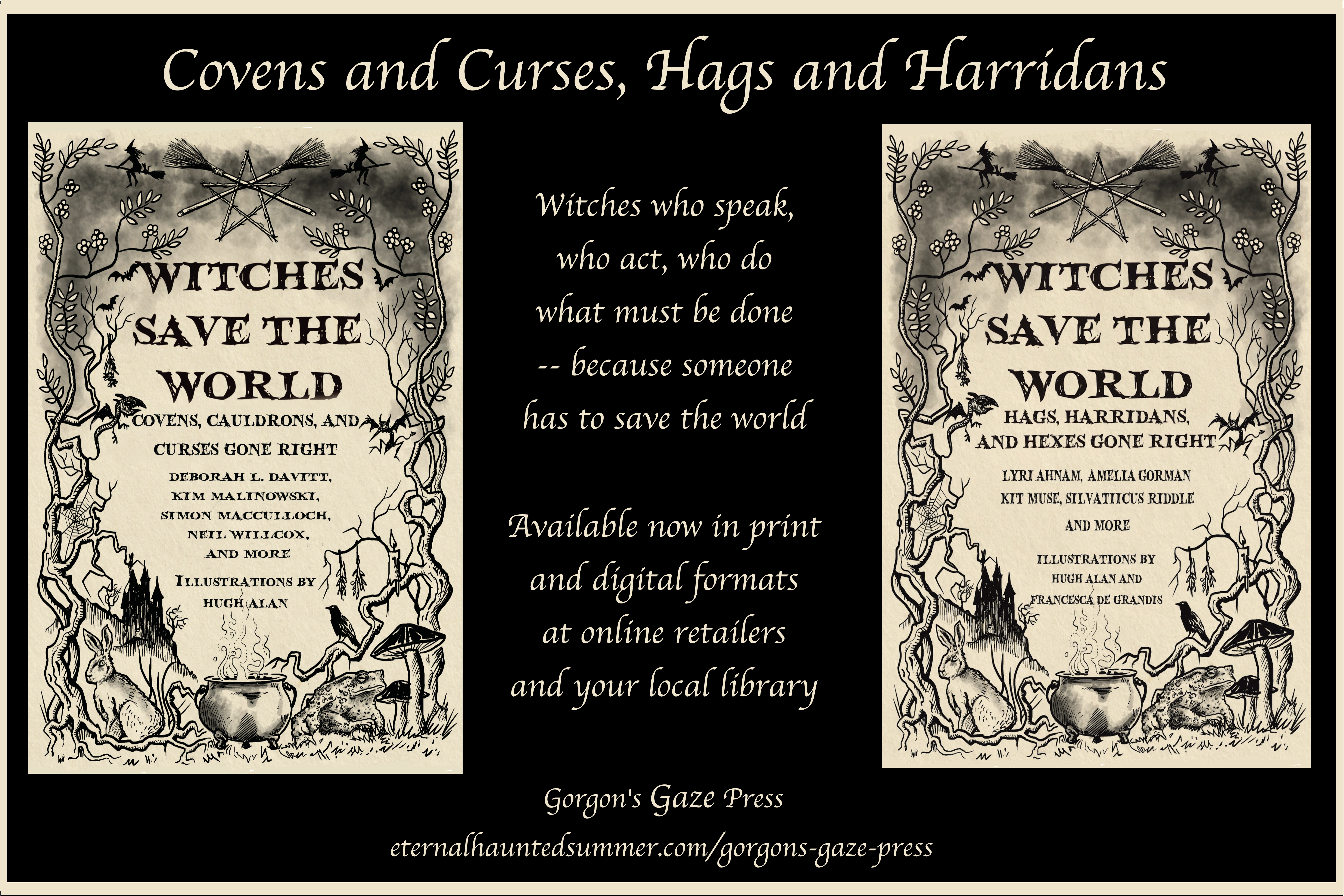
Welcome to the latest installment of the Witches Save the World Micro-Interviews! In honor of the upcoming Halloween/Samhain holiday, and in celebration of the release of Witches Save the World, Forests Haunted By Holiness will be featuring a series of interviews with the contributors throughout October.
Witches Save the World was a labor of love. Across these two volumes you will find poems, short stories, and essays celebrating the witch and their role as wisdom keeper, protector of nature, avenger of the forgotten, and defender of the oppressed. Individual poems and stories range from historical fantasy to contemporary horror to science fiction, with many questioning the nature and cost of honor, integrity, and freedom.
In concert with these interviews, one physical copy of Witches Save the World — either Hags, Harridans, and Hexes Gone Right or Covens, Cauldrons, and Curses Gone Right— will be given away at the end of the month! Two books, two winners! To enter the drawing, just comment below and share the interview on your favorite social media platform.
Ready? Let’s get started!
Forests Haunted By Holiness: What is the title of your story, and can you give us a spoiler-free summary?
Maxwell Czyzyk: The title of my short story is “The Festival of the Rusalka,” where you’ll discover what happens when the spirits among us are forgotten.
FHBH: How did you go about writing your story? Lots of research? Or did you just wing it?
MC: As with most of my stories, “The Festival of the Rusalka” began with a single image. In this case, it was the beginning image in the story — a person stumbling from the forest’s edge. From there, I decided how I wanted the story to end; I find writing easier when I know the direction the story needs to go as I generally struggle with planning anything else ahead of time — I’m more of a “wing it” writer. However, this particular story proved difficult for me. It came in pieces, fragmented scenes sporadically jotted down, and nothing seemed to fit together until I had the idea to separate the scenes into “days of the festival.” That’s when some light research came in.
While I’d taken a class (way back) in college called “Russian Fairy Tales” and remembered quite a bit of what was covered, I referenced one of the course books (Russian Folk Belief by Linda J. Ivanits) in order to ensure I got details correct and used the correct spellings (especially for the plurals). I also did online searches for some of the festivals that are mentioned in Russian Folk Belief since there wasn’t as much information as I needed. Ultimately, I broadened my search to Slavic festivals (rather than only Russian) and discovered pictures and articles from ongoing Ukrainian and Polish festivals, picking and choosing tidbits here and there as inspiration for the festival in my story. The tradition of weaving wreaths to float downriver to find a husband (or die) was pulled directly from a passage in Russian Folk Belief — this was something I vividly remembered from the college course and wanted to include.
FHBH: What draws you to the character and theme of “the witch”? What do you find so compelling about it?
MC: As for the witch [for my story], I instantly thought of Baba Yaga. Not only because I was already familiar with the figure from college, but because of how she’s become a more prominent, recognizable figure in books, television, and movies. For me, the Baba Yaga character exemplifies the duality of witches, of how they’re not inherently villainous or malevolent, but have, historically, been portrayed as such. Continuing with Baba Yaga as an example, (to my knowledge) “Baba” translates to “old woman” (it’s also what we called my grandmother, who was Polish), and at her most simplistic, that’s what she is — an old woman living in the woods. And from what I’ve learned in “Russian Fairy Tales,” Baba Yaga was both a hindrance and a help; it merely depended on the specific story. Her physical appearance also varied by region — in some she was the ugly crone figure, while in others, there’s no mention of any negative physical traits. So why did the negative features prevail? Why were the negative traits the traits that were magnified? Also, why has our perception of these folkloric figures remained fixed when the idea of “a witch” has evolved to include “mainstream” characters that are celebrated for their cleverness, power, and beauty? These are the kinds of questions — some with answers and some without — that draw me to “the witch,” and why that type of character is so engaging to write, read, and watch. The witch is an endless, ever evolving enigma, a character full of infinite potential.

