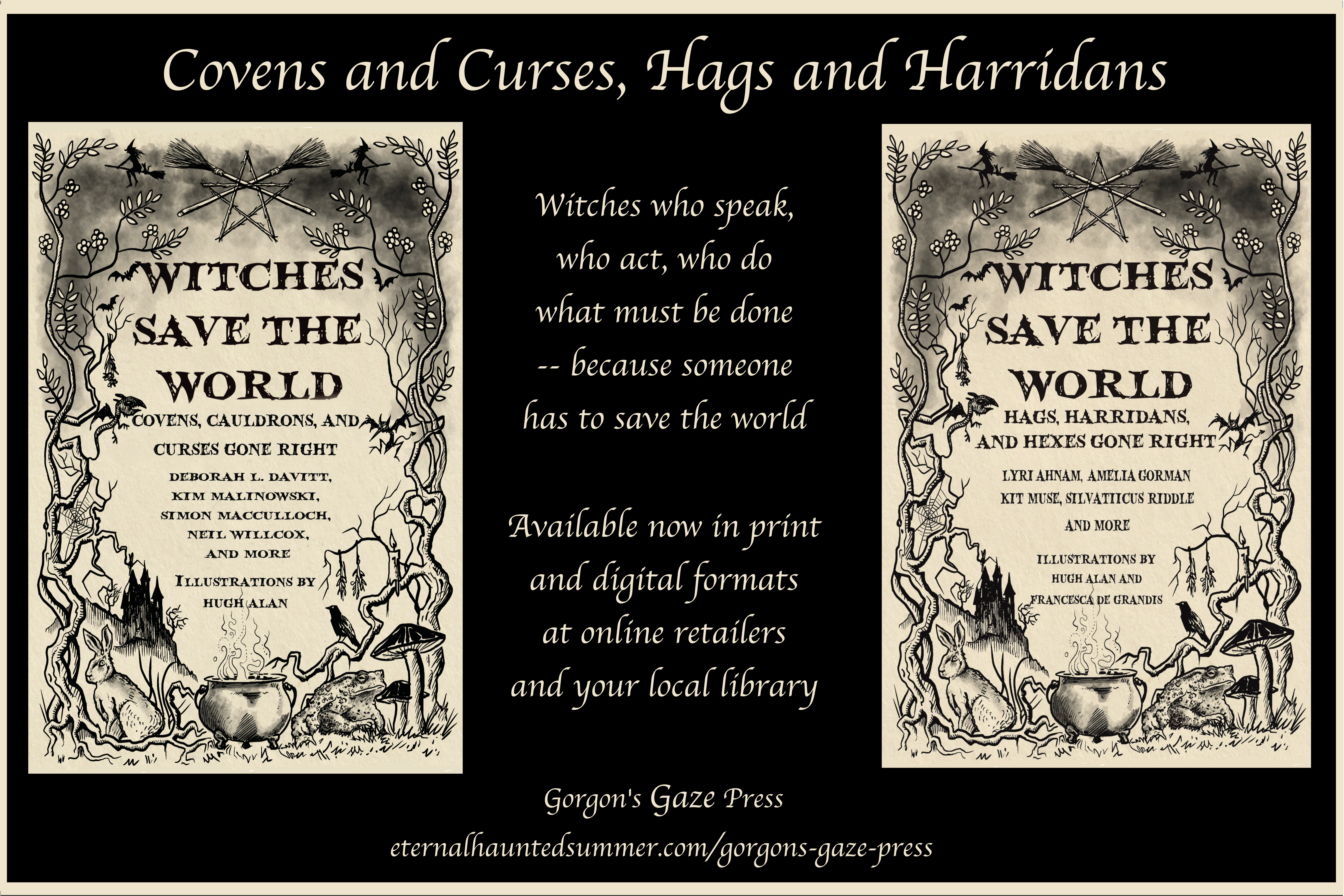
Welcome to the third installment of the Witches Save the World Micro-Interviews! In honor of the upcoming Halloween/Samhain holiday, and in celebration of the release of Witches Save the World, Forests Haunted By Holiness will be featuring a series of interviews with the contributors throughout October.
Witches Save the World was a labor of love. Across these two volumes you will find poems, short stories, and essays celebrating the witch and their role as wisdom keeper, protector of nature, avenger of the forgotten, and defender of the oppressed. Individual poems and stories range from historical fantasy to contemporary horror to science fiction, with many questioning the nature and cost of honor, integrity, and freedom.
In concert with these interviews, one physical copy of Witches Save the World — either Hags, Harridans, and Hexes Gone Right or Covens, Cauldrons, and Curses Gone Right— will be given away at the end of the month! Two books, two winners! To enter the drawing, just comment below and share the interview on your favorite social media platform.
Ready? Let’s get started!
Forests Haunted by Holiness: What is the title of your poem and can you give us a spoiler-free summary?
Deborah L Davitt: My poem is “Beldame, Bedamned.” I honestly started this poem with a couple of random words — spatchcock, which is a cooking technique which sounds dirtier than it is, and animalcule, which is one of the words folks appended to bacteria, when they were first discovered. That gave me a hint of an idea — who would split and roast a tiny bacteria? Obviously, something where magic and science met would be key. I played with language a lot in this poem, playing off irenic vs. ironic, using stereotypical, old-fashioned “witch talk” like cozen and poppet. Overall, this was just a fun piece for me to write, and it let me get a little philosophical by the end, which is also fun.
FHBH: How did you go about writing your poem? Lot of research? Or did you just wing it?
DLD: In this free verse piece, I knew some of what I wanted to accomplish up front, but sometimes free verse becomes a stream of consciousness thing. I can’t really explain it adequately. I just do it.
FHBH: What draws you to the character and theme of “the witch”? What do you find so compelling about it?
DLD: In this case, the notion that witches were among the first scientists is what drew me in. They were the one testing plants for medicinal values. And sometimes folk knowledge was right and helpful, and sometimes that folk knowledge actually has been proven less beneficial. But they were there first, doing the work. And scientists today are subject to witch-hunts. Amazing how that comes around, eh?


You had me at spatchcock!