
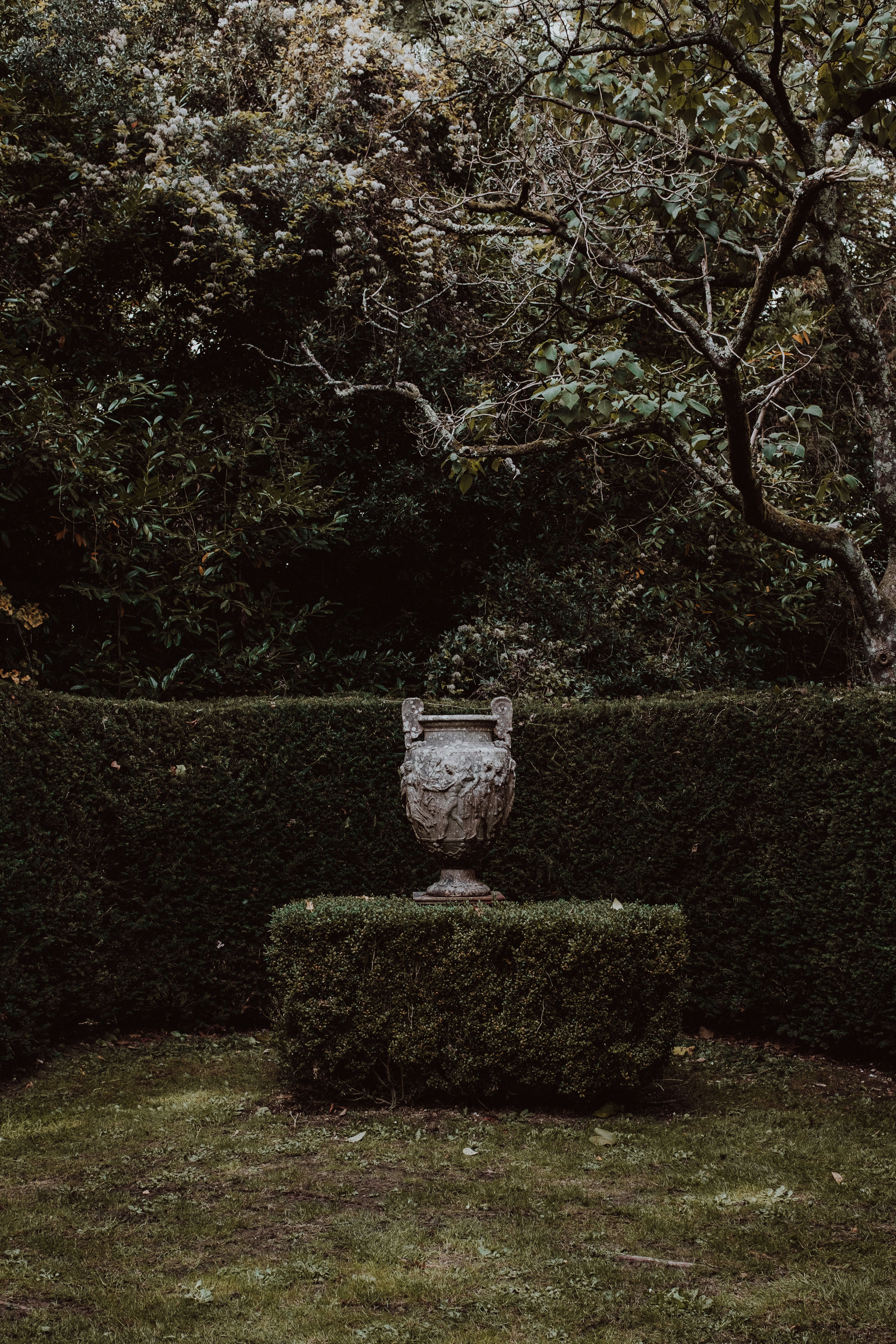
It waited for us in the garden.
When we first arrived, among the pools and fountains and beds of flowers, we suspected it was hiding behind the bushes. There was a faint rustling, but we weren’t sure if it was the wind, or our imagination.
There was a marble bench by one of the pools we flitted around. We were on edge from the rustling, and then we heard a disturbance in the water. Fear came sharply and suddenly, and we fled, past the beds of blue and white hydrangeas, the blue salvia, the white fan flowers, the Chinese fringe tree, looking back only once.
I looked at you as we flew away, with your tinsel tresses and gossamer wings sparkling in the sun. We were children, of course, permanently so, you might say, madly in love, and misbehaving, as fae are wont to do. We were not allowed in the garden, not that garden or any garden, unsupervised and unwatched. But it was summer and before the sun set, I had said we should leave the Land and play in the gardens while the others weren’t looking.
We slowed our pace. My ears were attuned to even the slightest vibration; the faintest tremor in the air sent shivers through me. I don’t remember exactly what garden it was, except that there were nemesia everywhere that year, purple, pink, yellow and white. We could have gone to any garden we wanted to in an instant, just by thinking. It was a smaller garden than Versailles or Hampton Court; I remember little plaques announcing the species, with their Latin names below, but it wasn’t a botanical garden, it was a garden for tall folk to wander in.
In Versailles we would visit each little square garden, and flitter around the fountains. In Hampton Court we always did the maze, trying not to find the way out but to get lost at every possible turn. Here, the garden was a series of descending squares extending from a fading yellow house, at least a hundred years old. Each square was carefully plotted, tended almost perfectly. We were drawn to that type of garden, mostly because it was not visited as often as the others by the tall folk, who were so clumsy and careless, and often said things that upset us, particularly their children with the sight, who would usually look at use in awe but sometimes think we were for play and swipe at us with their little hands.
But we also knew that empty gardens were dangerous, where the evil creatures of our world were drawn to. An untended, unvisited garden, neglected, lonely, even the tall folk who aren’t children can sense the monsters there, the hidden malevolence. The garden we visited that day was tended, but lonely. We suspected it was closed that day to the tall folk, for none of them were around.
But what we feared lurked there too. We could sense it, waiting for us to come by. Like a snake, coiled up, waiting to spring at us. I feared its teeth and its gaping mouth, although I don’t know for sure — does anyone? — if has teeth or has a mouth; but it is best to imagine it so. Danger comes when you drop your guard, when you don’t believe that evil can be real. So easy to forget! Especially when you are full of happiness, full of joy. We were at the top square near the house when we first sensed it, with the leaves of the catamoris, the lamb’s ear, the calamint, all in shadows cast by the old red oak trees shielding the house.
We fled down the hill, through each garden square. We knew it was behind us, but it was getting farther away. It cannot fly like us, and it must hide as it moves, it hates the sun and the bright things in the garden. Then we came upon a pool with a statue of a naked little boy holding two geese. The boy had a gentle smile and was full of delight. He was on an octagonal platform in the middle of the water. There were two urns, one on either side of the statue. The fountain was off that day, or perhaps it had broken, so the water lay still, except faint ripples from a breeze.
It must have come down the steps as we played among the plants and flowers: the spiky yucca, the frilly butterfly weed, the flat-topped umbrels of the yarrow. We were playing a sort of hide-and-seek game, I recall, darting behind the flowers or the statues, oblivious to the danger. We thought it was gone, had given up the chase; we had completely forgotten. You tagged me, and I started the count to thirty. And you thought an urn would be a marvelous place to hide.
But the monster was there, and it gripped you horribly and drew you in, enveloped you in cold death. I felt your short, sharp pain, the instant of agony before the blackness hit. Without fear I went as fast as possible and looked over the edge of the urn. Already I knew my life was nothing without you!
First there was shock, and then a sudden, sharp, painful grief. I flitted about the urn in a panic. I wanted it to take me too, but one was enough for its needs that day. It had swallowed you and was gone, vanished into the air.
My memories of that day still haunt me. The flowers and fountains of the garden world make me think of you; I cannot bear it. I sit in our Land, among our pansies and teacups, stirring in the ethereal winds, in my little wood home covered in pincushion moss, with my wings folded behind me. I think about what waited for us in the garden, and in my dreams, it still waits. I will never forget you or stop thinking about you. Your death will never end my love.
[Richard Simonds is an imaginative writer and poet living in New York City with his loving wife Ji. His speculative fiction has been published in Freedom Fiction, Möbius Blvd, Bewildering Stories and House of Long Shadows. His flash fiction has been published twice in 365tomorrows and Don’t Read This Book After Dark Vol. 3. His poetry has been published in Star*Line, Exquisite Death and the dark poetry anthology Beautiful Tragedies 4 (HellBound Books). His Instagram page is “@richardspoet”.]
 Eternal Haunted Summer