
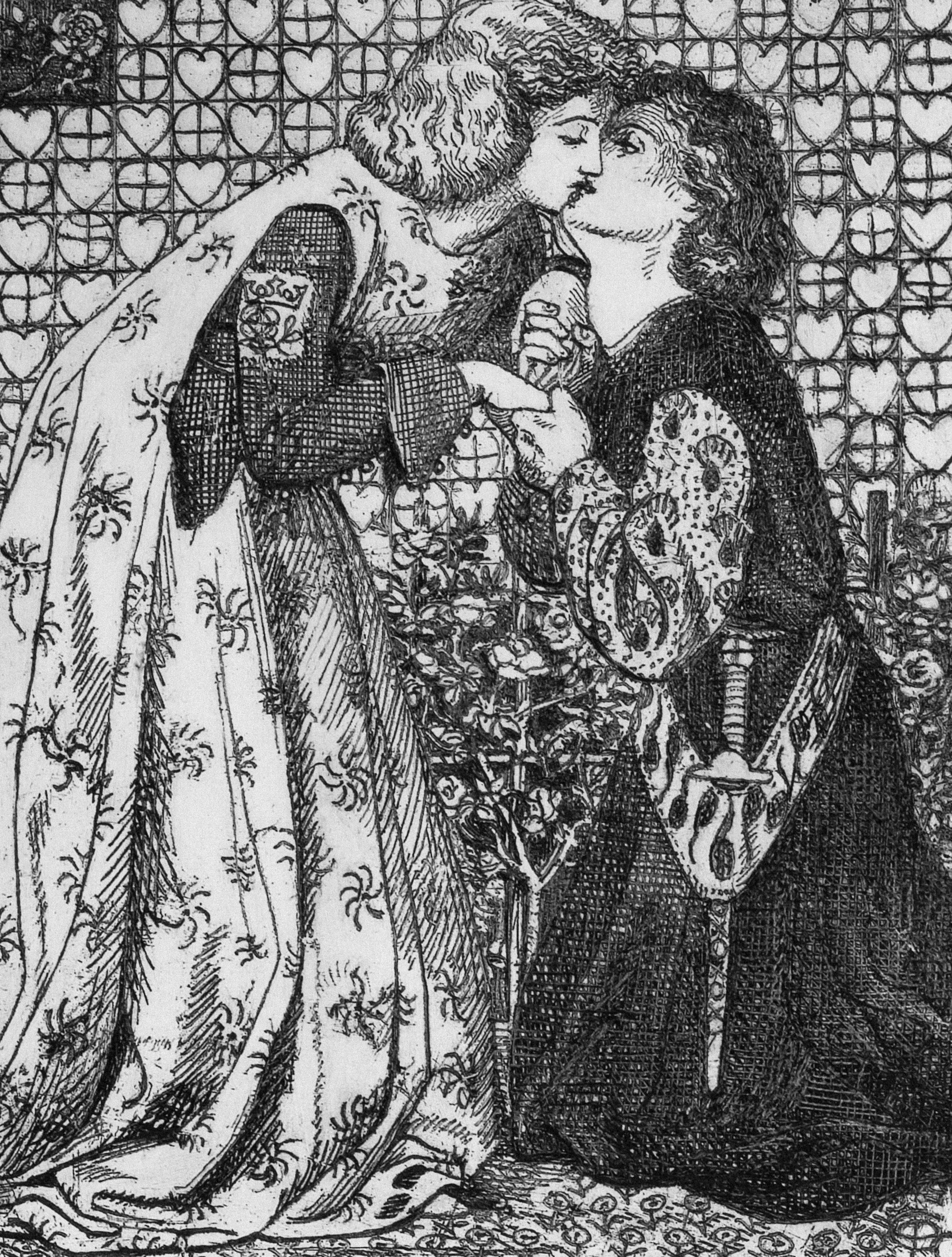
Melusine de Cornouaille ran her fingers through my hair and sighed. She was a Baronne, a Comtesse, and a Marquise by right of three successive marriages. As for me, Arganthael of Lyonesse, I had no title, and my homeland was barred to me.
We lay together in a dim, mossy grotto with a tiny silver stream running through it, a refuge in Melusine’s forested estate. I’d heard disquieting rumors of late, and uneasy due to these intimations, I asked, “Whence comes this sigh, my lady?”
“It’s another marriage, mon cœur,” she said. “This one will be a Pepin. Dux et Princeps, so he’s a step up for me. Unhappily, he is a devoutly Christian lord. As my demesne will shortly be overrun with bishops and exorcists and such, I’m afraid in the natural course we must be parted.”
“Oh!” I wanted to throw my head back dramatically, but as I was already resting my head on Melusine’s thigh while she fed me grapes, this was impossible. Still, I put a hand to my forehead to show my grief. “I am devastated, desolated to hear this! You are all my joy, my delight, my heart of gold….”
“So I am given to understand. Yet, you know, I have such bad luck with husbands. They always die so young … and so soon! It is not at all impossible that we may be reunited.”
“What a relief! But how long shall I have to wait?”
“Who can say?” The marquise adopted a philosophical air. “It’s down to fate, I suppose. And prudence, too.”
“Prudence?”
“My husband’s prudence in employing tasters, alchemists, alicorn horns, and the like. I have developed something of a reputation, after all. I imagine you’ll be returning to Lyonesse during our sad time apart?”
I sat up, and she frowned as I shook my head. “Alas, I have tarried too long in your country and eaten too much of your meat and bread. The way home is closed. Lyonesse, Avalon, Hy-Brasil… all of le royaume des fées is lost to me now.”
“Hm.” She seemed unsurprised. Melusine traced a finger along the shell of my left ear, to rest lightly on its pointed tip. I closed my eyes to luxuriate in her touch.
“This could be a problem,” she said, and I opened my eyes. “The exorcists are skillful at discovering faerie folk. I would be ruined if they learned the evil tales of my … relations were actually true.”
I knew now what was coming, what she had to do, but I decided to play out my part to the last.
“I’ll wear a wimple to hide my ears,” I said, “and sail to Plymouth-town. If I escape the priests, I’ll make my way to Gwynedd where they still keep the old ways. The people there will think me one of the Tylwyth Teg. They’d never dare betray me to their bishop.”
“Very risky,” said Melusine. “And such a sacrifice!”
“For you,” I said, “there is no sacrifice too great.”
We rose together and she kissed me full on the lips. I tasted sweetness and regret.
“Ah, well,” she said. “I suppose I knew this would happen. Come. We’ll share a last stirrup-cup for the road, and then I’m for Chartres to hear the banns read.”
We departed our secret vale and found Melusine’s black destrier waiting patiently by my chestnut pony. The marquise rummaged in her saddlebag, finding an ancient sea-glass bottle and a golden chalice.
“Here,” she said, pouring for me. “You drink first. To a sad parting. But we shall certainly meet again… in the fullness of time.”
Of course I knew what she meant. But for the love we’d shared …. I took a sip and swallowed it down. Black currant wine, sweet and tart, with something added, something familiar, an essence, a taste…. I was so surprised to still be alive I almost dropped the cup.
“The faerie wine of lost Ys,” said Melusine. “The last surviving bottle. I believe it will be enough. Please, drink the rest. Tonight is the dark of the moon. The way home will open for you.”
I couldn’t speak, I was so overcome.
“Did you think it was poison?” She laughed, like music. “I would rather be burned at the stake. Go. Return to your people. And when this marriage is done ….”
“I’ll bring the bottle next time.”
She saluted me, vaulted into the saddle like a chevalier, and just like that she was gone.
[Laurence Raphael Brothers is a writer and a technologist. He has published over 50 short stories in such magazines as Nature, PodCastle, and The New Haven Review. His latest book is “Pâtissier et Étranger” from Brigids Gate Press, a mash-up of baking romance, spy thriller, and science fiction set in 1967 Paris. Check out all his books and stories at http://laurencebrothers.com/bibliography and follow him on Bluesky at @lrb.bsky.social. Pronouns: he/him.]
 Eternal Haunted Summer