
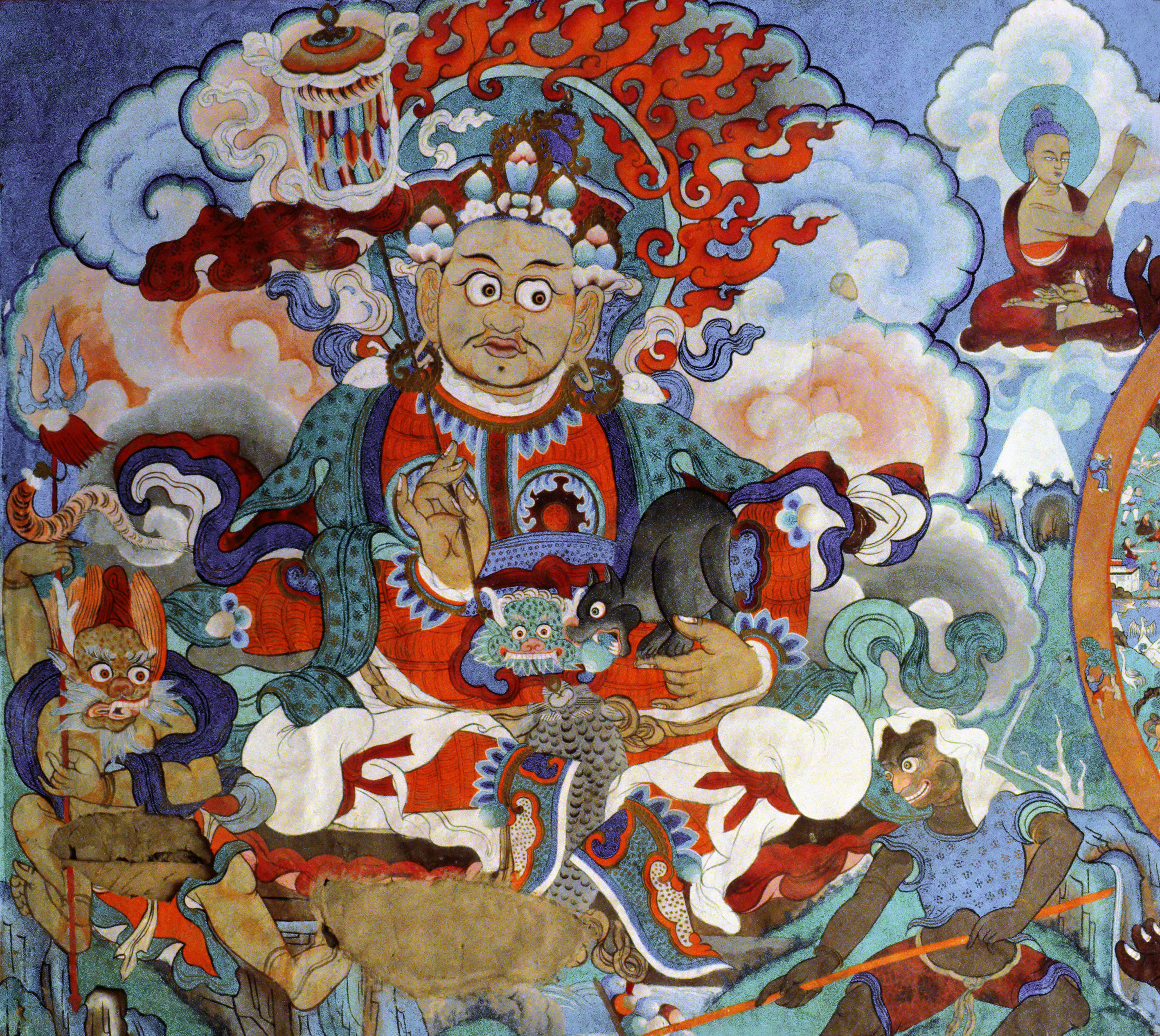
Yakshas and Guhyakas are allied classes of upadevas (Sanskrit prefix upa meaning “close to” or “below”, deva meaning “deity”) — semi-divine beings that feature in all religions originating in the Indian subcontinent.
The Atharva Veda and the Mahabharata describe them as punyajana (the “virtuous or good folk”), while a different version of the Atharva Veda calls them itarajana (the “other folk”). The Buddhist texts Dirgha Nikaya, Samyutta Nikaya, and Vinaya-Pitaka call them amanussa, which the Pali-English Dictionary translates as a half-deified non-human. The Dictionary further connects them with the Western idea of fairies, and with “ogres, dryads, ghosts, spooks”.
“Spirit-deity” (Misra 1981) is perhaps an easier term to acquiesce to. At the end of the Sanskrit epic Mahabharata, warriors fallen in war are said to have attained the status of yakshas and guhyakas, affiliating these beings with the ancestral dead. As if to accentuate their regional authority and constricted reach, such spirit-deities are often referred to as naivasika or dwelling deities (genii loci). A history of worship is evident in the veneration of temples or sanctuaries set aside for the yakshas (Misra 1981, Sterken 2023).
Their actual dwelling place is an enigma. Casually described as nature-spirits or tree-spirits (Misra 1981), the yakshas can be found on banyan and sacred fig trees (Atharva Veda), or cluster fig and white fig trees (Taittiriya Samhita). The guhyakas are described to live in caves (Hopkins 1968). The Mahabharata speaks of holy places and pilgrimage sites blessed by certain yakshas and yakshis (female yakshas), and these might have been their dwelling places as well. When Arjuna, one of the central characters of the Mahabharata, sets out to conquer the world, he reaches a region somewhere in or near modern Tibet, known as “Hataka, protected by the guhyakas”, who he is said to have won over through conciliation (Debroy 2015). The Sanskrit Puranas describe the yakshas and the guhyakas to live and lark about in the mountain Hemakuta in the Himalayas, identified as the mystical Kailasha, also home to the Destroyer god, Shiva. The god of wealth Kubera (popular as Vaisravana in Buddhist thought) is the king of yakshas and guhyakas, and the master of a court brimming with unimaginable wealth in these austere mountains. The Mahabharata imagines it as a floating court, held up in the sky by the guhyakas. In the Sanskrit epic Ramayana, the yakshas and guhyakas are found sporting with their king beside a lake near Kubera’s mountain-palace (Misra 1981).
The Vayu Purana and the Brahmanda Purana give a rather sad account of Vaisravana’s being named as Kubera. The prefix ku implies badness, while bera means body; it is said that Kubera was named so by his sage father for his large, pot-bellied body, and his ruddy complexion (which is also how Buddhist paintings depict him). Some texts render him as excessively deformed, with a small head on a big body and only eight teeth (Misra 1981). Even so, the yakshas are fertility deities and known for their sexuality; while the female yakshis are often conceived as dangerously beautiful and voluptuous, the male yakshas are mostly thought to be closer to their king in appearance. Perhaps that is why they turned shapeshifters, master illusionists. Perhaps that is also why they could turn invisible (Misra 1981). When beautiful, the yakshas are luminous, but when horrendous, they get more descriptors: dark hirsute bodies, pointy ears, dwarfish stature, frightening faces, huge mouths (Sterken 2023).
Another interpretation lets Kubera’s name stem from the Sanskrit root word kumb, which means “to conceal” (Sutherland 1991). Kubera is also called the god of hiding or concealment in the Atharva Veda (Hopkins 1968). His attendants, the guhyakas, are literally the Hidden Ones, owing to their name being derived from the root word guh, which means “to hide, keep secret”. As for yaksha, there’s a tug-of-war for its potential root word, the contenders being yaj and yaksh. In their commentaries on the Rig Veda, medieval scholars Madhvacharya and Sayana both endorsed yaj, meaning “to worship with offerings”, “to sacrifice”, “to consecrate” or “to bestow”. However, most scholars tend to support the Vedic root word yaks, meaning “to move quickly”, “to reveal”, “to be revealed” (Misra 1981), which seems to correlate well with the etymologies of Kubera and guhyaka, and with the Mahabharata describing the yakshas as “swift in speed and with pointed ears” (Debroy 2015). Indeed, Kubera owns the fastest vehicle in the pantheon, a much-coveted flying chariot (vimana) called Pushpaka, which is sometimes drawn by the yakshas and the guhyakas (Misra 1981).
The creation myths of the yakshas also offer some insight into the etymology. The Puranas recount how after a particularly painstaking creative spree, the hunger of the Creator god, Brahma, gave rise to the yakshas. Different texts and their translations put different cries in the mouths of the newborn yakshas: “we shall worship (yakshami) / let us eat (jakshana) / let us destroy (root word kshi meaning to destroy) and cause each other delight!” (Sattar 2016, Wilson 1840, Debroy 2024) All these conflicting meanings match the character of the yakshas.
The yakshas seem to be of ambiguous nature (Sterken 2023): they can at once be the “good folk” of the Sanskrit texts and the murderers of the Pali Buddhist canon. They can impart knowledge, provide wealth and fortune, bless us with children; or they can eat the children (Misra 1981). They can be liberal donors of gifts in the epics; they can be evildoers and robbers in the Shatapatha Brahmana. They can be Sthuna, addressed as both a yaksha and a guhyaka (Amba-Upakhyana Parva, Mahabharata), who exchanged his male organ with the female organ of Shikhandi who wanted to become a man (Debroy 2015). They can be Gumbiya, who lived in a forest and gave travellers poisoned honey so he could eat them (Misra 1981). When the dazzling queen Damayanti is left alone by her husband in the forest, merchants passing by propitiate her as a yakshi — as a blameless, beautiful, good woman — to protect them. When the caravan encounters difficulties, potential-yakshi Damayanti becomes misshapen and inhuman in their eyes (Sterken 2023).
Maybe the guhyakas are slightly exempted from such ambiguity (apart from a throwaway verse calling them cruel-natured) because their stories are not much-known in the texts; thus the aptness of their name, the Hidden Ones. Hopkins (1968) imagines them as gnomes, probably because they might live in caves (guha). In the Ramopakhyana section of the Mahabharata, we see them helping the eponymous hero Rama and his brother when they were beset by their enemy, Indrajit, who could turn invisible. A guhyaka came from the mountains with consecrated water (alternatively, a paste) that enables one to see invisible beings when touched to one’s eyes (Debroy 2015), true to Kubera and his followers’ reputation as being masters of concealment.

More is said about the Guhyaka chief Revanta who, unlike the king Kubera, fits the traditional image of a solar god: a warrior, protector of hunters and travellers, riding a horse, armed with a sword and a shield and a quiver of arrows. Revanta’s lineage might be why the guhyakas are called sun-worshippers (Hopkins 1968). A son of the sun god Surya, his most well-known legend is that of his birth: in some of these stories, he was born as a result of his parents shapeshifting and coupling as horses (Jash 1978). In the Markandeya Purana, Surya says to his son, “When mortals face great fear in forests from conflagrations and other things, or from enemies or bandits, if they remember you, they will be freed from those great calamities” (Debroy 2019).
The Vidyadharas (literally, “wisdom-holders”), a less-celebrated class of spirit-deities in the Indic landscape, might also be a good fit alongside the yakshas and the guhyakas. Their leader is uncertain, but a Buddhist text does give this title to Kubera again (Sutherland 1991). They are fair, wreath-crowned beings, treated as sylphs and fairies (Hopkins 1968) who enjoy watching human combat, strewing flowers in admiration (Mahabharata), while themselves being cowardly and fleeing from danger with their wives (Ramayana). This is unlike the yakshas and guhyakas who are more warlike, especially in their capacity as guardians. The yakshas and guhyakas famously fight against Bhima, another central character of the Mahabharata, who ventures into their domain to collect saugandhika flowers (divinely fragrant; often pictured as blue lotuses) for his wife Draupadi (Debroy 2015). Kubera himself is honoured as a guardian of the directions (dikapala) and a guardian of the world (lokapala). Like yakshas and guhyakas, however, the vidyadharas too rejoice in music and loud laughter (Hopkins 1968). Even though the Ramayana calls them doers of good and devoted to joy, in Jain belief they are regarded as evil creatures. Note that this is again in opposition to the yakshas who are worshipped only in guardian roles in Jainism, while being of more ambivalent nature in Hindu and Buddhist thought.
Even so, from India to Indonesia, the yakshas have been ideated as guardian deities and erected beside temple entrances. In Jain belief, they specifically occur as shasanadevatas (protectors of the teaching) in iconic yaksha-yakshi pairs, guarding the 24 Jain Tirthankaras.
REFERENCES
Debroy, Bibek. Brahmanda Purana Vol 1-2. Penguin Random House India Private Limited, 2024.
Debroy, Bibek. The Mahabharata Vol 1-10. Penguin Books Limited, 2015.
Debroy, Bibek. The Markandeya Purana. India, Penguin Random House India Private Limited, 2019.
Hopkins, Edward Washburn. Epic Mythology. Varanasi: Indological Book House, 1968.
Jash, Pranabananda. The Cult of Revanta in Eastern India. Proceedings of the Indian History Congress. 1978; 39: 990–999.
Misra, Ram Nath. Yaksha Cult and Iconography. New Delhi: Munshiram Manoharlal, 1981.
Sattar, Arshia. Ramayana. Penguin Random House India, 2016.
Sterken, Arjan. ‘Ka asi kasya asi, kalyāṇi?’ The Ambiguity of the yakṣas in the Araṇya Parva of the Mahābhārata. Religions, 2023; 14(1):37. https://doi.org/10.3390/rel14010037
Sutherland, Gail H. The Disguises of the Demon: The Development of the Yakṣa in Hinduism and Buddhism. State Univ. of New York Press, 1991.
Wilson, Horace Hayman. The Vishńu Puráńa. Ganesha Pub., 1840.
[Chandreyee Chakraborty (she/her) is an Indian writer and dancer. She enjoys reading history and fancies herself a photographer.]
 Eternal Haunted Summer