
Introduction: Theories, Revelations, and Poetry
This essay’s theories and opinions came from my common sense, visions, and seventy-five years of traveling with the Fey Folk.
Humans have the innate ability to receive direct revelation instead of having to abide by supposed authorities.
Revelations differ. They should.
Respecting yours does not require disrespecting my own. I trust my personal gnosis, though never blindly, and state it unapologetically, without disclaimers. I support you to do the same.
Often, I can best express my theories through lyric that my Goddess, in Her aspect of Muse, kindly inspires.
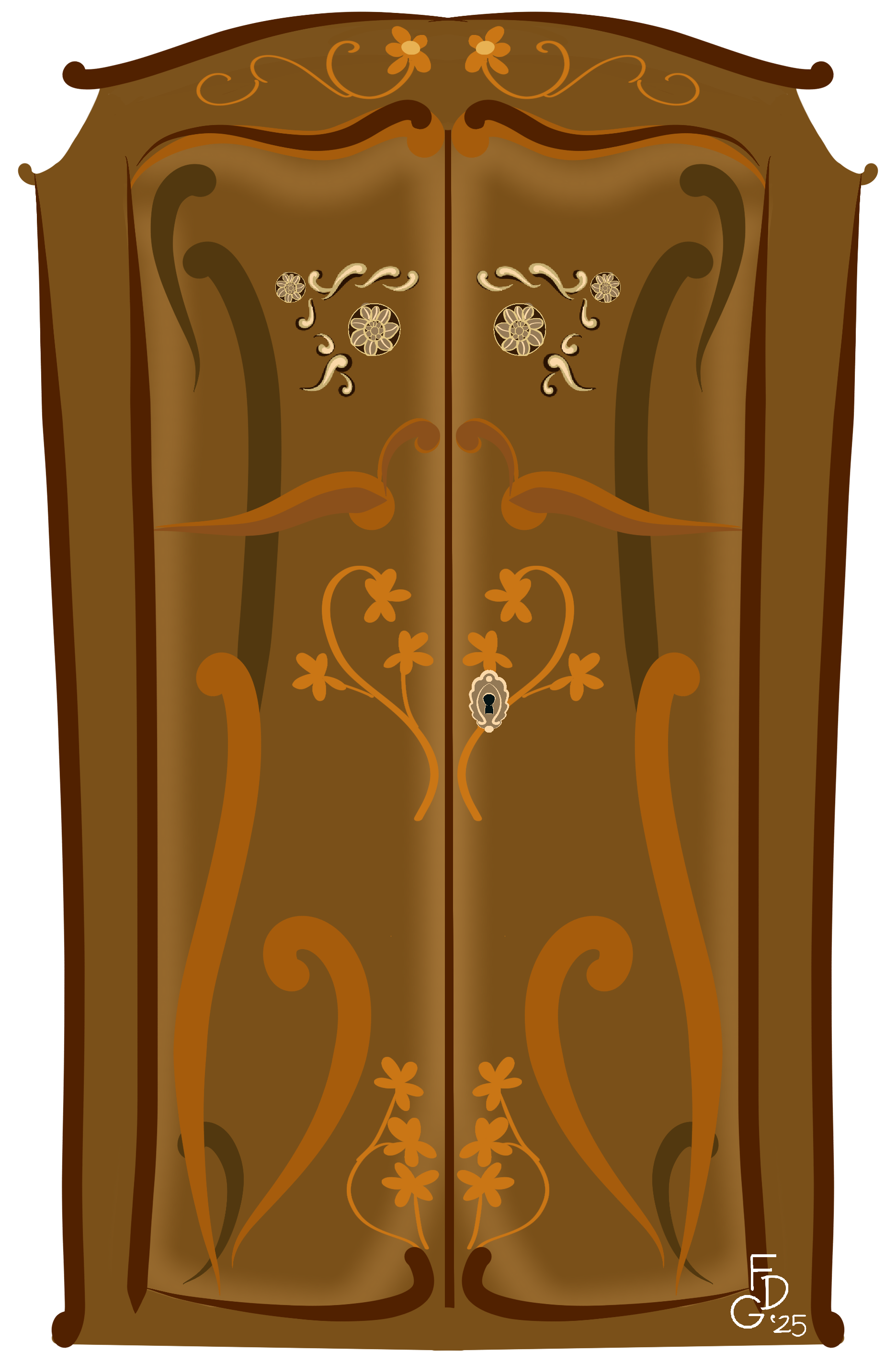
A magic door appeared.
So did its key.
I went to Narnia on an adventure
—a quest for power.
1) A Goddess of Door Hinges: Magical Opportunities Abound
In Juno Covella—Perpetual Calendar Of The Fellowship of Isis by Lawrence Durdin-Robertson, Lawrence describes the Roman Goddess Carna as a “guardian of door hinges, i.e. of … the life of man.”
Lawrence’s description resonates with my belief that opportunities to use magic abound; they surround us every moment. The universe is magical, everything is Fey, we can always access power.
Even door hinges are enchanted. So a wardrobe can open into a Faery realm.
C.S. Lewis’s mysticism allowed him to recognize magic in the commonplace. This insight is rare even among magicians. I suspect the recognition was in Lewis’s subconscious alone. Judging from his overall writings, Lewis viewed a magical wardrobe as a metaphor, other literary device, or whimsy to delight children. But I believe his cells knew the truth. They felt the magic in his books. They knew a mere wardrobe door could be a magical portal.
2) C.S. Lewis: Extraordinary Visions and Sexism
In his Narnia series, C.S. Lewis portrayed the White Witch as a megalomaniac tyrant. But I know her personally. She is the Faery Queen, who is kind and bestows power.
Lewis’s vision and sexism are at odds. In the Narnia adventures, his visions triumph more often than not. The books have a socially acceptable facade of Christianity; prejudices typical of institutionalized Christianity are disguised as virtues and philosophical thought. But the deceptive gloss does not hide the Faery King and Queen’s magic and love filling the texts. At heart, Lewis’s series is all heart.
I believe he channeled magic beyond his own knowing. His sexism and religious prejudices made him portray Narnia’s major villain as female and an enchantress: the White Witch. But he managed to channel many true Faerie mysteries in the Narnia series.
Unfortunately, that does not mitigate the enormous harm caused when his sexism and other prejudices held sway. Enumerating all those sections of the series and what they cost others is beyond the topic of this essay. But it’s vital to state that his prejudices had deadly consequences. Otherwise, I might be implying that they are less severe.
3) Irish Mysticism, the Faery Faith, and Disassociation
C.S. Lewis, though known as an English literary figure, was born in Ireland and identified as Irish. My intuition and common sense told me that must be the case, once I read Narnia.
For one thing, I knew a few male Irish mystic poets. One was born and raised in Ireland. They were torn in half. On one side of the rift was their love of the Goddess and their DNA rooted in the old Faery Faith. On the other side was a Christian upbringing that suppressed Fey longing and other passions for life.
This is not their analysis of themselves. This is mine, from watching their self-hatred including its subconscious aspects, recant of their visions, and abuse of women.
Here’s an example of one renunciation: One of these men wrote a lengthy piece outlining the meaning of a poem he had written. The analysis stripped away the poem’s meaning and passion.
His process of analysis killed his passion. In other words, he left his body, mystical awareness, and intuition behind, so that he could use his intellect alone to analyze the poem. This created a dissociated logic and a dissociated mystic.
The other poet, brilliant in his lyrics to the Faery Queen, confessed to me he loved gaslighting women. He was a therapist.
Not every male Irish mystic poet is disassociated. But it is common.
4) Fey-Touched Mysticism and Magic are Holy … Only in a Christian
Though C.S. Lewis was clearly in touch with magic, he betrayed it. For example, he portrayed it as beautiful and loving when the lion Aslan — a male deity figure — performed spells. But magic was evil in the White Witch. Note the word Witch. The longstanding Christian tactic of villainizing magic unless it’s performed by a male — usually a male God or clergy — oppresses Fey-touched women and their power.
For decades, the Snow Queen has been in my pantheon. She is the Faery Queen in winter. She is the true White Witch. In Narnia, the White Witch curses the world with an eternal bitter winter. But the Snow Queen is known worldwide as benevolent, unlike C.S. Lewis’s cruel despot.
The Snow Queen has consistently been kind to me. She blesses me with her magic, bestows her power on me, and walks beside me in loving companionship.
C.S. Lewis’s evil queen opposes Christmas and Santa Claus. Santa Claus is in my pantheon. The Winter Queen is his loving consort. She and Santa grant my wishes. Santa Claus puts a bow on what I request and gives it to me, if it’s what I really need. They grant my wishes at Yule, but they fulfill my dreams the rest of the year.
6) The Narnia Tale of Creation Vs a Faery Myth
C.S. Lewis’s Narnia mimics the Christian myth of creation. A Biblical God spoke into a void and thus His word caused all of creation. This story is an underpinning of Western culture and one of the most destructive myths of Western culture.
The Narnia creation myth is in The Magician’s Nephew (1955). In it, God, in the form of the lion Aslan, speaks into a frightening, dark void and thereby constructs Narnia.
Both the Biblical and Narnia versions strip away all feminine creation. The womb is scary and foreign instead of beautiful and holy. It is merely a void to be filled. Women are merely tools for men to create children or whatever else they define in words.
I’ve written at length about the destructiveness of the Biblical myth and channeled a highly developed Fey alternative. But in brief:
No mere “word of God” was spoken into the void and thereby constructed the cosmos.
The entire universe was created by a cognizant, living Darkness Who has all power and potential — a loving Goddess.
Darkness is not an empty void. The darkness I see with my closed eyes is the Magna Mater — Great Mother Goddess. In Her are vast expanses of love and potential. She has the means to create everything. So mote it be!
Mind you, Narnia’s creation has beauty. I honor and magically draw on that beauty. Writing his creation myth, Lewis was in touch with magic — the wonderful gift that the Great Mother Goddess gives us.
7) The Spiritual Truths in C.S. Lewis’s Creation Myth
Gods, Goddesses, and other mythological beings manifest when Aslan creates Narnia. Some animals are given the ability to speak.
Then Aslan says, “I give you yourselves. … I give to you forever this land… I give you the woods, the fruits, the rivers. I give you the stars, and I give you myself.”
That is an incredible vision by a brilliant visionary. I interpret it as a Faery Witch, which might offer a different interpretation than C.S. Lewis’s vantage point would provide. Here is my understanding of the vision:
* We are given ourselves: Our Creator gave each human dominion over themself. No clergy can choose our fates, take away our rights to make our own moral decisions, or interfere with our relationships with the Divine.
* We are given God, our Creator: He is not a distant judgmental deity who runs the show whether we like it or not. He gives Himself fully to us because He loves us. He gives Himself to us by walking next to us every moment, helping us each step of the way, bestowing His power on us, and providing luminous companionship.
* We are forever given the land … the woods, the fruits, the rivers, the stars: Yes! I abhor the Christian myth of Adam and Eve being kicked out of the garden of Eden to toil in slavery and misery endlessly.
The Eden myth supports colonizer culture. Supposedly, if you’re a good Christian, you will labor miserably, throughout the day, until the end of your days, with very little show for it. The myth justifies oppressors reaping what others sow.
My Divine Mother would never kick me out of Her garden. Here are song lyrics I wrote about it years ago. I still sing it for students who need healing from colonizer culture:
Both day and night we are healed by our Mother’s hands.
Her garden gates are open wide.
We live within her land.
Her children, we are without shame.
She’ll always understand.
By day, we’re kissed by her sunlight,
then sleep in her dark healing night.
8) Acceptable “Morality”
Immediately after the gorgeous passage in which an endlessly generous God gives everything to his children, Lewis unfortunately adds a “moral” lecture. Aslan warns his children not to become like beasts. It’s as if Lewis thought he could only get away with his inspired visions if he followed them up with acceptably sour morality. Did he hope no one would attack his vision of freedom, autonomy, and bounty if he distracted them with a pompous lecture that returned the moment to Christian repressiveness? Or did he feel so uncomfortable with his vision that he had to distract himself?
9) Shamanism, Adversity, and the Faery Faith
In the Narnia adventures, siblings are sent to the country to escape bombings during World War II. These displaced children discover a magic portal into Narnia, where they go on a quest.
A core premise of ancient Shamanism is that crisis can be a crossroads at which we find power.
Kindly Fey Folk want to help people in times of hardship. So do magical beings in Narnia.
This is timely. Displaced emotionally, economically, or otherwise, we can ask the Faery Queen and King for a magical adventure that empowers us to overcome oppression and help all Gaia’s children live free.
Like the magical beings in Narnia, some Fey Folk help humans, and other Fey Folk sabotage humans. This is not the place to expand on the benevolent and malevolent inhabitants of Fairy realms. But it’s important to point out that both exist.
10) Coming Home from a Quest
When the protagonists Edmund and Lucy learn that they can never visit Narnia again, they are horrified. Aslan explains that it is time for them to get close to their own world.
A premise of Aslan’s dictate is that being thoroughly part of the mundane world means never returning to Fey-touched realms. I disagree. I repeatedly tell my Fairy Witch students that a Fey path combines feet on the ground with head in the clouds.
I do think that we have to constantly leave Fey realms to apply what we learn there to the mundane world. A human is both a magical and worldly creature. We cannot live in visions alone. We must apply them to serve Gaia and all Her children. Otherwise, we spiral down into a self-pitying “spiritual” abyss that we might mistake for noble sacrifice and transcendence. Applying visions must include mundane, practical, quantitative actions.
I also believe there are Fey realms that we are meant to visit only once or a few times. Visiting them more than that is dangerous. Narnia is one of those places.
I’ve been there and brought students with me, and now that is over.
But I still read the Narnia books, watch the movies, and enjoy beautiful memories of my own Narnia adventures.
Those memories are like the eastern sea water in The Chronicles of Narnia. It is not salty water, but fresh and pure. It nourishes beyond food. That nourishment is otherworldly in itself.
Mystical adventures and memories of visions are meant to nourish our spirits, long after a Fey vision or adventure ends. So mote it be!
[Francesca De Grandis is the bestselling author of Be a Goddess! She teaches long-distance classes about Faery Witchcraft. De Grandis is a bard, painter, and innovator. Her Goddess spirituality embraces both mysticism and practical magic. https://outlawbunny.com/newsletter/]
 Eternal Haunted Summer