
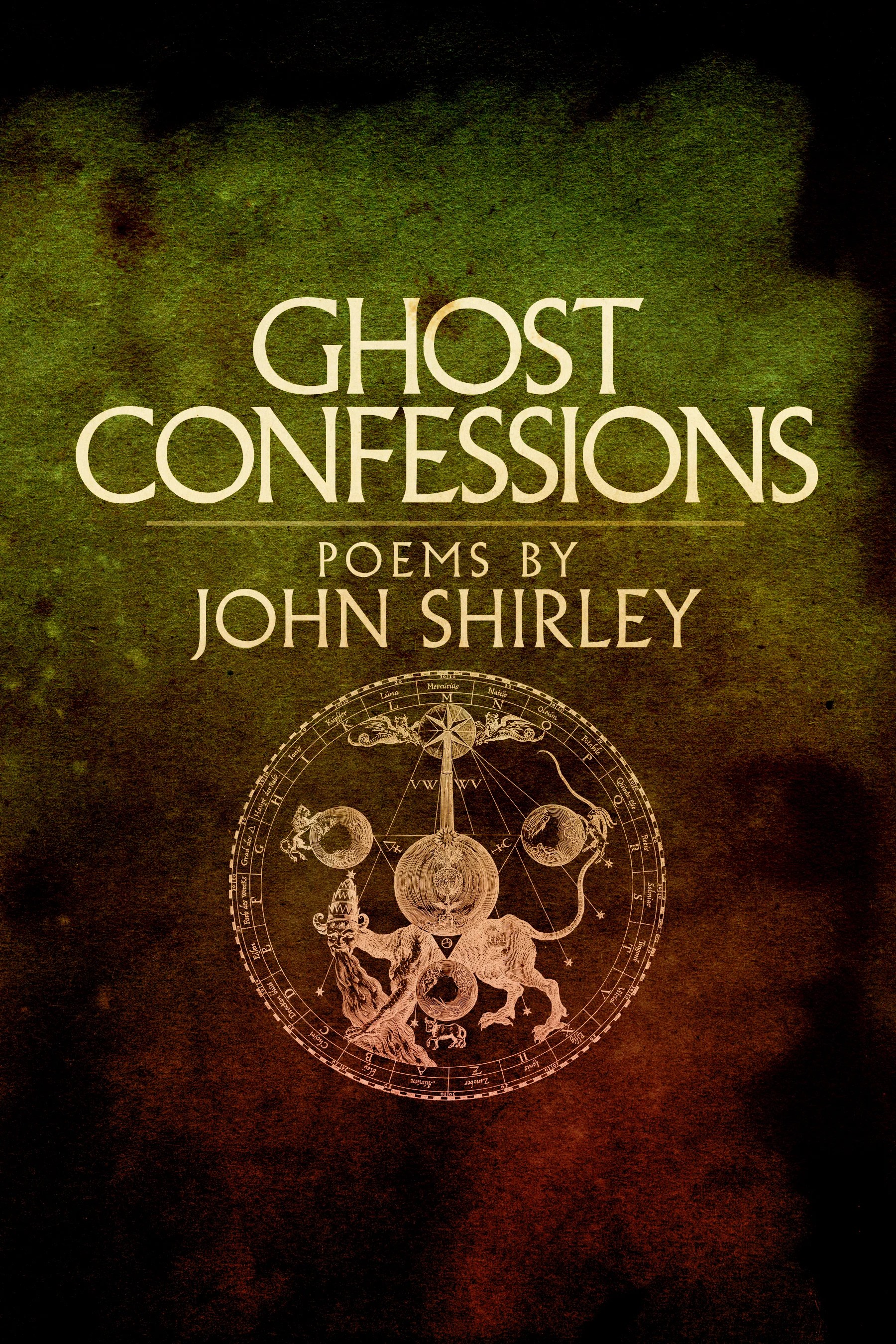
[This issue, we sit down with noted novelist, short fiction author, and poet, John Shirley. Here, he discusses his newest poetry collection, Ghost Confessions; his love of rhyming meter; and his upcoming projects.]
Eternal Haunted Summer: After publishing numerous novels and short story collections, you have now turned your hand to poetry. Is your creative process for poetry the same as it is for prose? Or do you find yourself writing differently (time, location, paper versus computer, et cetera)?
John Shirley: I’ve written poetry for many years, it’s just become more public lately. (Though some was public as song lyrics.) I sometimes handwrite a first draft, transcribe it and revise it. It happens that I often write part of a poem mentally, while taking a walk or working in the garden, say, and then when I get a chance I go in and put down the main idea, any phrases associated with it, on my PC. And develop it there. Most of my poems are based on original core ideas.
EHS: Both of your poetry collections, The Voice of the Burning House and Ghost Confessions, have been released by Jackanapes Press. Why that publisher? Would you recommend Jackanapes Press to other poets?
JS: Certainly, I can recommend Jackanapes. Dan Sauer is a talented Pacific NW publisher and book designer — He’s a graphic artist so I can work with him on the look of the thing and he does a great job. I know him and trust him. He’s published great things by Adam Bolivar, K.A. Opperman, which have done well, and many others, all choices attesting to his good taste. Jackanapes specializes in weird (as in Weird Tales) poetry and prose and he knows the field.
EHS: The poems in Ghost Confessions range from Lovecraftian weird fiction to horror to dark fantasy to eco-dystopian. What draws you to the darker end of the poetic spectrum? Why poems that deal with death and fear and alienation?
JS: I could say, why take the easy way out, with respect to themes? But really, “the darker end” is a successful subgenre of poetry. ST Joshi’s journal Spectral Realms specializes in it. Think of Christina Rossetti, Edgar Allan Poe, Clark Ashton Smith, AE Housman, even Coleridge. Even in mainstream poetry, many’s the poet who mournfully addresses the death of a loved one, or the cruel vicissitudes of life, the bleakness of loneliness or depression. Consider Goethe’s Faust, a play in rhyme and meters, or Milton’s Paradise Lost. Consider TS Eliot’s The Hollow Men. Auden often addresses sadness, and loss; Sylvia Plath, of course. Even Whitman, who can be so joyous, wrote verses speaking to the darkness he saw in the Civil War. And weird poetry provides a frisson, the dark thrill also found in horror films. But a close reading of much of my poetry reveal gleams of hope and of the possibility of justice. Some of my dark poems end on a bright note, like “Houses are Boxes of Drama,” “Two Demons and a Bird,” and “A Ghost Confession.” Also in several of the poems in Ghost Confessions, eg “The Slums of Heaven,” my sense of humor is at work.
EHS: In the introduction to Ghost Confessions, you argue that “Poetry without courage has little to offer.” Which of your poems do you think is the most courageous, and why? And which works by other poets do you recommend?
JS: I don’t know that courage in a poem is something that can be measured by a meter (yes, a pun), like a gas tank indictor, but some poems in The Voice of the Burning House, and Ghost Confessions have a certain boldness, in attempting to hint at the fundamental nature of existence. Like, “Who Plays the Music for the Dance of Chaos,” perhaps, or “The Torrent.” Others make some bold statements, like “Convenience is Doom.” Convenience is doom is a statement that people don’t generally want to hear. But I made it anyway. Brashness in a poem is usually welcome to the reader — because it’s not dull! But it must be distinctive, and, hopefully, eloquent, and even insightful, to justify writing it. One can try.
EHS: All of the poems in Ghost Confessions are rhyming verse. Why do you think rhyming poetry has a bad reputation? What do you think can be done to change that?
JS: I don’t think rhyming has a bad reputation, it just went out of fashion. After all, it’s much easier to write a poem without rhyme. And poems don’t need rhymes — I don’t think the poetry of Homer rhymed, though it is in dactylic hexameter. Homeric poetry was songlike, and was probably sung as often as recited. Many great modern poets don’t rhyme. Also many bad modern poets don’t rhyme. What matters is the quality of the verse itself. Rhyming poetry began to return, to some extent, with the New Formalism in the 1970s, and I think it’s getting another wave of respect, as people are rediscovering its musicality, and the propulsive power in that.
EHS: Many of the poems and sea shanties in Ghost Confessions reference world mythology and folklore. What sort of research went into the collection? Tall stacks of books? Quick jumps onto wikipedia?
JS: While I’ve been known to exploit Wikipedia, I’ve read through many, many books of lore, over the years. When I was young I would find the multi-volume The Golden Bough in the library and pore through that; I read books like The Black Arts by Cavendish, Magick in Theory and Practice by Crowley; books by Joseph Campbell, and Madame Blavatsky; I’ve read WB Yeats’s book about fairies, and as a youngster I absorbed Edith Hamilton’s retelling of Greek myths. I also admire Tolkien, and that led me to read Norse mythology, which was some of his inspiration.
EHS: Your poem “And Then He Died” contains layers of dark satire and social commentary, while “We Are Becoming Demonic Machines” laments the loss of our humanity to alienation and ecological destruction. Do you find poetry to be an effective tool for drawing attention to societal issues? Or is it just a way for the poet to work things out for themself? Or both?
JS: Both, I’m sure. Social issues are never the real focus in the poems, though it involves them; it’s more like a question of metaphysics and justice, and their reverberations in the hidden world. Is karma a social issue? Is consciousness itself a social issue? Those questions have social applications, but there’s a whole ‘nother dimension involved. As for ecology, I do believe that there is a Gaia spirit, of a kind, a global biospheric awareness, that will defend itself, will see its own justice done, as in my poem “Gaia’s Reckoning.”
EHS: Which poem in Ghost Confessions was the most difficult, but ultimately most satisfying, to write?
JS: If I were to choose one … well, I’ll choose two. “Gaia’s Reckoning” and “The Torrent.” They took many drafts till finally I felt — for it is a feeling — that I was “singing in tune”, in a sense; that I was “in the pocket of the beat”. Hard to explain. The sonnets opening the book were also somewhat difficult but gave me great satisfaction.
EHS: Which book fairs, conventions, or other events do you hope to attend in the foreseeable future?
JS: I’ll be a Guest of Honor at the StokerCon, in Pittsburgh in June. It’s the yearly convention of the Horror Writer’s Association — you don’t have to be a member of HWA to attend. I usually do readings of my work at the HP Lovecraft Film Festival in Portland. They’ll soon have a video accessible through their website, of me doing readings of some of my poetry, alongside other writers. Every Halloween I do an appearance with poet and storyteller Adam Bolivar, at the Rose City Book Pub in Portland Oregon, where we read out our own poetry and prose, and I also do interpretive readings of Poe and others.
EHS: What other projects are you working on?
JS: I’m doing some new recording of poetry and songs with prog rock legend Jerry King. Our tracks can be found online at youtube and there downloads of the albums Spaceship Landing in a Cemetery and Escape from Gravity are available. I’m still revising a new horror/urban fantasy novel, Inchy, which I wrote with Marc Laidlaw, and hope to find a publisher for it soon. There are eleven collections of my short stories out there, and I am putting together Grim Gems: The Best Short Stories of John Shirley. I have a new story about to (finally!) come out in The Magazine of Fantasy and Science Fiction … and I’ll be writing for Worlds of If magazine.
More at my site here.
 Eternal Haunted Summer