

[I was thrilled when Rebecca offered me the chance to do a column for Eternal Haunted Summer. I collect art and much of it is pagan/devotional art, so my first thought for what I wanted the column to be was to highlight some of the amazing artists I’ve discovered over the years. So pleased that Lisbeth Cheever-Gessaman agreed to participate as our first artist interview.]
Gerri Leen: First off, welcome to the opening installment of “The Art Gallery” column at Eternal Haunted Summer! I am thrilled you agreed to be my first guest. I love your art and own quite a few prints and I follow your instagram. Always blown away by what you come up with. Before we get into the meat of the interview, what is one thing no one asks you up front about you or your art that you wish they would?
Lisbeth Cheever-Gessaman: There isn’t a specific answer to that because it all depends on my mood, frame of mind, or even the day. But primarily, the soul who is asking the question matters more than all of that. Every moment, every work, every viewer brings its own curiosity and challenge.
But an interesting question that I wish all artists would discuss more is “From where does art come?”
GL: I read in an interview that your canvas is your altar. And that your individual art “serves as talismans and spiritual offerings and prayers to the divine.” How early in life were you drawn to a spirituality in which femininity and mythology was centered? How do you know when it’s time to make a new offering?
LCG: I don’t remember a time in my life that wasn’t linked to the spiritual — my earliest memories involve angels and Mary, and I had a terrific dread and fascination with the moon as a bloodless eye of night which I felt was if not a woman, then definitely feminine. But I do think those memories were an ancient calling back to something that came before, that I have just always been connected to, and always trying to tear through the veils to get closer.
GL: You describe yourself as a “self-taught, visionary artist that merges technology with traditional mediums to create new interpretations (metamorphoses) of myth and archetype.” Your work is seamless, but I imagine the process is multi staged. What can you tell us about your techniques?
LCG: Every work is different, and I don’t know what I am doing until it’s done. That’s literally true for each work. It might start out as a photograph I’ve taken, or a vintage image, or a scribble that looks like something that I coax out. From there, I may print it, or sketch and overpaint it, then run it through an app like procreate, print it again, pour wax on it, scrape the wax off, run it through filters, print it again. A consistent thing is that it’s always composed of many different parts, much like life. An eternal mosaic.
I think two things are a constant: I have a foot in each world, both this and the spiritual and also the analog and the digital. The rest is a dance I am still learning the steps to.
GL: Your use of light is extraordinary and it doesn’t always illuminate what the viewer might expect. Without giving away any of your secrets, how do you view and use light as a tool?
LCG: Every — and I mean every — work I have done began in darkness. That was an intentional decision as I felt myself going through a dark night of the soul when I returned to art after a hiatus of writing and focusing more on music. So I paint the canvas black before I do anything else. That’s where the light is born.
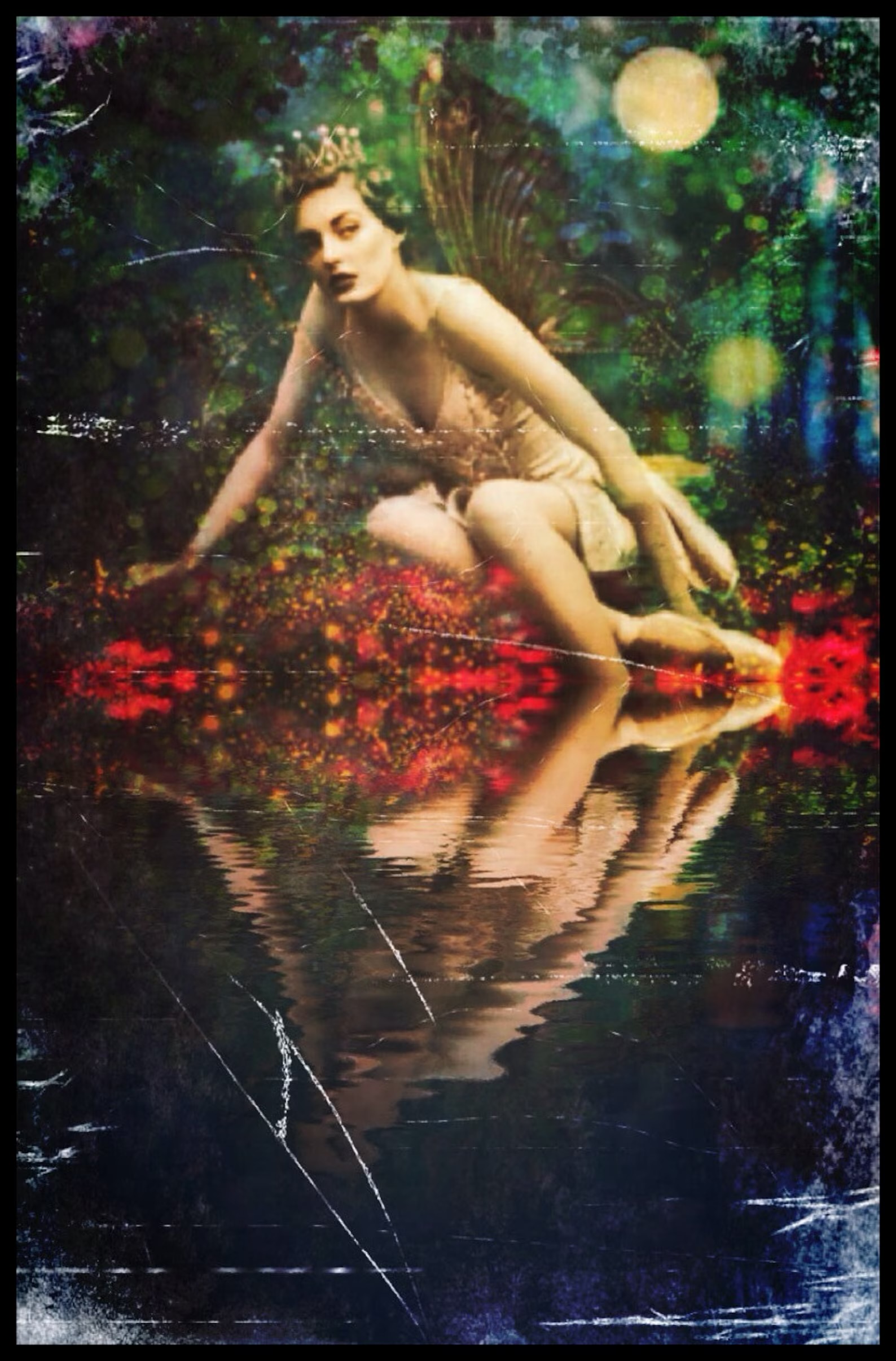
GL: I have quite a few of your prints. There’s a 3D element, both in person and on your Etsy shop, that I find quite remarkable. Like I could just pop into the scene (although I might not be welcome). How do you make them so simultaneously haunting and inviting with so much depth? Is that a goal when you work?
LCG: You are not only welcome in the scene, you are expected. I have always said my work is co-creative, the viewer brings it entirely to life with their own soul and engagement.
I’ve never thought consciously about the depth or dimension of it, so that isn’t a goal at all.
GL: A lot of your work has hints of art deco and art nouveau. And I’m at times reminded of the vibes of Maxfield Parrish or Susan Seddon-Boulet. Are those styles or artists that have been inspirations for you? If not, what directs your style and has it changed over the years you’ve been working?
LCG: Definitely Parrish and Seddon-Boulet are influences, as are all of the Pre-Raphaelites, but there are so many others: Hilda Af Klimt, Annie Besant, Leonora Carrington. And it all changes, although I think thematically there is a thread woven through it all. I do have pieces which I deliberately set out to create to look just like Waterhouse or Leighton to get that out of my system. Very few of those are public however.
GL: Birds (especially corvids), antlers, stars, wings, and leaves appear frequently. For me, when I take in your art, these things seem to both embody the natural world and serve as links between nature/divinity and humans/society. What do they represent to you? Are there other symbols you find yourself repeatedly drawn to?
LCG: That is the mirroring of works and worlds, I think. There is “the language of birds” which influences deeply, but also definitely the winged variety, moons, yes trees, organic shapes, flotsam, moss, seaweed. I am always reaching and seeking the ineffable, and always surrendering to the medium or moment, to see what that brings.
GL: As a fellow creator, I live in two paradigms. Fiction, which typically is “finished” and poetry, which is seemingly always ripe for a little tweaking. Not that fiction can’t be revised, but I don’t reach for that option most of the time whereas I will pick at a poem frequently to make it better. How do you know when a work is done? Does your process allow you to tweak or is there a point where you cannot go back to it?
LCG: I have an incredibly hard time ever seeing a work as “done”. I revisit some things over and over again, because it’s all an evolutionary process. I do get a sense when it’s ready to be born into the world as finished in some sense, but that’s honestly a constant challenge for me.
GL: Do you tend to work on a piece until it is finished or do some sit partially done while you wait for inspiration (or “offline process the concept” as I like to say my muse is doing while I’m waiting for the next part of a story/poem)? I know when I write, I sometimes have a very good idea what I will be creating and other times it’s more “let’s sit at the keyboard and see what comes out.” Do you find the same is true for you or does one method dominate?
LCG: That goes back to that initial thing in the first question, from where does art come? I have never felt that it’s me, I am merely a vessel. The key for me is to empty the vessel, to attune my eyes and being to what’s trying to come and trusting the process of that surrender.
GL: The feminist/feminine rage, mystery, beauty, and love come through so strongly in so many of your works. Where do you channel those things from and do you find you create more quickly or in a different way depending on what inspired it?
LCG: Each work is different, has a different energy and spirit. My job is to just still myself enough to be at one with that, to get myself out of the way as much as possible.
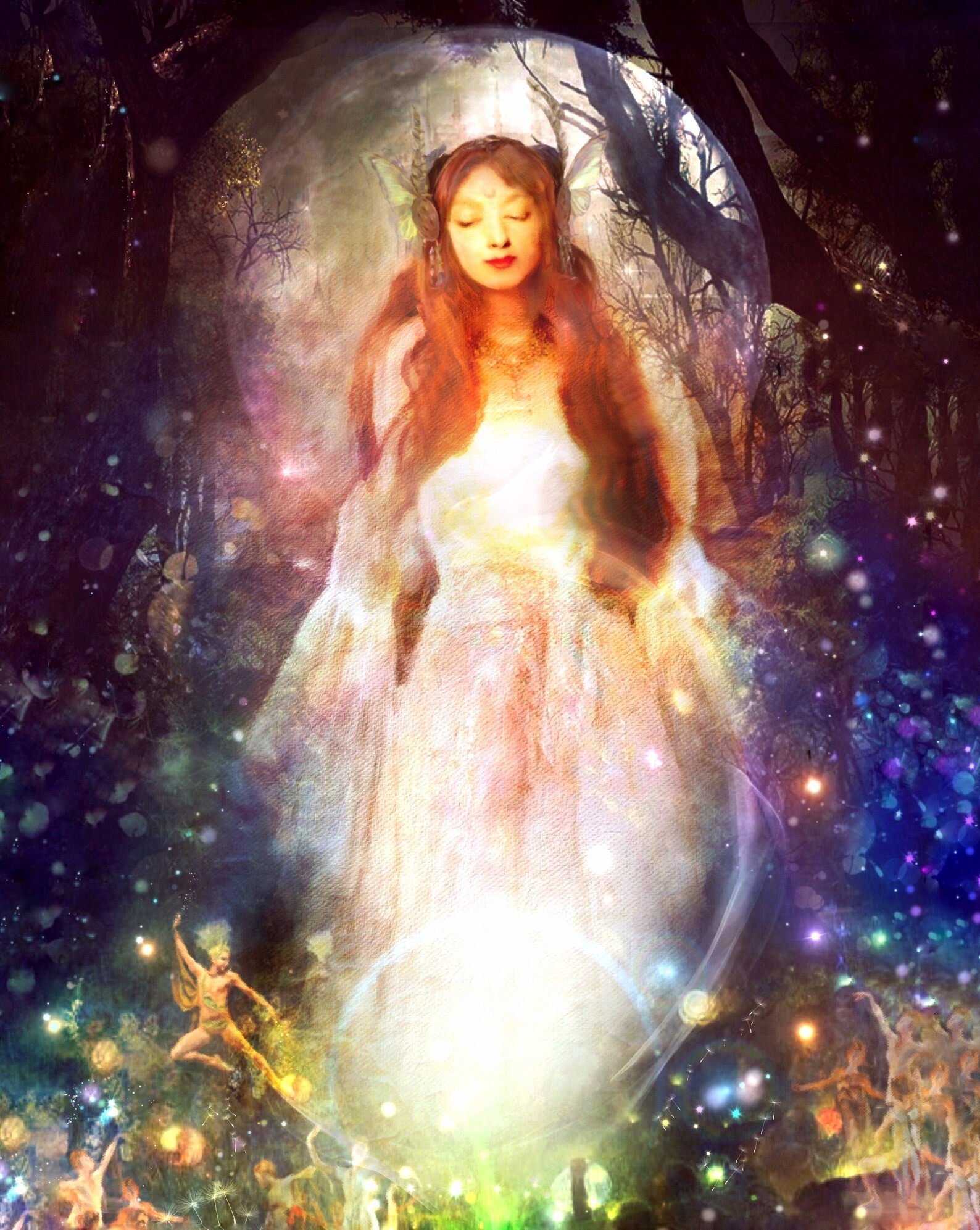
GL: What was it like working on the Spellcasting Oracle Cards? How did the collaboration between the authors and you work? Have you worked on any other similar projects we should know about?
LCG: It was different in that I had no connection with Barb or Flavia while making that, just a manuscript with card descriptions to work with. But I definitely sensed their spirit and the love of what they were seeking to bring, and that was the center of where I created it from. Whereas with The Divine Feminine Oracle, Meggan and I were in almost constant communication to bring forth these women in a way that was invoked from another realm. It was so much more that just a deck — it was a calling. I feel that way still.
And then there is my current project which will be published through Blue Angel Publishing, The Oracle of SheWhoIs which is in the final stages of editing right now. That is wholly written by me, and a project I’ve been working on for years. It’s an archetypal, spiritual journey of art, soul and spirit and nothing like anything I’ve ever done before.
GL: I know after seeing your gorgeous work some will be wondering if you ever do book covers. Is that a possibility? (If yes, what’s the best way to get in touch with you?)
LCG: I’ve actually done a ton of book covers — too many to list, but as time allows, I enjoy helping writers bring their own work to life. The best way to get in touch with me is through email at she@shewhoisart.com.
Links
Website: https://www.shewhoisart.com
Facebook: facebook.com/shewhoisart
Instagram: @shewhois
Etsy Store: https://www.etsy.com/shop/SheWhoIsArt
 Eternal Haunted Summer