
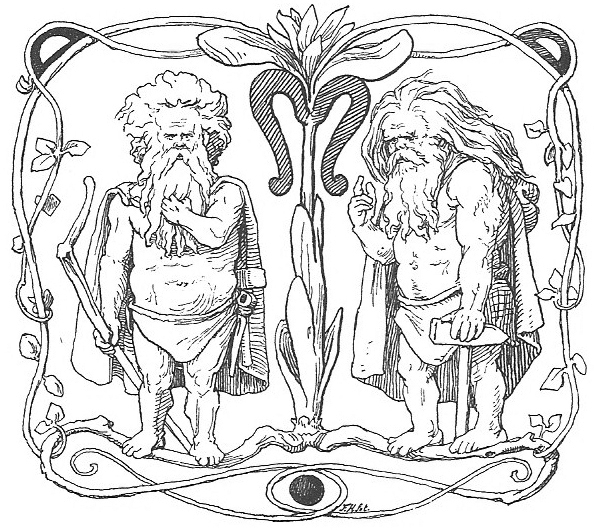
Our Germanic word which occurs as English dwarf, Swedish dvärg, Icelandic dvergr and Dutch dwerg is of uncertain origin but possibly related to Sanskrit dhvara, dhvaras (a demonic being) and Greek σέρφος (little insect) (Svenska Akademien 1925:2407). Such an etymology would fit in rather well with the Norse story of the origin of dwarfs as maggots in the flesh of the dead giant Ymir.
Dwarfs have long been associated with mining, as we see with the story of Snow White and the Seven Dwarfs, one part of the corpus of fairy tales collected by the German philologists Jakob and Wilhelm Grimm. This association also shows up in some of the mineral words in use today.
The German word Quarz has become a mineralogical internationalism, occurring inter alia as English and French quartz, and Swedish and Danish kvarts. Quarz possibly derives from querk, a dialect form of German Zwerg (dwarf) cf. the Norwegian word dvergstein (crystal – literally ‘dwarf-stone’. This would then be comparable to the origins of the other German mineralogical terms Nickel and Kobalt (Hellquist 1980:533). Possibly also relevant here is the Danish Jutland dialect word dverghammer, referring to ancient stone axes (Dahlerup, V. 1921:1153). It seems that people would sometimes find prehistoric stone axes and attribute them to dwarfs. There is an association with big rocks, mainly cliffs, of the Norwegian dialect word dvergmaal, found in Old Norse as dvergmáli, meaning ‘echo’, literally ‘dwarf-speech’ (Falk & Torp 1903:122).
An alternative possibility is that Quarz is of Slavonic origin. This would make sense as German mining went on for centuries in areas that were largely Slavonic-speaking. For instance, the German and Czech languages coexisted in some areas for centuries. On the other hand, it is characteristic of the standing of Latin that Jan Hus – later burnt at the stake by the Roman Catholic Church for his religious views – from 1406 to 1412 wrote his treatise De orthographia bohemica (On Bohemian orthography) in Latin. His orthography with its diacritic signs is the basis for that used in the Czech language today (Skála 1969:165). Quarz may derive from a Czech mining term with the root tvrd- (hard, solid), perhaps the word tvŕz (stronghold, fortress) [> hard rock]. A supporting piece of circumstantial evidence is that there is a number of other German mining terms of Czech origin e. g. Düse (nozzle, jet) from Czech duše (Черных 1994:391). A variant of this “hardness” Slavonic etymology is the proposition that the “original” word was the Polish dialect form kwardy (hard), which then gives German Quarz. Along these lines, Alexander Brückner’s Polish etymological dictionary gives Polish kwarc as coming from German Quarz which according to him comes from the Polish dialect form kwardy, a variant of standard Polish twardy (Brückner 1927:286). This would make Polish kwarc a kind of returned traveler.
Even if the Slavonic non-dwarf etymology should be the correct one, the close association of dwarfs with quartz is undeniable.
I can see that this kind of mixture of Norse, German and Slavonic elements may seem to risk being all over the place, but different languages really do interact with each other, sometimes in unexpected ways. For instance, a standard work on the historical morphology of the Ukrainian language includes an attestation from the year 1063 in the Cyrillic alphabet: ана ръина (Німчук, В. В. et al. 1978:27). This ana reina i.e. Anna Regina was the current Queen of France, of East Slav origin, who in this instance signed her name in Latin but in her native Cyrillic alphabet. This is perhaps an extreme rather than typical example, but I think it makes the point that the different nations with their languages are not sealed off from one another.
These interactions between languages have taken place in addition to the fact that most languages of Europe, and many beyond, are descended from the Indo-European protolanguage. For example, Old Persian ardata, Old Irish arggat, Welsh arian, Cornish arghant, Middle Breton argant, Latin argentum and Greek ἄργυρος all designate the metal ‘silver’. They are descended from a Proto-Indo-European root which meant ‘shining’, ‘white’ (Туманян 1978:168-169). The same root is also found, with the early non-metallic meaning, as the Greek adjective ἀργός (white, shining) (Туманян 1978:116). I did not pick this example completely at random. In contrast to the bogus digital pseudo-money which the swindling bankers are trying to foist upon us, the colors of the metals – particularly gold and silver – are important properties for their use in real money. Karl Marx discusses this point in some depth. Concerning the etymological connection of the names of such metals with color designations, Marx cites none other than Jakob Grimm’s work Geschichte der deutschen Sprache (History of the German language) (Marx 1961:130). Yes — this is the same Jakob Grimm whom I mentioned earlier as the collector (along with his brother Wilhelm) of the story of “Snow White and the seven dwarfs.”
As for interactions between languages, we should keep in mind that not all Indo-European languages have kept the original Indo-European word for ‘silver’. The Germanic (e.g. English silver), Baltic and Slavonic languages have borrowed another word from an uncertain non-Indo-European source. We see this point particularly clearly with the twelfth-century translation of Greek φιλαργυρία (filarguria – love of silver) into Old Russian as сребролюбие (srebroliubie) (Вялкина 1964:110).
We see intercultural influence again where Swedish chemists named the elements they discovered after German subterranean dwarfs.
Because nickel usually occurs mixed with other elements, it took a long time before people recognized its independent existence. This is reflected in the very origin of the name. The word nickel comes from modern German Kupfernickel, which meant ‘copper-devil’, because it seemed like copper but really was not. The discoverer of nickel was not a German, but instead the Swedish chemist Cronstedt in 1751 who alluded to this German miners’ tradition of a subterranean goblin in deriving the name for his chemical discovery (Hellquist 1980:696). Low German (de) Nickel is still used today in the sense of ‘obstinate person’ (Brunnert 1994:220)
The English word cobalt comes from German Kobalt (Амосова 1956:151). This word had its turn been derived from Kobold, which was supposed to be a kind of gnome or goblin who lived underground and stole silver and replaced it with cobalt, which used to be regarded as worthless. Since silver is used in such large amounts for minting coins, it is easy to see why people were so fussed about this. Kobold seems to be derived from Koben – related to English cove – which means ‘shed’, and walten – related to English wield – which means ‘to govern, have power over’. Thus the original meaning of Kobold would have been something like ‘house-spirit’ (Wasserzieher 1922:148-149). The metal cobalt was first isolated in 1739 by the Swedish chemist Georg Brandt (Carlquist & Carlsson 1959:399).
It is striking that the Old Norse Niflung — German Nibelung — saga ascribes a significant role to Andvari, a cunning dwarf who owns a huge treasure of gold. The Rhine river is connected with it, although already in the nineteenth century the Russian historian Granovskij pointed out that in this Norse saga Rin or Hrinn really functions just as a general river designation rather than specifying the German (and French) Rhine (Грановскій 1892:424).
Notwithstanding the native Germanic traditions about dwarfs, there has clearly been some influence from other cultures. For instance, some Norse sagas feature dwarfs who willingly or unwillingly help the heroes in the same way that some nains (dwarfs) serve heroes in French poems about King Arthur and his knights (Halvorsen 1958:378). This sort of ambiguity has a parallel with the Norse stories of dwarfs making valuable objects and weapons for the gods, but usually unwillingly and involving plenty of strife (Hafstein 2003:33).
So, let’s take a look at some of the French — and with them — Celtic sources.
Under Roman rule, mining of metals was economically important in the Armorica region of Gaul. This included mining for tin, lead, silver and zinc at Poullaouen-Helgoat and gold at Besné (Abalain 2000:9). Later on, events elsewhere in the Roman Empire had immense effects on Armorica. In the middle of the fifth century CE the Germanic Angles, Saxons and Jutes started to conquer Britain. They established their own Germanic kingdoms and killed the Romanized Celts or drove them to the north, to the west coast of Britain, and over the sea to the peninsula of Armorica, which is now called Bretagne (i.e. ‘Britain’) in France (Неронова 1982:275).
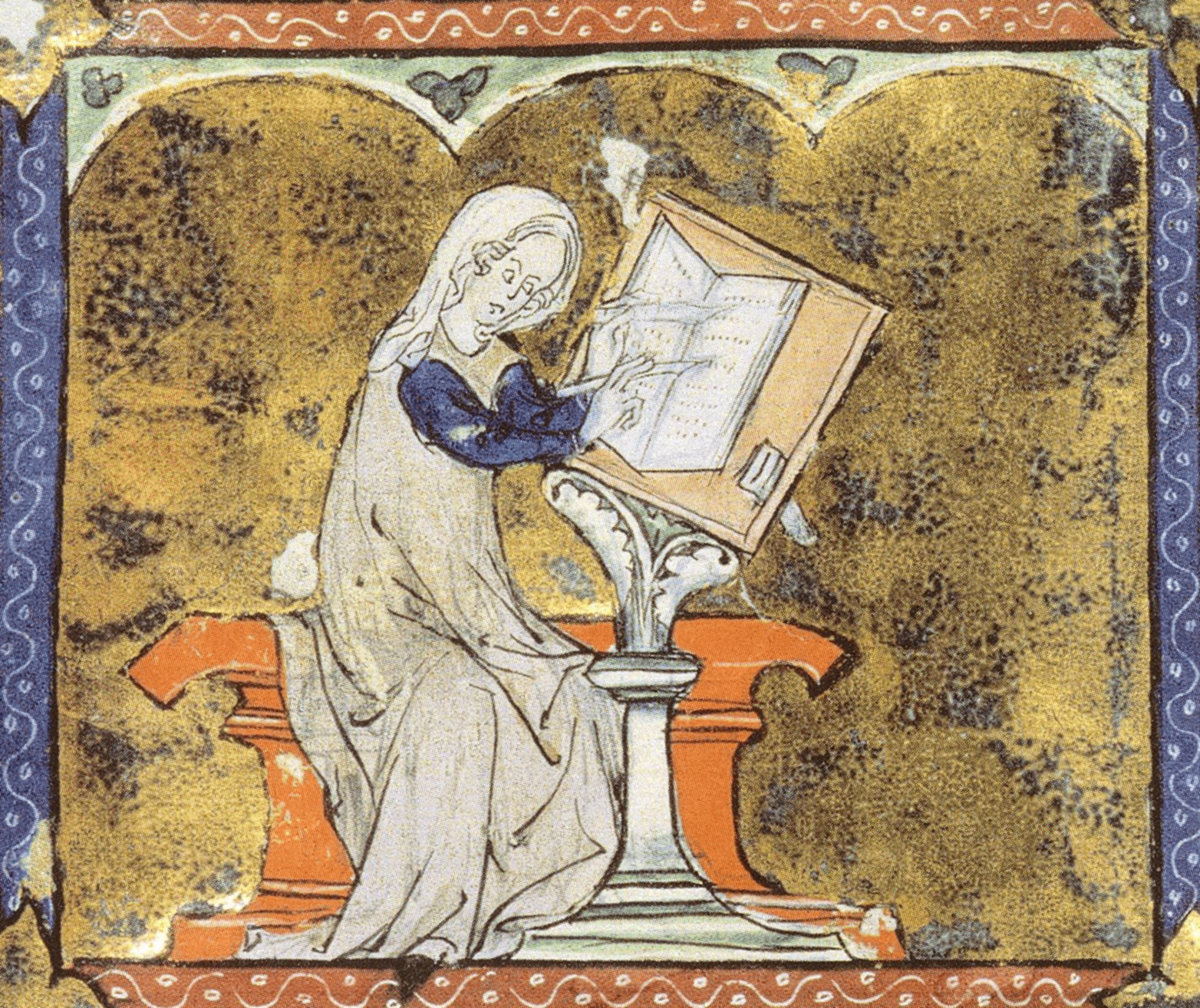
In the second half of the twelfth century, Marie de France wrote a number of stories in Old French verse which she called lais in reference to the music which accompanied the Breton stories which she retold in her French verses. These were translated into Old Norwegian at the behest of King Haakon in the early thirteenth century (Paasche 1924:438). It is perhaps unsurprising that here we find a dwarf, who has various items of gold and silver kitchenware, maliciously tricking an unsuspecting knight (Cook & Tveitane 1979:127-131). In another lai, the eponymous main character is Bisclavret, a name which according to Marie de France means ‘werewolf’ in the Breton language. She also states that the Norman equivalent is Garulf. This knight is indeed a werewolf. At the end of this story, the Norwegian translator helpfully adds his own eyewitness account of a werewolf, a wealthy Norwegian farmer whom he had seen in his childhood (Cook & Tveitane 1979:98-99). This gives us an insight into the way Marie de France’s Breton stories in Old French interacted with Norse culture.
It may not be immediately obvious how much knowledge Marie de France had of the Breton language, but we are well informed about her use of Old French. For instance, during the Middle Ages, Old French texts had two ways of rendering the past imperfect tense, an etymological one based closely on Latin and a developed French form which reflected more closely the reality of the spoken French language. Unlike many authors, Marie de France employed both alternatives in her writing. This is unusual, although not quite unique – the alternatives also co-occur in the Song of Roland and the Romance of Troy (Скрелина 1973:92). It is clear that Marie de France was no dogmatic Latinizer. For instance, she employed the Old French particle en in a different way from its etymological “ancestor”, the Latin adverb inde (thence) (Реферовская 1980:122-123).
The works of Marie de France retained their popularity over the centuries such that, before the use of printing, they continued to be copied by hand into the fifteenth century. By this time the spoken language of the French copyists was no longer Old French but Middle French, which, unsurprisingly, had its effect on how the copyists to some extent rewrote the text (Parussa 2000:29).
In the twentieth century, the linguist Gerhard Rohlfs wrote an introductory textbook titled Vom Vulgärlatein zum Altfranzösischen (From Vulgar Latin to Old French), which introduces the Old French language assuming the student already knows Latin. The heart of the textbook is Marie de France’s Bisclavret. Rohlfs takes us through the whole lai, two lines at a time, explaining vocabulary and grammatical features as they come up. On the way, he deals with such things as the Celtic etymology of lai and the Latin etymology of French fée (fairy). Among other things, he affirms the Celtic etymology of the word Bisclavret (Rohlfs 1960:100) and the Germanic etymology of Garulf. He derives the latter from Old Frankish werwulf and adduces Swedish varulf as a modern relative (Rohlfs 1960:101).
I decided to check these werewolf words in independent sources and managed to find varulv — which is in line with more modern Swedish spelling than that used by Rohlfs — attested in a Swedish Academy dictionary which explains it as a man who, according to folk belief, can change into a wolf (Gellerstam 2003:1006).
The Breton werewolf name Bisclavret was a bit more of a challenge. I looked it up in a modern Breton dictionary, but could not find it. That comes as little surprise — after all, the language has changed over the centuries. I then tried looking up loup-garou in the French-Breton section. Success! This entry included the modern Breton form bleiz du with the note “cf. lai Bisclavaret” (Favereau 2000:1103). If these werewolf words are any indication, it looks like not only her modern commentators but also Marie de France herself knew what she was on about with her references to the Breton language in her deservedly famous lais.
REFERENCES
Abalain, H. 2000 Histoire de la Langue bretonne (Editions Jean-Paul Gisserot, Quintin)
Brückner, A. 1927 Słownik etymologiczny języka polskiego (Nakład i Własność Krakowskiej Spółki Wydawniczej, Kraków)
Brunnert, C. 1994 Wie et hett un wat et is (Grobbel Verlag, Schmallenberg-Fredeburg)
Carlquist, G. & Carlsson, J. (Huvudredaktörer) 1959 Svensk uppslagsbok (Band 16) (Förlagshuset Norden AB, Malmö)
Cook, R. & Tveitane, M. 1979 Strengleikar. An Old Norse Translation of Twenty-one Old French Lais (Kjeldeskriftfondet, Oslo)
Dahlerup, V. et al. 1921 Ordbog over det danske Sprog (Tredje Bind) (Gyldendalske Boghandel – Nordisk Forlag, København)
Falk, H. & Torp, A. 1903 Etymologisk Ordbog over det norske og det danske Sprog (Første Bind) (Forlagt af H. Aschehoug & Co. (W. Nygaard), Kristiania)
Favereau, F. 2000 Dictionnaire du breton contemporain. Geriadur ar brezhoneg a-vremañ (Embannadurioù Skol Vreizh, Morlaix)
Gellerstam, M. (Redaktör) 2003 Svenska Akademiens ordlista över svenska språket (Svenska Akademien, Stockholm)
Hafstein, V. T. 2003 Groaning Dwarfs at Granite Doors Fieldwork in Völuspá Arkiv för nordisk filologi Vol. 118 pp.29-45
Halvorsen, E. F. 1958 Dverger col. 376-378 in: Karker, A. (Dansk redaktør) Kulturhistorisk leksikon for nordisk middelalder fra vikingetid til reformationstid (Bind III) (Rosenkilde og Bagger, København)
Hellquist, E. 1980 Svensk etymologisk ordbok (Första bandet) (LiberLäromedel, Lund)
Marx, K. 1961 Zur Kritik der Politischen Ökonomie pp. 3-160 in: Marx, K. & Engels, F. Werke Band 13. (Dietz Verlag, Berlin)
Parussa, G. 2000 De l’ancien au moyen français, ou comment transcire les ‘Fables’ de Marie de France au XVe siècle? Travaux de linguistique et de philologie XXXVIII, pp. 27-50
Paasche, F. 1924 Norsk Litteraturhistorie (Første bind) (Norges og Islands Litteratur indtil utgangen av middelalderen) (Forlagt av H. Aschehoug & Co. (W. Nygaard), Kristiania)
Rohlfs, G. 1960 Vom Vulgärlatein zum Altfranzösischen. Einführung in das Studium der altfranzösischen Sprache (Max Niemeyer Verlag, Tübingen)
Skála, E. 1969 Stabilität der Norm in deutschsprachigen Quellen der Tschechoslowakei aus dem XVI. und XVII. Jahrhundert pp. 159-172 in: Гухман, М. М. et al. (Редколлегия) Норма и социальная дифференциация языка (Издательство “Наука”, Москва)
Svenska Akademien 1925 Ordbok öfver Svenska språket (Sjunde bandet) (C. W. K. Gleerups Förlag, Lund)
Wasserzieher, E. 1922 Woher? Ableitendes Wörterbuch der deutschen Sprache (Ferd. Dümmlers Verlagsbuchhandlung, Berlin)
Амосова, Н. Н. 1956 Этимологические основы словарного состава современного английского языка (Издательство литературы на иностранных языках, Москва)
Вялкина, Л. В. 1964 Сложные слова в древнерусском языке в их отношении к языку греческого оригинала (На материале Ефремовской кормчей) pp. 94-118 in: Аванесов, Р. И. (Ответственный редактор) Исследования по исторической лексикологии древнерусского языка (Издательство “Наука”, Москва)
Грановскій, Т. Н. 1892 Пѣсни Эдды о Нифлунгахъ pp. 407-424 in: Грановскій, Т. Н. Сочинения Т. Н. Грановскаго съ портретомъ автора (Часть I) (Типографія А. И. Мамонтова и Ко, Москва)
Неронова, В. Д. 1982 Вторжение варваров и крушение Римской империи pp. 269-277 in: Дьяконов, И. М. et al. (Редакционная коллегия) История древнего мира. Упадок древних обществ (Главная редакция восточной литературы издательства “Наука”, Москва)
Німчук, В. В. et al. (Редакційна колегія) 1978 Історія української мови Морфологія (Видавництво “Наукова думка”, Київ)
Реферовская, Е. А. 1980 Формирование романских литературных языков. Французский язык (Издательство “Наука”, Ленинград)
Скрелина, Л. М. 1973 Некоторые вопросы развития языка (проблемы и методы диахронического исследования) (Издательство БГУ им. В. И. Ленина, Минск)
Туманян, Э. Г. 1978 Структура индоевропейских имён в армянском языке (опыт реконструкции) (Издательство “Наука”, Москва)
Черных, П. Я. 1994 Историко-этимологический словарь современного русского языка (Том I) (Издательство “Русский язык”, Москва)
[Doctor Neile Kirk’s most recent work has appeared in Aothen, Eternal Haunted Summer, NewMyths and Utopia Science Fiction magazine.]
 Eternal Haunted Summer