
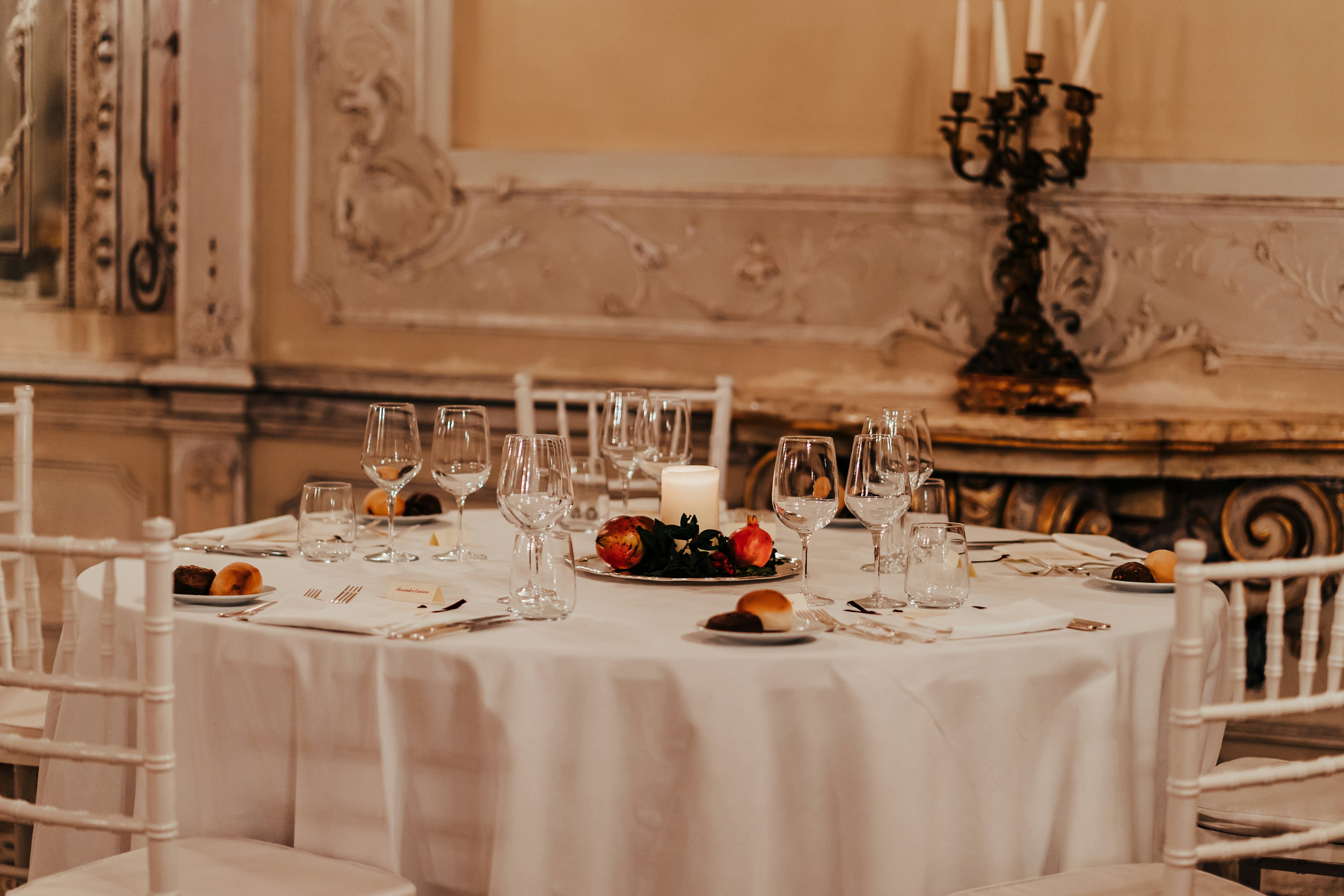
The maître d’hôtel looked up and saw three women approaching his podium. His restaurant had just opened in a prime location, below Coit Tower on Telegraph Hill, and they were booked solid for weeks to come. The sun was setting, and fog was rolling in over San Francisco Bay, marking the restaurant’s busiest time. There was no hope of a free table, and the host was sure there was no booking for three at this hour, but he always hated to turn away casual diners. Of course, there was always the chance they were part of a quad, the fourth perhaps looking for a place to park.
“Mesdames?” he asked.
“I spin,” said the youngest of the three, slender, pretty, dressed in red cotton, but rather cold-eyed withal. Though her hands were empty, the maître d’ suffered a momentary flash of blurred vision during which he saw her holding a spindle wound with shimmering gold thread.
“I measure,” said the second, mature, chillingly beautiful, but if anything, even more severe in demeanor. Her garment was spun from white silk. For an instant she seemed to be holding a slender silver baton ruled with fine lines.
“I cut,” said the third, who was older, with a refined elegance and self-possession that took the maître d’s breath away. She was dressed in black linen, and her hand was positioned as if holding a pair of red-handled shears.
The maître d’ looked into the abyssal depths of her dark eyes and his heart stopped beating. Coldness expanded outward from the icy core in his chest, and his vision dimmed and shrunk to a narrow, fading circle before the woman in white silk put her hand on the older woman’s arm.
“Atropos! You should be more careful!”
“Sorry, Lachesis,” said the woman in black, “force of habit.”
The host felt a sharp spike of pain in his chest followed by a pulse of warmth as his blood began once more to flow. He staggered but caught himself by gripping the edge of his podium. He took refuge in the ritual utterances required of his role.
“Do mesdames have a—”
“Moirai,” said the white-clad woman, Lachesis. “Table for three.”
“Of course,” said the maître d’ doubtfully, referring to his leather-bound book. “Let me see…. Oh! Yes, indeed: seven o’clock—” He looked up. “Pardon me, madame, but you have a table for four, do you not?”
Lachesis frowned. “I’m quite sure I made the reservation for three.”
The girl in red coughed and Lachesis turned to face her.
“No,” said the girl, “don’t even start. I swear it wasn’t me. I just think— Someone might show up. By chance, you understand. Or good fortune, perhaps….”
“Clotho,” said Lachesis severely, and a shiver went down the host’s spine. This time it was the older woman, Atropos, who interrupted.
“Now, Lachesis. Clotho wouldn’t lie. Not to us.”
“Hmf. Very well.”
The host escorted the women to their table, by a picture window overlooking the bay. Pale mist swirled in the looming darkness around Alcatraz to the north. The mournful note of a foghorn sounded in the distance. The sound and the sight had never seemed ominous to him before; he’d seen the fog rolling in hundreds of times from this vantage. Now, though… he shuddered, almost recoiled, but told himself he had to face his doom head-on, not shrink away from it.
That’s why the maître d’ intercepted the table’s assigned server and told her to cover for him at the front. He felt it was his duty to protect her from anything untoward; but more importantly there was the question of his life-debt, which had to be paid. Acting as waiter and sommelier, he took the women’s orders and bussed their table himself, from water (Ferrarelle with lime) until cordials (metaxa for the elegant Atropos, mastiha for the beautiful Lachesis, and blood orangeade with a grown-up dash of bitters for teenaged Clotho). No fourth member of the party ever arrived. The host was pleased to observe that all three women had hearty appetites, and while of course he didn’t spy on them as they dined, when he served their table the three were engaged in a fine flow of conversation. Contrary to his feeling of doom, nothing out of the ordinary transpired; the three could have been any trio of mother, daughter, and grandmother out on the town, though on consideration they behaved more like sisters.
At last, it was time for the final remove, and after clearing all away, the maître d’ approached to ask the usual ritual question about their enjoyment of the meal.
“I should apologize for my rudeness before,” Lachesis was saying to her companions. “I thought you were setting me up—”
“Oh no!” said Clotho, and “Certainly not,” said Atropos, a little too hastily.
The maître d’ coughed to announce himself. “Is there anything—”
“Please,” said Clotho, and “Sit down,” said Atropos, gesturing, and though it was an outrageous breach of propriety, the maître d’ sat numbly in the fourth chair. He couldn’t help himself.
“Now then, since you bring it up,” said Clotho with an ingenuous smile, “what about him?”
“What?” Lachesis was outraged.
“You could do worse,” said Atropos. “Consider the refinement of his dress and appearance. The care with which he’s served us. He was almost overcome with mortal dread at my inadvertent touch, and yet here he is, steadfast in service and polite to a fault. No hero could do more. Don’t you think—”
“Don’t be ridiculous,” said Lachesis. “You’ve got him enthralled. It’s outrageous—”
“Pssh,” said Clotho. She turned to the maître d’. “Isn’t she gorgeous? Be honest, now.” An ominous tone entered the girl’s voice.
“Madame,” he said to Lachesis, horrified at his effrontery, but quite unable to avoid speaking truthfully, “you are undoubtedly the most beautiful woman I’ve ever seen.”
“There,” said Clotho, satisfied, but the maître d’ continued.
“However—”
“What?”
“However, I couldn’t possibly address madame,” he said, the words forcing themselves out of his mouth. “My heart has been touched by another.” He turned to face Atropos.
“Oh!” said Clotho, and “Oho!” said Lachesis.
“Madame,” said the maître d’hôtel. “You killed me and returned me to life. It may have been mere chance, but I am yours to use or discard as you see fit. Please forgive my gaucherie. I was required to speak the truth.”
“This is even better than we planned!” cried Clotho, and Lachesis’s laughter was the peal of a silver bell.
“I — I —” Atropos was speechless. But she turned her head toward the maître d’ and blushed slightly, and his reanimated heart leaped within his chest.
“There, there,” said Lachesis, patting Atropos’ hand. “There’s no help for it. You can’t fight fate.”
[Laurence Raphael Brothers is a writer and a technologist. Check out his other books and stories here and follow him on bluesky at @lrb.bsky.social. Pronouns: he/him.]
 Eternal Haunted Summer