
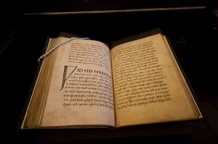
[Translator’s Note: This translation from Old English (Anglo-Saxon) represents an extract from a somewhat longer poem known as ‘The Fortunes of Men’, which enumerates the various accidents of fate, both bad and good, that may befall the individual during the course of his life.
Central to the Anglo-Saxon understanding of fortune is a concept known as wyrd, which I express as ‘Fate’ in line 44 of my translation, but which apparently comprehended in the mind of the Anglo-Saxon both destiny and chance, tinged often with the more negative connotations of doom.
The current extract comprises the first half of the poem, excluding the introduction (lines 1-9), and presents the reader with a catalogue of human misfortunes, generally fatal. The extract ends with line 57 of the original poem, after which point the preceding material is balanced by a corresponding catalogue of the gifts and accomplishments of mankind.
For an edition of the source text, see Bernard J. Muir, Exeter Anthology of Old English Poetry (1994).]
Alas, for many a wretched man it may
betide that ere his youth has passed away
he meets his end, and that in manner grim;
for then the wolf shall tear him limb from limb
as, grey of head, it roams across the moor.
His mother shall lament the loss full sore,
and yet it lieth not within the power
of man to change the fate of such an hour.
One man shall be consumed by hunger, yea,
and one the tempest-blast shall sweep away;
so too the thrusting spear will bleed one dry,
and one upon the battlefield shall die.
One leads his life in darkness, forced by fate
to find his way by touch. With halting gait
and aching joints, another shall deplore
his old infirmities and, troubled sore
in mind, shall make lament for fate’s decree.
Within a forest one from forth a tree
shall plummet; thus, although he may possess
no feathered wings, he fledges nonetheless,
disporting in the air; for truly now
he hangs no more as fruit upon the bough.
Down to the roots he plunges, black of heart,
and falls to earth where soul and body part;
for even then the spirit journeys on.
Down roads that lead through distant regions one
must make his way upon his own two feet
with naught but what he carries for to eat.
The wetland paths of outlaws he shall tread
in parlous lands with few men but the dead
to greet him; for the friendless hero knows
but enmity by reason of his woes.
Mounting the lofty gallows, one perforce
shall sway in death until the bloody corse
that housed his spirit is destroyed. For there
the raven in her sable cloak shall tear
to shreds his soulless husk, and as her prize
will claim the guerdon of his sightless eyes;
nor with his hands may he now render brief
the depredations of that wingéd thief.
His life spent; inanimate and pale
beneath the gibbet, shrouded in a veil
of charnel mist, he lingers for to learn
his Fate, nor hopes that life will e’er return;
for there is now a curse upon his name.
Atop the pyre, tormented by the flame,
another fated man shall be consumed
in deadly immolation. Thus ’tis doomed
that life shall swiftly leave him as the gledes
that rage beneath him redden where he bleeds;
well may his mother weep to see the fire
envéloping her son upon the pyre.
One man the sharpened edges of a sword
shall rob of life whilst at the festal board;
enraged by ale and having drunk his fill
of wine, his final words were chosen ill.
Another, like the first, shall be unmanned
through beer provided by the steward’s hand.
No moderation will he thenceforth find
wherewith to limit either mouth or mind
but shall most wretchedly give up his life,
enduring extra-ordinary strife
amid his loss of joy, though one and all
will claim that he himself contrived his fall,
and many a mouth will murmur that his need
of drink bespake a mind destroyed by mead.
[Translated by Thomas Suddell. Sudell is a graduate of Oxford University (2015) where he studied English with a speciality in Old English (Anglo-Saxon). His dissertation on Tolkien’s use of alliterative verse in The Fall of Arthur was subsequently published in Tolkien Studies, Vol. 13, and his translation of the Anglo-Saxon poem ‘Maxims II’ has recently appeared in Issue 32 (Samhain) of Littoral Magazine, with further work forthcoming in Areopagus and Briefly Write. Thomas’ new alliterative poetry project may be found on X @Cwidegiedd.]
 Eternal Haunted Summer