
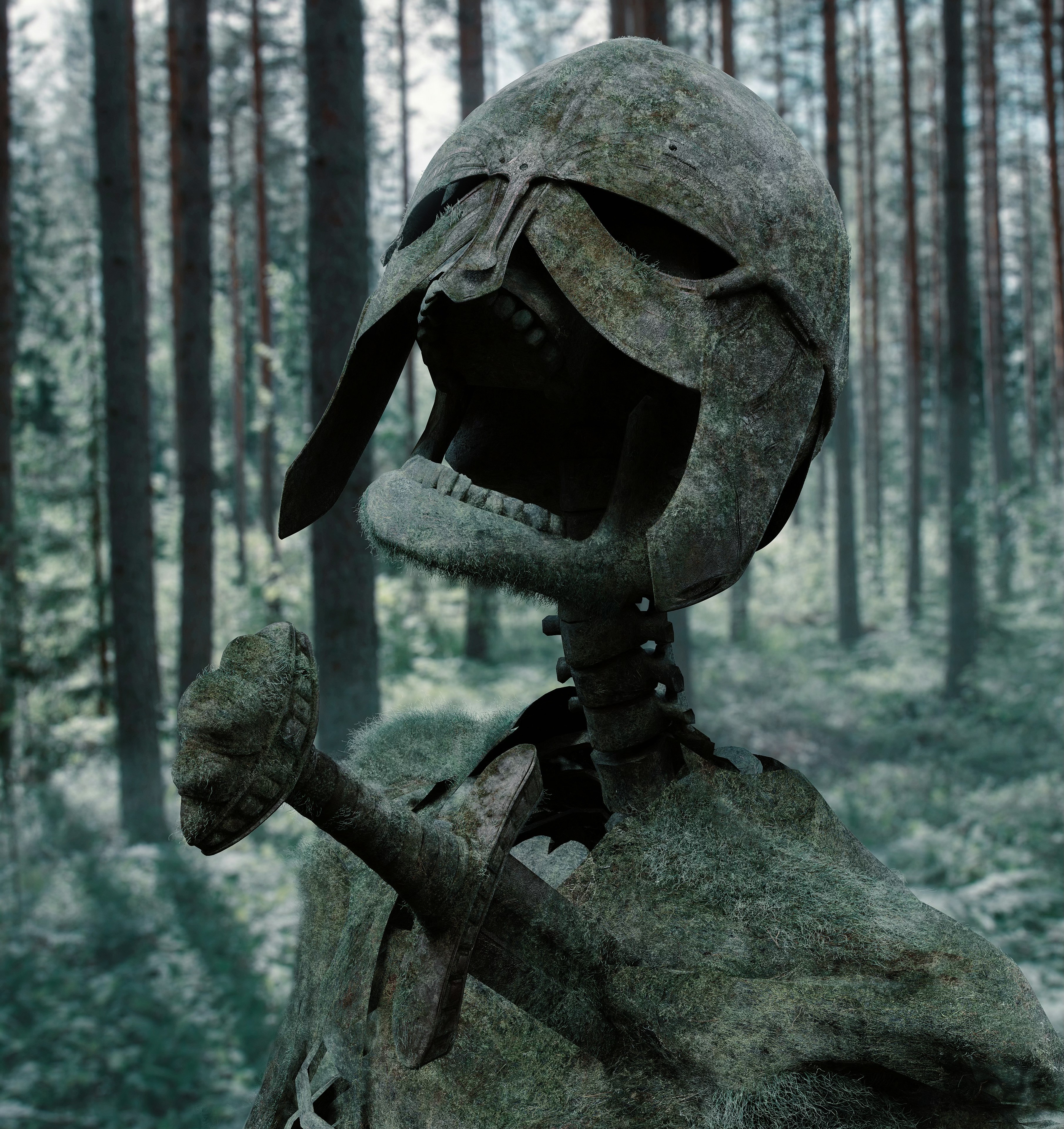
Asmund peered out the door-crack. The campfires flickered grim and red against the darkness, illuminating high helm and bright byrnie. A horde gathered outside, full of men strong and fierce. Their swords were sharp, and their axes eager for slaughter.
An uneasy calm hung over the field. For now, the foemen waited. Like Jotuns awaiting Ragnarok.
“They’re still there,” Asmund called back.
Old Bjorn Redhands, he of the white-beard and scars, looked up from the table. Dagger in hand, he etched runes into the wood by candlelight.
“Of course they’re still there. Where else would they be?”
Asmund turned away from the door. He knew he should rest, ere the battle tomorrow. And yet, he could not wrest his thoughts from inexorable fate.
When the sun rose, those warriors would attack this place, throw open its doors, and kill all they found within, even down to the lowliest thrall.
Such was the way of war. Even a farmhand like Asmund, who had never before known the crash and thunder of battle, much less the screams and the scavenger-beasts, understood the end was oft less glorious than the songs of the skalds. But for one last night, Asmund and his fellows found themselves spared.
Asmund stared at Olaf’s carven chair.
Olaf and his sons now supped with the One-Eyed one, but his treasures remained for all to see. Inlaid with gold and garnets from the distant East, that throne alone was worth many a song.
Asmund was grateful for the songs. Jarl Harald, the fell leader of these foemen, was quarrelsome, but also greedy for plunder, or so rumour ran. Crueller or more reckless men might have already set the timbers and thatch alight. But with the gilded hoard within these walls, Harald clearly waited to seize the wealth before setting the hall ablaze. The fabled red-gold rings of Olaf the Old had given him pause.
“Has this happened to you before?” asked Asmund.
Bjorn Redhands laughed.
“You mean being the last survivor of a battle, ordered by my lord to fall back on the hall? There to muster the last dregs of Olaf’s people in heroic defence, and die the same glorious death I could have had on the battlefield? No. It’s never happened.”
Asmund bristled.
“I am no dreg.”
“A dreg you are, and unless the Norns have taken leave of their senses, a dreg you shall remain. But we are both the folk of Olaf the Old, and so we shall die side by side. Dreg or huscarl, it matters not. We shall fall tomorrow, as is our fate and our duty.”
“We might have fled.”
The words left Asmund’s mouth like an arrow, but he could not recall them. The hall fell silent. Gunnar and Ivar, farmhands like himself, ceased their chatter in the corner. In the shadows, their eyes glinted like the eyes of weasels. Bjorn Redhands himself sat motionless and silent at the table. Then he placed his dagger down before him, beside the stubby candle.
The tip of the blade pointed towards the door.
His cheeks burning, Asmund slunk away, into the furthest nook he could find. Yes, the time for talk was over. Time indeed to sleep.
***
Asmund woke with a start.
Gloom hung all about, black as pitch. He scratched his head, wondering if he had indeed died, and arrived in Hel’s domain. Or maybe he lay within the terrible confines of a burial mound, trapped with a blue-faced ghost and its golden treasure. That dream had plagued him often enough since childhood, and on sleepless nights he still sometimes imagined cold fingers wrapped around his throat.
But no. The snores of his fellows sawed away, and the hard floorboards ran firm and familiar beneath his back. This was a hall for living men, not a mound for the dead. For one last night at least, he lived.
Asmund was about to settle back into sleep, when he heard a creak. At once, his doubts returned, and worse. Who was supposed to be on watch? Had some fool let his guard down, allowing Jarl Harald to cut the defenders’ throats in their slumber?
He swore, and sat up.
His eyes widened.
A strange web of cloud gathered about Olaf’s chair. Imbued with a pale sheen of light, as if it were a creation of mist and moonbeams, it glowed amid the darkness. Even as Asmund watched, the wisps of silver-grey came together, in the shape of a man.
A young mail-clad warrior stood there, slender and beardless, long hair spilling out from beneath their helm. A sword at their hip, silver as the rest of them. Then they removed their helm, and Asmund gasped.
The phantom was a woman.
A Valkyrie? No. It could not be. The Valkyries would not come until tomorrow, when they would carry away the bravest to the halls of the One-Eyed one. And yet…
The woman looked across the darkened hall, right at Asmund, and smiled.
***
A boot prodded at his flank. Asmund’s eyes flickered open. Bjorn Redhands loomed over him in the grey gloom of morning.
“Arise, lad. The sun will be up soon, and with it a red dawn. Don this mail and helm. You have an axe already. I trust you know how to use it?”
Asmund blinked.
“For felling trees.”
Bjorn laughed.
“A man is much like a tree. Hack at them hard enough, and they fall down just the same. But beware the thorns. They draw blood.”
“Did you see the woman last night?”
Bjorn frowned.
“Woman? There was no woman. I sat up all night, etching my name into the table, so you and the others might rest before battle. I saw no-one.”
“Even so, a strange woman came. Clad all in mail, she was. Her face shone like the moon. She smiled at me.”
A shadow passed over Bjorn’s face.
“A dream. One I like little. But come, and arm yourself. Swiftly now.”
***
Bjorn had his sword. Gunnar and Ivar bore axes. One nameless thrall, barely more than a boy, had found a spear taller than he was. All wore mail and helms raided from Olaf’s hoard. Readied now for battle, the men gathered about the table. The sun had still not yet risen, but it would soon. Such was the inexorable path of fate.
When he heard of Asmund’s vision, Gunnar stroked his chin thoughtfully.
“That was no Valkyrie,” he said. “That was a draumkona. A woman of dreams. I wonder what it means.”
“Perhaps it is a hopeful sign,” said Ivar. “Olaf’s treasures were many and strange, some inscribed with magical runes, and others taken from the dead hands of Lapland wizards. Maybe this draumkona will fight alongside us, and grant us unlooked-for victory?”
Bjorn shook his head.
“No. I do not think so. Recall, my friends, the river of saliva that runs from the jaws of the great and savage Fenris-Wolf. It is Ván. Hope. False trust that destiny will somehow bend itself to our desires. It is such hope of victory we must avoid, if we wish to partake in the mead of Valhalla. We must go sternly to our doom, with our eyes open and our hearts fierce. We have Olaf’s hall to fight for. Let us grow ever-bolder in the face of inevitable fall.”
Ivar frowned.
“But what then to make of Asmund’s draumkona?”
“I have never seen one,” said Bjorn. “But long ago, a skald of many winters told me of men who dreamt strange things before battle. Fylgia, the old folk called these visions, and all-too often they came to the men as beautiful women. Alas for Asmund. For the skald told me something else. To see a Fylgia is to see the promise of one’s own coming death.”
Asmund licked his lips.
“So I shall die.”
“That, you have always known,” said Bjorn. “The matter that lies before you is how you shall meet your death, and whether your name lives on hereafter.”
A thudding knock rang through the hall. For Asmund, it was like foreboding thunder.
Ivar ran to the door, and peered through the crack.
“It is Jarl Harald. Or his messenger. I imagine he wishes to speak with us.”
***
They stood at the entrance of the hall. Asmund looked out at the red dawn, and at the grim forest of swordsmen. He wondered if he might fell some of these trees, ere he died.
Harald was a thin man, but tall. His byrnie shone, and his round shield was painted with many runes. His brown beard hung long and plaited.
“Redhands.”
“Harald.”
“You have fled before me as a coward, running from the battle with your tail between your legs. I would have thought better of Bjorn Redhands.”
“I am no coward, my friend. This was Olaf’s order. That I return to his hall, and muster what I could in defence of his hall and his hoard.”
Harald looked at Asmund and his fellows.
“You have mustered this? Truly, Olaf left behind the very dregs.”
“Dregs doomed to die might yet be dangerous,” said Asmund.
“Silence,” said Bjorn. “Let me do the talking.”
“Doomed to die, is it?” smirked Harald. “No need. I shall spare your lives. In return for your surrender, I shall make you my thralls instead.”
“I shall die,” said Bjorn. “It is my duty to my sworn lord.”
“Of course, Redhands. Of course. But I was not addressing you. I make my offer to these dregs you have mustered.”
A pause. A slight breeze blew up in the fresh morning.
“I shall die,” said Asmund. His heart beat faster. “My fate is no other.”
“I shall die,” said Gunnar.
“I shall die,” said Ivar.
“I shall die,” said the young thrall with the spear.
“Cattle die, kinsmen die, and so one dies oneself,” said Harald. “So be it. Your corpses shall feast the crows ere midday, and Olaf’s treasures shall be mine. Pass my regards onto the One-Eyed one, if you are fated to meet him.”
He turned, and headed back to his army.
***
With brute strength and battering-ram, Harald’s forces broke down the door of the hall, and drove inside.
Ivar was the first to fall, swiftly overwhelmed by three enemy warriors. Bjorn hewed and thrust with his back to the wall, until the floor ran red and slippery with blood. Gunnar took shelter behind Olaf’s chair, and even knocked it over two attackers. Asmund never saw what happened to the young thrall.
Asmund ducked and hacked. He did not know if he slew anyone. He just tried to keep fighting, keep swinging, keep dancing…
And then the blow came down upon his helm. He crumpled to his knees amid the blood. Another thrust, a stab to the chest.
There was pain, so much pain. His ears rang too. So much shouting.
The last thing he ever saw was the smiling face of the woman.
The woman of his dream. The Fylgia.
And then all went dark.
[Daniel Stride has a lifelong love of literature in general and speculative fiction in particular. He writes both short stories and poetry; his first novel, steampunk-flavoured dark fantasy Wise Phuul, was published in November 2016 by small UK press Inspired Quill, and a sequel, Old Phuul is due out in 2025. His short fiction has appeared in Heroic Fantasy Quarterly, The Lesbian Historical Motif Podcast, and SpecFicNZ anthology Te Korero Ahi Ka. He has enormous fondness for chocolate, cats, and the works of J.R.R. Tolkien, and can be found blogging at https://phuulishfellow.wordpress.com/. Daniel lives in Dunedin, New Zealand.]
 Eternal Haunted Summer