
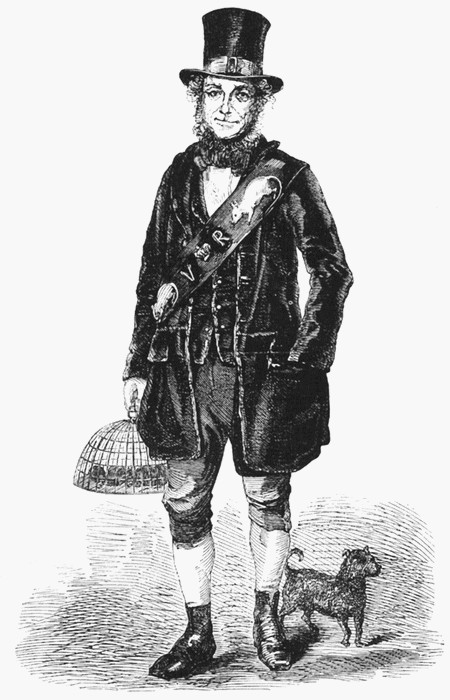
It ain’t often my profession as rat-catcher takes me out of London. But when your reputation spreads abroad among the so-called upper classes, and you get the summons, wiv a ’andsome tip just for attendin’, well, blow me, but I’d be a fool to ignore a cozy set-up like that.
Sir Bramwell Toulson, wool-merchant to the world, got ’is start in life in the West Mendips, in a village no larger than a flea-bite, by the name of Upper Loxwell.
Very ’andsome an’ all. ’E sent me own, very private, special out of Euston Station. Blimey, a ’ole train to meself.
All dressed up in me Sunday-go-to-meetin’ togs, but I ’ad me workin’ gear in me workin’ trunk, all on a porter’s trolley I use when I ’ave to be away for a few days.
It were sunny, departin’ the metropolis. But, the sun shut down around noon, and the clouds rolled in. A mizzlin’, ’orrible rain. Weather don’t normally matter to me, coz of ’ow I tend to work underground a lot. If I ain’t in a cellar or dugout, or a midden or a culvert, then I ain’t where I’m supposed to be – where the vermin is.
The train pulled into Exeter. I ’ad taken the opportunity to change into me workin’ gear. Me ’eavy boots an’ bindings; me leather trews wiv all me pockets for knicks and knacks of me trade. Padded weskit, leather breech coat, and a sou’-wester of the best oil-skin, coz I could see that the weather had continued its liking for ducks.
At the empty station, I met with a very toffee-nosed gentlemen who obviously thought ’isself better than the likes of me.
‘You the rat-catcher?’ he asked, although it were plain as day that I were.
‘I is,’ I replied, right civil. ‘And who might you be?’
‘I’m Neck. Sergeant Neck. But you can call me Neck.’
I opened me mouth to speak, but he cut in, raising a ’and with a swagger-stick.
‘Don’t bother with a name, man. You’re the rat-catcher. You do your job, and we won’t need to find out anything else to call you.’
‘Who’s we, an’ all?’
‘The household.’
He called over his shoulder. ‘Magog!’
A shambling mountain of an idiot-man came around the brick-built corner of the station. Magog was easy seven feet in height, and broad across the shoulders like a bull. ’Is ’ead was lop-sided on sloped shoulders, but carried a gentle, baby-faced expression.
’E didn’t speak, but stood panting like a cart-hoss, waiting for orders.
Neck didn’t look at him. ‘Magog, take the rat-catcher’s traps to the gig.’
Magog slouched past. Gor, ’e didn’t ’alf make me ’old me breath.
Neck pointed with his swagger-stick and I found meself in the gig. Presently Magog came lurching up, and loaded in me trunk and trolley. The hosses were nervous at Magog’s approach, but Neck had taken ’em in hand.
Magog patted the luggage and gave a soft moan. Neck set off, and the hosses trotted along, happy to be away from the moon-calf.
‘Magog ain’t one of the ’ouse’old, then?’
‘Perish the thought. And, we have a rule in the household. Don’t speak, unless you are asked a direct and immediate question.’
‘I been called garrulous, in me time, Sergeant Neck. You know what that means?’
‘I know what it means. Do you catch rats with your tongue, sir?’
‘No, I don’t.’
‘Then, you won’t have much use for your tongue at Loxwell.’
I chuckles. ‘I catches em wiv me brains.’
‘Rum impertinence,’ Neck muttered to ’imself.
‘Rum your drink, then, sergeant? Rum’s a Navy drink. I’d’ve thought gin would be more to your liking.’
His face flushed like a drunkard’s, but he made no reply.
Gor, I hoped this would be a short job, and easy.
The land were flat and dismal. The rain made it worse. To the north, low hills rose into hill-mist.
Neck mumbled something, staring ahead, morose, and gagging for a drink, unless I’m no judge of men. ’E were talkin’ to hisself; either that, or the hosses’ arses, bobbing in the rain.
I squinted at the edge of the hill-mist. ‘Some sort of stone tower up there? Built to defend against Napoleon?’
‘Hah!’ Neck barked like a bulldog, but said nothing more.
The fields was flooded on both sides of the road. Pot-holes that could drown a platoon of Irish navvies told me that Sir Bramwell didn’t like to spoil ’is tenants wiv the latest amenities like safe roads.
We passed a few farms. Each one with a sign that told its name. The one with the grandest gate was carryin’ the mounted skull of a bull. Borwater Farm.
‘Stop the gig,’ cries I.
Neck exploded. ‘What? But we’re still miles to get to the house.’
I fixed ’im wiv me sternest glare. ‘Stop the cart, Neck, or I’ll put you on your back in the nearest pothole.’
’E looked ready to turn ’is ’orsewhip on me, but ’e read the resolution in me eye.
Bringing the hosses to an unruly halt, he scowled and threw down the reins.
Ignorin’ ’im I ’opped off. Underneath me sou’-wester I groped into one of the longest pockets in me coat.
Out comes me box o’ rosewood, with the brass clasps all verdigris and gorgeous with antiquity.
‘What the deuce,’ began Neck.
But I turned an’ calmed ’im down. Proper gentled ’im, I did. Just wiv that quellin’ look of mine.
I opens me box, and the rain lashes down upon the contents.
‘By Christ, you heathen,’ began Neck.
‘Shut it, you napper,’ I barked. ‘You’re in my ’ands now.’
‘Sir Bramwell shall make sure you’ll not get a penny more. He’ll hound you with debt-collectors for the guineas you’ve already stolen.’
I snapped the box closed and let it slide down on its brass-link chain. ‘I’m about to earn those very guineas, you plum duff, so don’t give me any more of your cheek.’
I stepped up to the lane, into the lashin’ downpour.
‘Wait ’ere.’
‘In the middle of the road, in the – ’
But I ’ad already turned me attention away from ’is mouthings.
In me hands was me virgula divina, named by better-educated blokes than me. Blokes educated in old tongues. It might be called a divinin’ rod, or a dowsin’ rod, but to me it was Ol’ Virgil.
It ’ad come down from antiquity, ’anded down by generations of water-witches. I ain’t no Catholic, but their Popes ’ad a similar tradition. Apostolic succession, they called it.
Gor, just listen to old me. No wonder they calls me ‘Garrulous’. Sounds like a regular free-thinker, I does.
Ol’ Virgil is carved from end to end wiv all sorts of nonsense letters. I got me letters at me Granddad’s knee, but none ever looked like these.
I’ve never let anyone clap eyes on it for ’em to decipher which alphabets they come from. Ain’t proper. I’m sure there’s some perfessor who would give ’is right bollock to screed the letterin’, but – it’s private. Nearest thing in me unholy life that I would call sacred.
I walks over to the oak tree, one of a pair, that stood in for gate posts to Borwater Farm. The rain torrents around me. I takes up Ol’ Virgil in the time-honoured tradition of dowsers everywhere.
It’s a Y-shaped rod, and the cleft where the two ends join is set afore me.
I keeps me touch light, like, coz I could tell I was onto something. Whatcher call the odylic forces. The odylic forces wot the virgula divina works wiv had reached right out and touched me, even afore I ’ad produced Ol’ Virgil.
Sure enough, Ol’ Virgil rears up like a feisty colt, and points up the lane.
Not surprisingly, Neck ’ad relented and joined me.
‘You filthy Papist,’ he barked. ‘I’ll have you run out of the county.’
‘Bring the gig, like a good man.’
My calm tone seemed to subdue ’im more than if I ’ad let fly with a military bellow. ’E turned, and mounted the gig, and brought it round. I stepped up onto the foot-board, one arm ’ooked through the metal rig that ’eld the unlit lamp.
‘Take ’er easy, Neck. Just a gentle walk. Tell me what Farmer Borwater’s like. Is ’e a good Christian? Does ’e say ’is prayers at night, and go to church a-Sunday?’
‘Borwater’s the name of the farm, you dolt. The man who tends this land is named Hatch.’
‘’E a fambly man?’
‘Wife’s dead. Five grown sons.’
‘Any ’ouse-servants? Kitchen maids, milkin’ wenches?’
Neck cast me a ’orrible, reproachful look. ‘He’s… taken in a wretch or two. Parish charges. Saves the county from payin’ for their wretched keep.’
‘’E go through many of these wretches, Neck? Keep losin’ ’em, does ’e?’
‘You know what those sort are like. They run away – they’re good-for-nothings.’
‘Oh, I bet they’re good for somethin’.’
We ’ad journeyed up the laneway about ’alf a mile or so. Up ahead, a dog ’ad started up a racket. Deep bark. Big dog, by the sound of it.
‘That’ll be Borwater Ben,’ Neck muttered, with something like a gruff affection. ‘Best ratter in the shire, reckoned by all.’
‘Does ’Atch run a rat-pit?’
‘Course, he does. It’s a tradition in these parts. You got to keep down the rat population by some means.’
‘Oh, I knows, Sergeant Neck. No one knows better than me.’
Ol’ Virgil showed steady in me ’ands.
‘I bet you like to lay a shillin’ or a sixpence on the likes of ol’ Borwater Ben. You and Sir Bramwell, eh?’
Neck looked ahead, but ’e looked shifty. ‘It’s been known.’
‘Rat-pit an’ knockin’ shop. I reckons Farmer ’Atch is a right proper little go-getter.’
The laneway was lined with lime trees. All a-shudder, they was, in the drivin’ rain and the tossin’ winds.
The farmhouse reared up out of a lot of overgrown shrubbery. Gor Above, but it looked for all the world like a squattin’ toad. Loathesome an’ ’orrible, it looked. Right ’orrible.
Neck saw me look, and chuckled. ‘Local flint and cobb,’ he muttered. ‘Too old to be built any other way.’
The ridge of the roof were sway-backed. The chimneys was toppled, stickin’ up out of the slates, like stumps of old teeth.
‘An’ folks live ’ere, do they?’
Neck said nothin’.
I got down and found meself up to me calfs in mud, clayey an’ suckin’, an’ slippery wiv each step.
I turned as afore, lettin’ Ol’ Virgil tell me which way to go.
The front door of the ’ouse was lyin’ at an angle. No one ’ad used it for more than a generation.
Ol’ Virgil tugs me to the right, and I starts me wading, takin’ care wiv each step. I wonders just ’ow big an’ feisty Borwater Ben might be.
Round the corner, the mud’s not so manky. A rough, cobbled path leads up a slight rise.
Ol’ Virgil is practically jumpin’ outta me ’ands by now.
When I first got gifted me virgula divina, I was taught right an’ proper ’ow to attune ’im to the local odylic conditions. Coz I works with rats, mainly; well, rats, an’ mice, say. I usually need to attune Ol’ Virgil by tyin’ a rat’s whisker to ’is pointin’ end.
Not today, me luvs. Gor, but I could feel the odylics runnin’ through me, like static from a glass rod wot’s been rubbed by a fur.
I ain’t educated. Not me, sir, but I ’ave found meself in the company of educated gents. I ’ear words, and I keeps ’em.
Odylic be the word taught me by the previous owner of the virgula divina.
No, rat’s whisker today, me luvs.
The odylics was runnin’ on the pure juice – like to the clash from a illegal mountain still.
There was a old orchard behind the ’ouse. The cobbled flints leads straight up an’ through it, climbin’ a little, Not very greatly, coz all this land is level. But I knows that the way is up, coz I saw the low ’ills on me journey ’ere, all lit up by the strokes of lightnin’.
Soon, the ’ouse was left behind. The orchard fell away, stragglin’, it seems, to grow on thin soil.
I comes out onto a moor. Behind me, I could see the roof of the ’ouse, all dunderin’ in an’ ’orrible to look upon. I got a squeamish feelin’ in me guts, and since rat-catchin’s no Sunday school outin’, I knew I was in for a bad ’un.
I’ve met a with fair few properties in me time. I think Borwater was the worst. There was something wrong wiv it. The chimneys stuck up like the ’orns of a ’orny toad, I saw once in London Zoo. It were lookin’ at me. Regardin’ me, as a gentleman of quality might talk like.
But, Ol’ Virgil would not be put off on ’is quest.
The rain was still sheetin’ down, blindin’ me, but through the muck an’ the murk, I could see the ghost-faint outlines of the hill ridges up ahead. And, there, like an offensive finger juttin’ to the ’eavens, was the stone tower, I’d glimpsed earlier.
The cobbles gave out beneath me feet in the sucking ditches and marshy tussocks. Ol’ Virgil led me to a sheep path, and straight up a steep flank, right into the tower’s own domain. Only a ’undred feet or so, but in this flat coastal plain, still a height.
The tower were surrounded with the cobbled flints, and it loomed over me, starin’ down from empty windows. If somethin’ up there was a-watchin’ me, then I felt all its ’orrible an’ unnecessary eyes on me at once.
The tower ’ad once ’ad a right ’andsome double door, but the timbers were gone. Inside was darkness as dark as the throat of the Devil Hisself.
I gets out me carbine lamp. ’Ardly needed to add water to get the reaction, coz the rain was still flingin’ itself down. I affix me carbide lantern to me ’eadgear, ol’ leather ’elmet wiv ear-flaps.
I picks up Ol’ Virgil by both ’ands.
Inside the tower, the floor’s all rotten. Stone steps lead down. I takes ’em, otherwise Ol’ Virgil’s like to tug me arms out of me sockets.
The inner walls of the tower ’eld no plaster, if they ever ’ad. Rock rough enough to give ’and-’olds is on me left-’and side. It takes me a moment or two to register the stench. Gor luv a duck! It is right rotten, an’ I is a man well-acquainted with stenches.
I’ve smelled dead bodies. I’ve smelled dead, drowned bodies. Corks, they is worse than rotten.
I reckons I ’ave ’ad the privilege of nosin’ the worst stinks of the worst sewers in the world. Worst and greatest sewers, true, but by the Lord ’Arry, they is punishin’ to the ol’ nostrils.
This stench, ’owever, was like bein’ kicked in the mouth, the stomach and the bollocks all at the same time. A few deep breaths steadied me.
An’ that was when another of me poor senses was pummeled into action.
From below, out of the deepest darkness me eyes had ever traversed, there came a sound. It were a song o’ some sort. Sweet an’ pure, as if a robin’s egg had learned the tune of its Creation.
The stench had brought tears to me eyes – but, that’s a natural reaction to a over-powerin’ physical assault.
This new sound brought new tears to me eyes. Tears that were sweet, an’ not salt.
I could taste ’em, like honey on me tongue.
Wiv me ’ands still ’oldin’ on to Ol’ Virgil, I can’t wipe ’em away. So on I trudges. Down I trudges.
The singin’ gets louder an’ louder, sweeter an’ higher, till it feels like its ringin’ right in me very brains. Gor, but it makes me weep. I is in floods of tears. Blinded by tears. Like as if I is a-stewin’ in me own juices.
’Old ’ard!
Now, there’s a thought.
The steps ’ave come to a stop. An’ the light from overhead is little more than the light of the evening star. The chamber in which I finds myself is broader by far than the floor of the tower. It’s paved underfoot, with broken shards of pottery, so that underfoot it feels all cobbled. Bigger cobbles than the flints by the farm’ouse. I kneels down, and there’s a bloody ’uman skull starin’ right back up at me.
It’s like bein’ ’it in the belly.
An’ all the time this wheedlin’, needlin’, honey-like music is playin’. But it ain’t music now. This is a choir of some sort. Voices, ’igher than anything I ’ave ever ’eard afore.
Ol’ Virgil is tuggin’ me to me feet.
’Is pull leads me to the far end of the chamber.
A rivulet of water runs from the wall, clashin’ into a old slate gutter that in turn leads into a old slate basin. It’s a bath, big enough to take a ’uman bein’.
At the far end of the basin is a old statue, like something from one of the old legends, Greek, or Roman, or maybe something older. It’s a naked man – not a stitch on. So, I reckon ’e’s one of them gods that the poets still clamor on about.
But, ’e ain’t got no ’ead.
There’s an inscription at ’is feet. It’s in letters like unto what’s writ all over Ol’ Virgil.
‘Apollo Smintheus,’ comes a voice.
By gor, I jerks up and near dies on the spot.
Magog is there. Bold as brass. An’ ’e didn’t come down no stairs, like I did.
‘So, you talks.’ Although me throat is crooked with fright and disgust.
‘Forgive me, m’sieu. It suits me to model myself on a dumb brute -– the brute I certainly resemble. Were I to speak, however, I’m afraid, that the locals of this good borough might well consider it expedient to return me to La Belle France by the quickest route. Namely, the waves. And, I cannot swim.’
‘Yer a Frenchie,’ I croaks again, although it sounds like I’m more frog than ’e is. An’ ’is English is sweeter than mine. Well-bred. Educated. No Cockney yammer for ’im, by Gor.
‘What’s your business ’ere?’
All rattled an’ nettled, I am.
‘Like you, m’sieu, I am un sourcier.’
‘Like me? I don’t think so.’
‘But, of course.’
’E gestures to Ol’ Virgil and then pulls out ’is twin, except ’is looks darker, carved from a different wood.
At once Ol’ Virgil drops in me hands.
‘Wot’s ’appened to me odylics?’
‘Les forces odyliques, they acknowledge each other. They bow down to each other, and cancel out the other.’
‘’Ow come you know so much?’
‘There is no time for the casual chatter, mon frère. Can you not hear? The Choir of the Depths. It is approaching.’
‘Strewth, so it is.’
I darts about, lookin’ for a’ iding place, but the only nook that appears is right behind the statue of Mr Nakedness hisself.
That’s when I notice that under one of his stone-carved feet is the image of a mouse. No ordinary mouse, neither, but a dormouse.
From the far end of the chamber, I can see the faintest bobbin’ of candle flames. And there’s a cloud of incense comin’ up as well. Rose petals, mixed wiv an underlyin’ smell of decay an’ ordure.
Magog bundles me in be’ind the plinth of the statue, and the first clear sounds of the approaching choir enter.
I am still cryin’ buckets. ‘Why am I weepin’ like a willow, mate?’
‘Hush, mon frère. It is the start of the transformation. But do not fear, it shall not reach its full and total ending.’
Transformation?
My throat is all agog with questions, but the Frenchman is right, for all ’e might be the ugliest moon-calf I ever ’ad the indignity to lay eyes upon.
I wants to peep out, but Magog ’olds me in a grip as tight as convict irons.
‘Close off your lamp, m’sieu.’
’E loosens ’is grip enough to let me close the shutters.
Whilst I squirm in ’is grip, ’e ’as ’is ’and on ’is own virgula divina. ’E runs ’is fingers up and down the shaft like ’e’s playin’ a silent flute. The lights come closer from around the plinth, an’ I can ’ear, the soft pad of naked feet.
Above the voices, there comes a bellow of a single ’uman voice.
I recognise that ’oarse, coarse, brutal tone. Neck.
The voices quiver an’ waver in the air, an’ then the voice comes again. This time I can make out the words:
‘Sir Bramwell! We are undone! The dowser is on the loose.’
I struggles as I recognize that it’s I what he means.
‘Silence!’ comes a new voice.
Before Neck can say any more, a great barkin’ breaks out. That same barkin’ that I ’eard down at the laneway.
I meet Magog’s ’orrified gaze in the dim light.
Borwater Ben.
I whispers: ‘’Ow bad can ’e be? ’E’s just a ratter. ’E’ll be no bigger than a terrier. I got me rat-boots on, an’ me puttee windin’s round me calfs.’
‘He has been trained to kill, mon frère. To go for the throat of a man.’
‘Pish an’ tosh, mate. We might ’ave ’idden behind Sir Bollocks-Out from ’umans, but that Borwater Ben’ll suss us out in seconds. You go that way an’ I’ll go this way. We can take ’im from two sides at once.’
Magog went to speak, but ’e ’ad loosened ’is grip on me, just a mite, but it were enough.
Out I dodges, ready to kick Borwater Ben ’ard enough that ’is bitch-mother would never come into season again.
Well, blow me down.
The whole chamber was filled wiv folk. All sorts an’ shapes an’ sizes, they was. An’ all as naked as Sir Bollocks-Out hisself.
Now, I ain’t no prude, but I was sickened to me stomach. Not because of the nakedness, like, but because of what the nakedness revealed.
There was children there, little goggle-eyed mites, no more than knee-high to a grass’opper. Boys an’ girls. An’ older. Naked nymphs, like what they show in them ’igh-class art galleries in Trafalgar Square. Naked youths, and older. Grizzled gaffers an’ gammers.
And, although they were all naked as Adam an’ Eve, as we are led to believe, they all ’ad one thing in common.
They had breasts.
Blind me for a pagan, but I seen plenty of naked ladies in the shows, so I was uncommonly acquainted wiv a breast or two. But none were like this.
For a start, none of ’em grew out of their bodies where breasts is meant to grow.
Every one of ’em, except for the gent I took to be Sir Bramwell, who was dressed in a toga wiv a golden necklace an’ all.
Every one of ’em ’ad breasts. A-growin’ from their leg muscles. Two or three small little dugs, all swollen wiv milk, an’ drippin’ on the flagstones of the chamber.
An’ those who ’ad the flesh for it, all ’ad breasts a-sproutin’ from their thighs, an’ buttocks. Their backs an’ their sides. All over their chests, in random patterns, like nature certainly never intended. Even along their arms.
An’ now it ’it ’ome to me, just ’ow sweet an’ ’igh they’d all been singin’, coz all the little boys ’ad ’ad their little members cut off, bollocks an’ all. Right ugly scars they left behind, too.
An, then, through the crowd, came Borwater Ben hisself.
By Christ, ’e was ugly. So ugly, he made Magog look like a lady-in-waitin’, ready for the Queen’s service.
Borwater Ben took one look at me, and opened ’is chops to growl. Ratters is fast, as I’ve witnessed, but Borwater Ben was faster still. ’E reared up on ’is hindlegs, the better to get at me throat. ’E was big an’ all, for a ratter, bigger than a true terrier ought to be.
I braced myself for his attack, but quick an’ all as the brute was, the other brute in the room was quicker still.
A pistol blast boomed around the walls, an’ Borwater Ben thudded to the skull-cobbles with blood a-coursin’ from ’is chest.
Magog waved his old Army revolver at Sir Bramwell and Sergeant Neck.
‘Back, you fiends!’ bellowin’ like a bull.
Sir Bramwell fumbled for his own revolver beneath ’is toga, but that was enough for Magog. ’E plugged ’im. Right between the eyes. The bullet went clean through, coz I could see the splatter of gore hit the worshipers be’ind ’im.
Sir Bramwell went down like the sack o’ shite he was.
Neck roared from up the steps.
I couldn’t see ’im over’ead, but the blast of a shotgun rained down pellets.
Magog cried out, but still ’ad the strength of will and clarity of sight to aim upwards. Once again the revolver-blast ricocheted its echoes around the stone walls.
Neck’s body fell down and landed in the midst of the choir.
The worshipers all fell down, a-groanin’ an’ a-floppin’, like fish tossed from a net, an’ a-waitin’ to be gaffed.
They was dead within minutes. An’ their bodies ran with milk an’ blood, an’ stained the central gutter of that dreadful cavern.
An’ Magog, wiv a look of ’orrified madness on his baby-face, went through the entire crowd, and shot ’em all in the fore’ead.
It were an act o’ kindness, ’e told me later, though ’e reckoned they would die an’ dissolve into what ’e called le tohu wa-bohu, which just sounds like gibberish to me.
***
We stayed a week in that god-awful ’ole, cleanin’ an’ buryin’. We overturned the statue of ol’ Apollo Smintheus, and reduced ’im to powder, bollocks, dormouse, an’ all.
We never found ’is ’ead, but Sir Bramwell ’ad a bag under ’is toga. And inside that bag was a rough piece of stone. Shaped like a rat’s ’ead, it were, and roughly done. And writ down the center line between the eye sockets, were the letters R A T T U S.
Even I could read that, but readin’ it made no sense.
Magog explained in different conversations, that Apollo Smintheus was an old Greek god. Maybe even Anatolian, although that made no difference to me. ’E was worshipped in cities as the god what cured plagues, an’ diseases, and infestations of vermin.
‘But, if they was a-worshippin’ Apollo Bollocks-Out, why’d they want a rat-catcher?’
Magog liked ’is wine, an’ we ’ad plundered the wine-cellars of Loxwell ’Ouse, where an underground passage led from the ’ouse to the foundations of the tower.
Up above, the ’ouse’old staff were oblivious to our presence, coz the wine-cellar door was locked and bolted from the inside. So all Sir Bramwell’s pagan shenanigans went on beneath their feet, beneath notice.
‘Thou art no mere rat-catcher, mon ami. As am I, thou art un sourcier, gifted with the sacred virgula divina of old, handed down directly from – antiquity? Who knows? Perhaps from the very Hand of Hermes Trismegistus.’
‘Never ’eard of ’im.’
‘He is known to you — but, by other names.’
‘So – they – what? Lured me down ’ere?’
‘I think so. I have looked through Sir Bramwell’s papers in his study overhead. He was planning to bring his cult to London. I think he –- somehow -– divined that you might be an obstacle to his machinations.’
So, we parted, Magog an’ I. I asked ’im if Magog were his real monicker, but ’e only smiled. Like a cherub, I thought. Until I remembered the look of frenzy on his face as he butchered those poor, mutilated souls down in the idol chamber.
They were buried now. And the tower was tumbled, coz Magog ’ad waxed ’is mighty thews on the tower from the top. ’E smote it ’ip an’ thigh, just like Samson in the Bible, smitin’ those dastardly Philistines.
An’, as I caught me train back to London (no special for me this day!), I thought I might be glad to be one of those Philistines, Philistines what know nothin’ of the dark ways of the world, an’ the even darker ways of the Underworld.
I fished out me Granddad’s Bible an’ thumbed through its pages till I comes upon the words of St. Paul.
‘We are all changed. Changed utterly.’
I recalled Magog’s word: Transformation. Funny, but that was a topic we never entered into. It made me wonder, in me simple Cockney way, whether Magog had always carried the stigma of a moon-calf, or…
’Ad ’e been transformed in some way?
I let the rhythm of the train lull me back to me ’uman sleep.
***
And, then, a few weeks later, I gets a package delivered to me lodgings. All knotted with the best of silk and sealin’ wax. It were a book entitled Ovid’s Metamorphoses. No return address.
Gor, lumme.
But ol’ Magog ’ad ferreted out somehow where I lived.
Inside was an inscription in a beautiful, educated ’and: To mon frère.
I fingered through the chapter ’eadings.
Gor, it all seemed a bit far-fetched to me. I put it on me mantelpiece, and promised meself that I would read it. Someday. When the nightmares and the castrati-music had dinned down a little.
[Jim Johnston has been writing since the 1980s, numerous short stories published in small press publications, both sides of the Atlantic; over 100 poems published, and a poetry volume from local press, Lapwing, highly regarded by Guardian newspaper; produced a short film, short-listed in the Hennessy Film Festival; written several plays, four of which received multi-venue productions in Belfast, North of Ireland, and in Antwerp, Belgium; song-lyrics with multiple music collaborators, many of which have been produced on albums. Currently creator/producer/writer children’s puppet show for television, which is currently being platformed on UK-based Children’s Media Conference.]
 Eternal Haunted Summer