
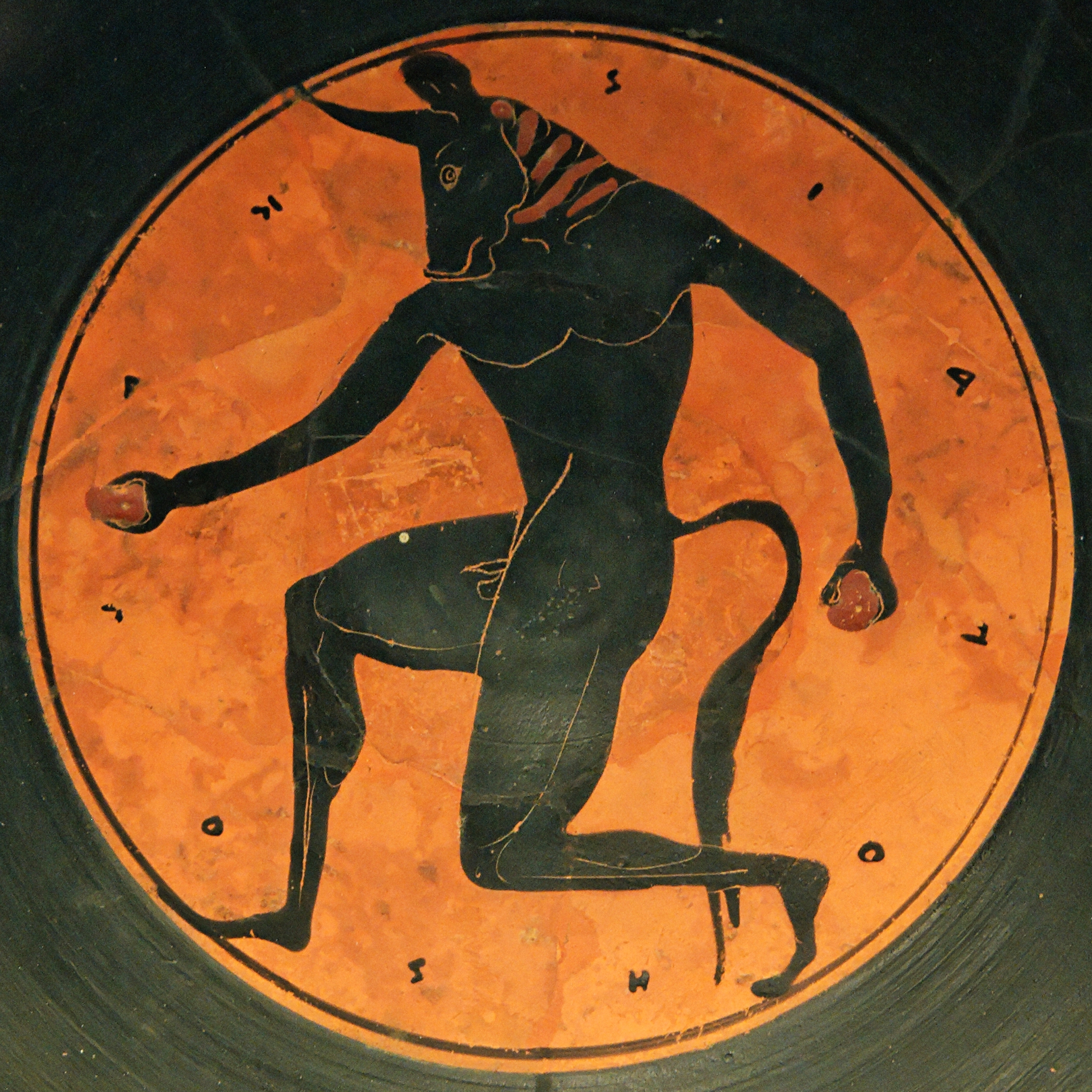
Theseus believes that he is the only person to ever survive the Labyrinth, but then, heroes always think they are special. In truth I escaped the Minotaur’s lair before Theseus ever set foot on Crete or met Princess Ariadne. Let me tell you the secret of how I did it.
As children in Athens, stories of people being thrown into the labyrinth to be devoured by the Minotaur, the half-bull half-man flesh-eating monster, were told to frighten us into good behaviour. They were told so often that I saw the labyrinth in my childish dreams. Every nine years, seven women and seven men were sent as blood sacrifices to appease King Minos who said that the Athenians had killed his son. I never thought that one day I’d be picked to be among them — or attend the infamous party at the palace of Knossos before being sent to the labyrinth to be slain at dawn. My father nominated me for the blood sacrifice because I dared to study medicine in secret, something forbidden for women, and so my nightmare of the labyrinth solidified into reality.
The masquerade ball was just beginning when we arrived. Torches lit the palace walls, but brought no warmth, only casting flickering shadows across the marbled floors. The air was heavy with perfumed garlands, scented with lilac, jasmine, and heliotrope’s sweet vanilla which couldn’t quite obscure something muskier, an almost animal stench, that seemed to rise from the palace’s depths through the ornamental grates in the floor to steep the halls above. Something else rose from the depths which was far worse than the scent; a discordant clashing of musical notes as if an unhinged band of musicians had been locked away with their instruments in the entrails of the palace. Every time the awful din came up through the floor a trope of musicians rushed through the halls to cover up the sound, their scurrying at odds with the dignified dirge that they played on their lyres.
Guests jostled around the many banqueting tables, sampling decorative knots of glistening eels, drinking wine, and gossiping. A little girl sitting on her mother’s lap licked her fingers as she plucked out the eyes of a roasted blackbird. At the centre of each groaning table was a lamb’s head on a platter, one to represent each of us, the Athenian captives. A woman dressed as a naiad sashayed past, the beads of her gown shimmering like water droplets. Her friend in dryad costume stooped under the weight of her headdress of ornamental nests each containing a nightingale attached by a golden chain. The costumed Cretan guests failed to disguise their gawping at us behind their fans and masks. The only time their attention turned from us was when the terrible music came up through the grates. It was impossible now to ignore, a thunderous roar of drums, bells, and tambourines, the musical equivalent of an oncoming storm. The guests huddled together as if the racket from below would shake the palace to its foundations. The troupe of musicians rushed in to cover the sound once more, but by the time they did it had gone.
Only two figures set themselves apart from the crowd: a slight old man with cunning eyes who I recognised as Daedalus, and his son Icarus lounging beside him, statuesque, beautiful and petulant. Daedalus tapped one sandaled foot to the troupe’s soulful music; his gaze fixed on our anxious group.
“The maidens are to follow me.”
Ariadne’s voice caught me by surprise. She dismissed our guards and stalked away with her quick light step; we trailed at her heels like lambs behind a shepherdess. She led us to a dressing room where attendants forced gloves onto our shaking hands. We were bedecked in burial shrouds pinned at the shoulder with a brooch in the shape of the deathly asphodel.
Ariadne seemed uncomfortable under the attendants’ watchful gaze. She gestured to them to retreat.
“Give us space. I want to give the Athenians a treat as is my custom — as a thank you for forfeiting their lives.”
They drew back and she ushered us around her, her regal manner gone.
“Look,” she said.
She drew a small box from the folds of her gown and opened it. It was a music box of such exquisite beauty that for a moment it almost made me forget where I was. Two carved figures stood in the centre of a miniature dance floor facing each other, a girl and a Minotaur, and when Ariadne turned the key, they began to dance together to lively music that made my blood sing. We stood hypnotised by the twirling figures and the spinning walls, the bull-man chasing the girl who always stayed just beyond his reach.
“Daedalus made the box for me when I was first learning to dance,” said Ariadne.
I might have thought she was mocking us with this treasure if it wasn’t for her expression of almost ferocious intensity. We were brought back to ourselves as she began to close the lid and the music slowed. She cupped her hands around the box, hiding the figure of the dancing girl who suddenly vanished through a wall, leaving the bull-man alone. The girl appeared an instant later to face the Minotaur once more as Ariadne snapped the lid shut and the music ceased.
The attendants crowded around her once more, and her regal tone returned.
“Daedalus also made the dancing floor for me where the ball will be held. Pay attention to the music and the dance. My father the king will be there.”
Ariadne led us, a swan with her unsteady cygnets trailing behind her. The great carved doors opened to a blaze of music from a large group of costumed musicians. Silence descended as we entered with the Athenian men and made our way to the centre of the dance floor. We stood there, orphaned by the vastness of the room while King Minos glowered at us from his throne. Queen Pasipae was beside him, daughter of the sun, straight-backed, imperious and radiant as a naked flame in the semi-darkness. With a wave of Minos’ hand, the music resumed. A conspiratorial, quicksilver look passed between Daedalus and Ariadne before she led us in the revelry.
It wasn’t long before my fellow Athenians were getting drunk. I couldn’t blame them. Who wouldn’t want to forget what lay before us all? We spun, clasping each other while the lyres, harps, and drums played on, the music of the ballroom dulling the discordant clash of sounds rising through the floor. Soon my companions began to waiver and stumble. Masked guests led them away for private debauchery as the party spilled out into the torch-lit gardens.
Ariadne, however, danced on, with the same terrible intensity that she had shown us in her dressing room. The ballroom seemed to swell and shrink in time to the music; the incense thickened the air until all was a blur of deepening shadows and whorls of light from the candelabra. My feet were red and swollen, my mouth parched, and the world seemed to slip a little more with each step. The crowds were thinning out and I was about to rest when trumpets sounded. The doors opened for another procession of fresh dancers dressed like spirits of the dead, led by the costumed figure of a minotaur. The few remaining guests drew back, tittering and pointing.
The minotaur-figure towered above the other dancers, the cloth of his tunic straining over his broad shoulders. Either side of his forehead were massive, polished horns, curved and capped with silver coverings like large thimbles. He leered at the guests before seizing a jar of wine from a servant and tipping his head back to drain it to the dregs. Ariadne ushered servants to bring him more wine as he gobbled up a lamb’s head from a banqueting table. The ghostly dancers he entered with created an uneasy buffer between him and the guests who in any case drew back from him. When at last he paused his feasting Ariadne signalled to the musicians to resume playing and beckoned the minotaur-figure to join her in a dance.
Ariadne held him at arm’s length, fixing him with a glare that could boil lead. His cloven hooves made an odd ringing sound in the expanse of the ballroom, and he staggered a little as he danced. Everyone changed partners and I found him opposite me. The same stale scent that rose from the palace grates hung about him, a sepulchral mustiness and animal reek. I gaped at the bull’s head, the too-real wide set eyes. The man-creature smiled, exposing his many blunt teeth.
“Daedalus, with his genius, designed the costume,” he said. His breath was hot in my ear and smelt of wine.
He knew that I realised that he was the creature from the pit, but he enjoyed toying with me and grinned, tilting his head to fix me with one devouring eye. In that moment the music changed again, as he released me to sweep Ariadne across the dancefloor. I staggered away to shelter against a wall. It was then that I recognised the heady music from the music box. The dancers leapt and whirled, joining hands to create a moving maze of walls that Ariadne and the Minotaur raced through. They danced together until Ariadne broke free from the Minotaur. She disappeared for an instant under a dancer’s arms and as she did so she caught my eye. It was in that moment that I realised what she had been trying to tell us; that this music and her dance was a map of how to escape the labyrinth. The Minotaur seemed unaware of her brief absence. He had snatched a nightingale from the dryad’s headdress and swallowed it whole, ripping the golden chain away with his teeth.
Ariadne dragged the Minotaur back into the dance and I noted her twists and turns. She danced until she grew weary, and the first quartz rays of dawn began to break on the gardens outside. I drifted away from the dance and pretended to sample something from the feast. I peeled off my gloves, found an unlit oil lamp and poured its oil over my arms. A trick I learnt from my brothers who liked to wrestle. King Minos finally called Ariadne away and the music evaporated on the morning air. The Minotaur pushed his way through the languishing dancers and strode unsteadily through the ballroom to take his place in the pit.
“Now,” said King Minos rising from his throne, “it is time for the Minotaur’s song.”
We Athenians assembled; drunk, despairing and half-deranged in torn and muddy costumes. The labyrinth door was a boulder that was rolled back, and the now familiar animal stench swept over us. We were thrown in, one by one. I was the last and by the time I entered the others had already scattered. Inside the labyrinth was nothing like I imagined. The walls, ceiling and floor were covered in thin strings that vibrated and played musical notes every time you touched them. Touching the strings often shifted the walls, carrying the music into newly revealed halls. It was like being trapped in a moving musical spiderweb. Every footfall signalled to the Minotaur where we were. I edged along a passageway creating what seemed like a peal of a hundred copper bells and thought of King Minos’ glee, listening to the musical bloodshed rising through the palace grates.
The Minotaur’s hooves struck different notes to our human feet and so it was possible to follow his progress through the maze and hear the answering music of those he pursued. Often the chase came close enough to hear screams over the music, the walls and floor reverberating with a discordant clash as his victim fell, sometimes followed by the crunching of bones. I avoided the paths where the dark shapes of long-ago slain bodies were strewn across the floor or slumped against walls. They were preserved by the coolness of the labyrinth, their weight on the strings surrounding them with a continuous funeral song.
I wandered through the passageways, every step triggering noise that echoed down the infinite halls. One vibrated with a repeated chord like a thousand buzzing insects, another rang with the doleful, reedy sound of the aulos; I crept along this route when I stumbled and as I did my hand brushed against the strings of another hall. It was then that I heard the music box sound. I froze, listening to the beginning of the tune when it was suddenly swallowed by the sound of drums.
The Minotaur’s horns pinned me against the wall before I could scream. He tilted his head and I saw myself reflected in the dark mirror of one of his wide set eyes, his laughter joining the drone of the aulos. A metallic reek of blood enveloped us both: the blood of my friends, of my fellow Athenians. All fear was eclipsed by my rage. I unclasped the brooch that held my shroud and plunged the pin of it deep into the horizontal pupil of his bull’s eye. With a cry of agony he released me, and I was nearly free when he grabbed my arm. His long fingernails dug into my flesh, but I twisted and writhed, and his grip slipped on the lamp oil that coated my arms. I fled, bundling my shroud around me, running haphazardly until I was so far inside the labyrinth that I could no longer hear the music of his pursuit.
Rediscovering the music box tune was agonizing. With every misstep the walls shifted and became dead ends or sent me in the wrong direction until I picked up the tune again. In the end I closed my eyes and followed the music, dancing Ariadne’s dance while the music of the Minotaur thundered after me in the distance. Exhausted, I reached the hidden door. It was blocked by the body of an Athenian youth. I wondered if he had understood the meaning of Ariadne’s dance or realised that the door was too small for him before he was caught.
I tugged at the body, but its shroud was stuck fast in the strings. I expected pulling on it to set off music, but the hall was quiet. The trapped fabric had somehow disturbed whatever mechanisms that controlled the strings and silenced them. I was still working it free when the music of the Minotaur ceased. Instead, his stench washed over me where I crouched with the body. I turned to see his dark shape silhouetted at the end of the passageway. He lowered his head and charged. The world collapsed in on itself in a tangle of bodies. Something sharp grazed my side, teeth bit down on my arm, an enormous weight knocked the breath out of me, and the corpse shroud broke free. I slid sideways through the door, and was met by the cry of gulls, the dazzling brightness of the sun, and the salt scent of the sea.
Daedalus was there to greet me. He was gathering feathers along the shore and pulled me to my feet.
“You are the first person to find the door. I hid it there for Ariadne in case the beast ever turned on her and she couldn’t escape through the labyrinth’s entrance.” He wiped a sunburnt hand across his brow. “Of course it was for me to use too, and Icarus. An insurance policy if you will, if Minos ever locked us in and threw us to the beast. But Icarus grew too big for the door and so we have another plan for escape — just in case.” He indicated the feathers in his bag, smiled, and led me along the shore.
“And Ariadne’s dance?” I said when I had breath.
“It was her idea. She will be glad when I tell her that you escaped.”
I told Daedalus about the body, the trapped shroud, and the silence of that hall. He nodded but said nothing as he led me to where a small boat waited, dancing on the vast expanse of glittering blue.
Years later when Theseus was known as a hero I asked him about the ball of thread Ariadne had gifted him to help him navigate the labyrinth.
“Ariadne showed me,” he said, “how to silence the music of the halls by wrapping the thread around the labyrinth’s strings, as well as using it to find my way in and out.”
I could imagine the silence of Theseus’ ambush, taking the Minotaur by surprise.
Theseus paused and sipped his wine while I thought of Ariadne’s music box and the disappearing girl, finally free of the dance.
[Alex Glebe is a lover of all things gothic and fantastical. She studied creative writing at the University of St. Andrews. Her fiction is featured in The Lit Nerds, 101 Words, and Crow & Cross Keys. Find her and the books she loves on Instagram @alex_book_treaure]
 Eternal Haunted Summer