
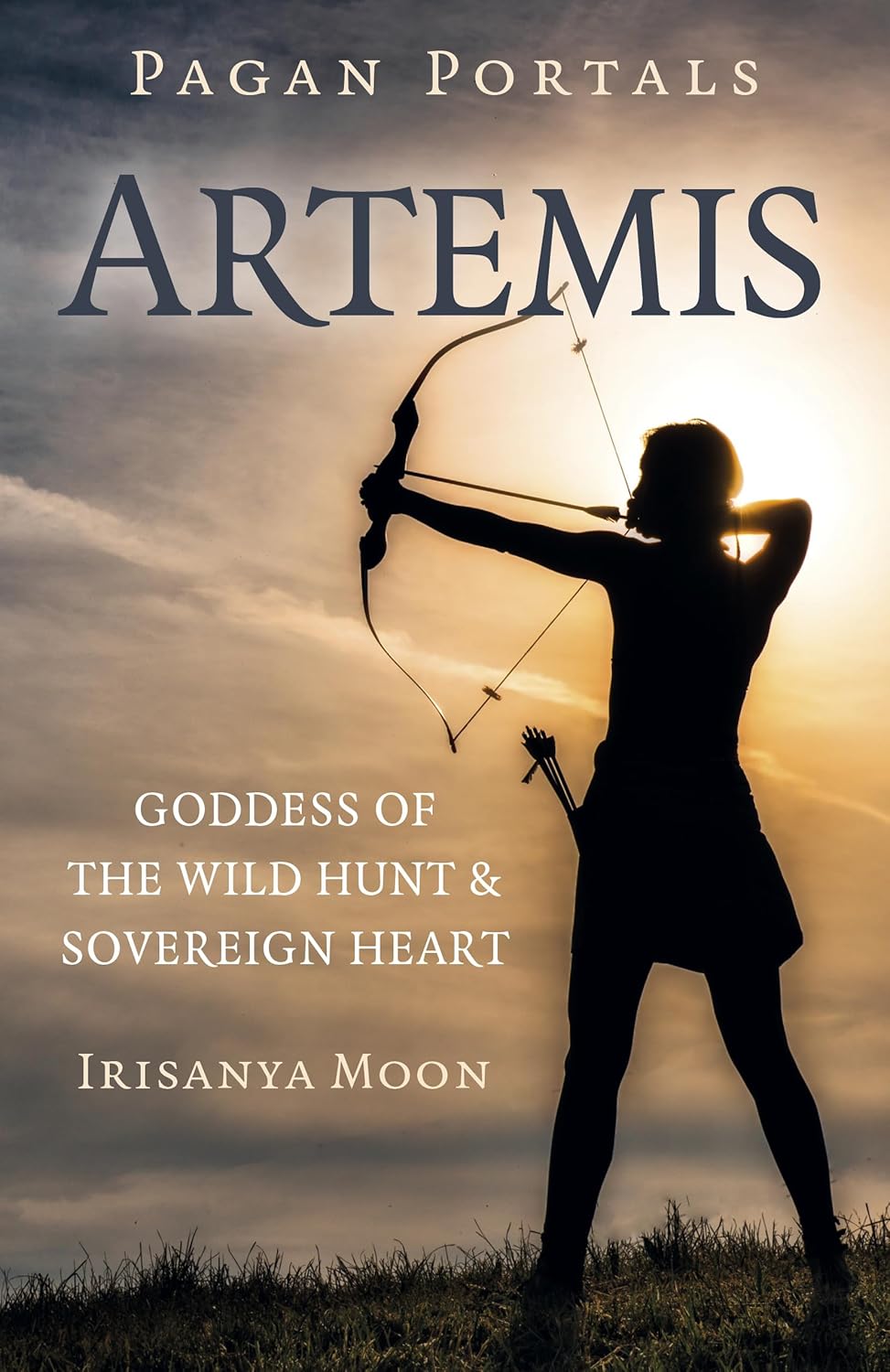
Title: Pagan Portals: Artemis — Goddess of the Wild Hunt & Sovereign Heart
Publisher: Moon Books
Author: Irisanya Moon
Pages: 96pp
With Artemis: Goddess of the Hunt & Sovereign Heart, Irisanya Moon again seeks to expand the reader’s horizon of a complex goddess figure. Artemis is a key goddess in the Greek pantheon, twin sister of Apollo and daughter of Zeus and Leto. What can the reader gain from this latest book in the vault of goddess mythography?
The key theme that Moon connects with Artemis in this book is that of “wildness,” not a savagery disconnected from civilized life, but the deep and inherent truth of who one is as an individual, a kind of “true self” that exists apart from social constructs and cultural expectations. To encounter Artemis, goddess of the moon and goddess of the hunt, is to come face to face with the truth of one’s own wildness. Moon writes, “The first encounter with Artemis can be a moment of recognizing how far you may have strayed from your wildness.” And wildness she defines as “that which is inherently you, outside of the constructs and confines of the overculture. Wildness is the deepest trust in yourself and the deepest knowing” (14).
Cultivating a relationship with Artemis, for Moon, means ultimately recognizing the strength and surety of the goddess, finding confidence and clarity and discernment within oneself to live the life of one’s boldest vision, to take aim and let fly the arrow, as it were — straight, clear, and true. “To hunt with Artemis,” Moon suggests, “is to take on a sacred task” (62). To return to one’s wildness is a restoration of the general disconnectedness and dislocation that afflict so many in the modern world, so riddled with noise and distraction and distancing of the self from interaction with the living sensuousness and dynamism of nature. Artemis, in this connection, takes on a kind of shamanic role, that of restoring wholeness and vitality to the dislocated soul. Artemis, Moon writes earlier in the book, is a goddess “who can travel between worlds of nature and man to protect the wild, women and children, and the movement of life” (18). For it is the shaman, the archetypal magician, the wounded healer, who best can help to restore wholeness and integrity to a soul that has strayed too far and long in the shades. Artemis, in short, “knows what it takes to come back into your being” (67).
Artemis: Goddess of the Hunt & Sovereign Heart leaves the reader with an illuminating sense of this complex, fascinating, shamanic goddess. Moon’s book supports her claim at the start that Artemis “is wild, and She is the Wild.” Various excerpts from Greek myths and Homeric hymns enhance and contextualize this portrait, and workable devotional practices make the idea of cultivating relationship with the goddess a more achievable aim. The bibliography provides over twenty scholarly and popular sources for additional reading, and a brief glossary serves as a ready reference for names, places, and events mentioned in the book. Artemis, in short, offers not only useful informational and storied background for understanding the many aspects of the goddess but also focused meditations for sharpening self-awareness and, as Moon describes one such exercise, taking up the bow.
One aspect I found intriguing in this book, as with Circe, is the possible Minoan origins for Artemis. It is a point worth exploring, and Artemis serves as an excellent starting ground for such a search — as it will for each reader in what speaks to their inner wildness, be that somewhere in the ancient Aegean, the deep mythic forest, or the distant imagined beyond.
[Reviewed by Christopher Greiner ]
 Eternal Haunted Summer