
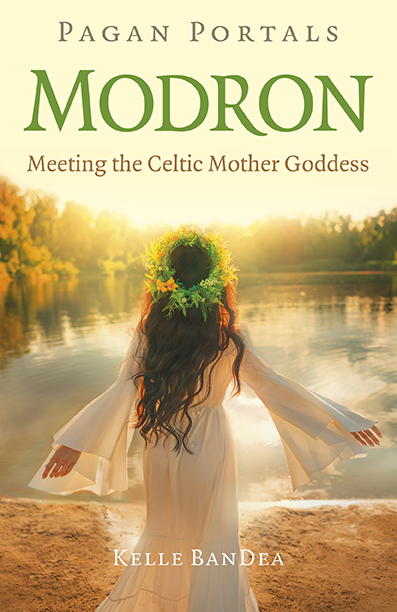
[This issue, we sit down with author Kelle ban Dea. Here, she discusses her personal spirituality; her new book on Modron, the Celtic Mother Goddess; her upcoming books on Aine and Airmid; and more!]
Eternal Haunted Summer: How do you define your personal spiritual practice? Does it have a name or is it more intuitive and eclectic?
Kelle ban Dea: Its changed over the years and things are much more fluid now. I no longer feel any label fits quite right and tend to just use ‘pagan’ or sometimes ‘pantheist.’ I’ve also started to use ‘naturalistic pagan’ more often as I no longer have any strong belief in the supernatural. I’ve become much more cynical with age! But if Im feeling whimsical I do like the term ‘greenwitch’ which is to me just a more poetic way of saying ‘naturalistic pagan.’
My background is in Goddess spirituality, which I was deep into for a long time until I studied it at the academic level and honestly, that took a lot of magic out of it. I had to deconstruct a lot. But I’m glad I did, because there was a lot of pseudohistory in the beginnings of that movement and I don’t find that at all helpful. Same with Wicca, which is how I found paganism — I read Silver Ravenwolf at fifteen and was hooked!
I still like simple ritual especially in nature and/or with plants, meditation, retelling myths and folktales, and working with story.
EHS: Which Deities, spirits, or other powers do you honor?
KbD: I have representations of Modron, Mabon, Aine, and Airmid on my altar, but I don’t really honour deities how I used to. I see them more now as ancestor figures or/and representations of certain energies and concepts.
I don’t have a literal belief in fairies, et cetera, though members of my family still practice the old Fairy Faith. But I do think there’s something to the concept of land spirits; more and more science is discovering about consciousness in nature, for example. You can sense the presence in a forest, for example, the existence of an Other Mind.
EHS: You recently published Modron: Meeting the Celtic Mother Goddess. First, congratulations! Second, why a book about Modron? What draws you to her?
KbD: I had a profound spiritual experience at Madron Well in Cornwall and that led me to her. I was pretty shocked to discover her roots go back to the Iron Age Celts. We don’t tend to think of there being a ‘Mother Goddess’ in the Celtic tradition, but there absolutely was. Modron was originally Matrona and we find inscriptions and statues to her across Europe. And then the Welsh figure of Modron seems to have become Christianised into St Madryn and also inspired the Arthurian figure of Morgan le Fay. Modron’s father is Afallach, a King of the Otherworld, from whom we get the name of Avalon. She’s like this hugely significant figure yet we barely hear about her in pagan or even Celtic circles.
EHS: What is your favorite story, hymn, or practice centered around Modron?
KbD: We only really have one story left of her mythos — in the Welsh manuscripts she is described as washing clothes in a river in Cumbria when Urien of Rheged comes across her. He’s enchanted by her and she becomes mother of his twins. It’s clearly a sovereignty myth. She’s most well known as being the mother of Mabon and him being stolen from her as a baby. But we have only a few lines about that; the original story is lost. Although we have a much longer story about Mabon embedded within one of the stories of the Mabinogion.
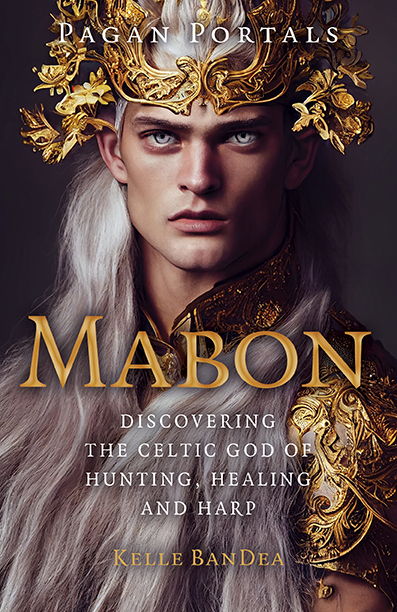
EHS: You also had a Pagan Portals title come out at the end of May, this one dedicated to Mabon. What sort of research went into the book? Long hours at the library? Deep discussions with other devotees?
KbD: Definitely long hours with a lot of books and archives! I also visited the areas associated with him; the river Severn in Gloucester, and southern Scotland, as well as North Wales.
EHS: If you could correct one common misconception about Mabon, what would it be?
KbD: He’s got nothing to do with the Autumn Equinox!
EHS: Your next book is due in November 2025. Aine: Goddess of the Sun, Fairy Queen of Ireland will also be released by Moon Books. What do you find so compelling about Aine? And what interesting bit of lore or history did you absolutely have to include?
KbD: She’s interesting because there’s such a popular folk tradition associated with her, unlike other deities such as the Morrigan, who were virtually unknown until the medieval myths were popularised by the elites during the Celtic Revival. But Aine never went away. She shows up as a fairy queen, a banshee, a muse, a mermaid, and the ancestral mother of various Irish families.
My favourite story about her goes back to possibly the eighth century. At her lake in Munster, Lough Gur, King Ailill tries to rape her, and she bites off his ear, taking away his right to rule. I see a message here about patriarchy and sexual violence that resonates with me as a survivor.
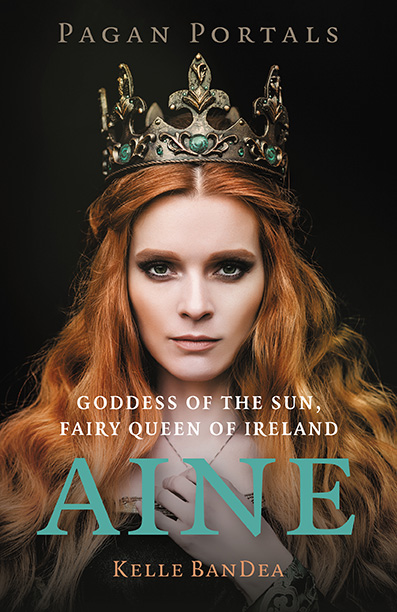
EHS: Aine is described as both a goddess and a fairy queen. What is the difference between the two and how do they overlap? What does it mean to be a “goddess” and what does it mean to be a “fairy queen”?
KbD: So in the Irish mythos, the fairy nobles, or Sidhe, are pretty much indistinguishable from the deities. The Sidhe are also known as the Tuatha de Danaan or ‘Children of the goddess D/Anu’ and feature in the myths. Many of them are listed in medieval sources such as Cormac’s Glossary as being pre-Christian gods. Aine features briefly in the myths and there is some evidence to suggest she is the same figure as the Mother of the gods, Anu, although this is hotly debated. As a fairy and folkloric figure, she has been honoured by the Irish people for hundreds of years.
EHS: Where can readers find your books?
KbD: All the main outlets and on the Moon Books website. Drafts of my current work in progress are going up on the Pagan Collective blog.
EHS: In addition to your own books, what other resources do you recommend to those interested in Celtic traditions?
KbD: Kris Hughes’ Youtube channel is fantastic for Celtic pagans, as is Gwilym Morus-Baird’s channel and website. For specifically Welsh resources, Mhara Starling has some great stuff, and Morgan Daimler for specifically Irish. And of course the myths themselves; the Four Branches of the Mabinogion (Welsh) and the Second Battle of Moytura (Irish) are my favourites.
EHS: Which book fairs, conventions, or other events do you hope to attend in the foreseeable future?
KbD: Those things can be difficult for me due to disability, but I’m hoping to attend the Viking Camp at Wirral and I’m scheduled to talk at Woodspirit Pagan Camp in July.
EHS: What other projects are you working on?
KbD: A book on Airmid, including her presence in the Irish Traveller tradition and the specific herbs associated with her. The Irish herbal tradition is fascinating and has such a rich history. Then on my blog I’ve started recording audio versions of my own folktale tellings. I’m of Welsh Romani and Irish Traveller heritage, so I’m including tales from those traditions.
 Eternal Haunted Summer