
Winter in the forest was the deepest dark and the most biting cold, a boon for any traveller intent on ending their lives as a cautionary tale. Anais knew well how the ice could empty your veins, how the dark could fill your eyes, even in the whitest snow. That was why she was there. The forest was a blanket to her, a cover and a salve. The cold kept the blood from escaping from the gashed wound on her leg, the dark concealed her as she fled.
Without a person to pass through it, time becomes loose, untethered, racing forward then doubling back on itself, searching for an anchor, for definition. In the dark, so complete that she could not see the hand in front of her face, Anais lost herself, her personhood and with it all sense of time. She might have been running for an hour, a day. It might be last week, she might be sat at home right now, warming herself by the hearth, blissfully unaware of her other, later self, running for her life in the depths of the woods.
Anais stopped and crouched down behind a large tree that she could feel solidifying out of the darkness before her. A sound had wound its way around the trunks to find her, and she did not wish to return the favour to whomever made it. She had thought she was free, lost to her pursuers as much as she was to herself. She drew in her breath, waited, and listened.
Nothing, silence, void. And then it came again. It was not footsteps, nor a dog’s bark, or the hunter’s horn. Barely audible, this was something deep and far off, an infrasound. The whole forest swelled with it and rose as a low droned note came up just to the edge of Anais’s hearing, then receded again with a tone shift like the tide on the shore. There was a warmth in it, a feeling of safety, or at least of welcome, both things Anais was in desperate need of.
She waited, and presently the swell rose again, rustling the leaves of the trees, pushing out the world then pulling it back. And then again it came, rhythmic and predictable, out and in. Anais closed her eyes -– she couldn’t say why for it made no difference to her vision -– and allowed the wave to lift her, pass over her, and pull her back down. More than hear it, for a moment, she was in the swell, a part of it, and after two or three passes, Anais knew in her bones which direction to go to find the source.
With her arms an outstretched rudder, her feet a pair of earthbound oars, Anais allowed the tide to take her, no longer scrabbling her way through the woods, but floating gradually down the current of sound, gently guiding herself away from the tree trunks as they loomed out of the darkness. As she went, the sound grew and so did its pull, the current growing ever faster. Soon, Anais knew it for certain as music, a great droning beacon, to whom? To her? Was it possible? Finally, she could resolve the sound into two notes, a two-tone, two-step drop, high then low, high then low. One high to beckon -– out. One low to soothe -– in.
A light blinked out in the void, and Anais’ hungry eyes devoured it. It was the tether by which she guided in her little boat lost at sea. The light grew swiftly as Anais moved towards it, not brighter, for it was faint, wan, and ill-formed, but larger. A familiar but unexpected shape began to resolve itself out of the gloom. A building, tall sides tapering off to a sharp spire, weak but multi-colourful light seeping from tall, slender windows; a church, Anais had no doubt, and the source of what she could now make out was singing.
Even with the little light coming forth from within, Anais could make out enough of the forest around her to know that she was still deep, deep within it, perhaps deeper than she had ever been. There was no parish for this church to serve, no road granted access to it. A monastery then, or a convent, Anais supposed. All the better. They must take her in and they would ask no questions, or be easily sated with lies. For the first time in her life, Anais was almost moved to thankful prayer.
Anais fell upon the large wooden door to the church and bashed her hand against it. She felt nothing, her hands blue and limp. The desperation of her situation filled back into her mind as the trance of the music fell away. She had little time, and impoliteness must be forgiven by men and women of the cloth, so she pushed her body against the door without invite, and it gave easily to beckon her inside.
As the door swung shut behind her, that swell of sound came again. Anais could recognise it clearly as singing now, a wave of human voices that in their first note slammed against the door and closed it tight, and in their second receded back into the depths of the abbey. A dull orange light was sketched along the edges of the stones in the walls, and it brought with it just the outline, the impression of warmth. Finding no one in the entry hall, Anais moved towards the source of that light.
The hallway turned to the left and opened up into a room with entrances east and west, and at the north wall, the fire that Anais’ body had prayed for. She skittered over to it and, finally allowing herself to feel the fatigue that pulled against her every move, slumped into a heap before the flames, and waited for life to spread its way back into the dark and cold corners of her. Unfortunately, with life came mortality, and what the fire breathed into her was exiting almost as quickly through the wound in her leg.
Without aid, Anais would not survive, but she had not encountered a single soul, just that ever beating chant that reverberated around the walls of the abbey. Exhausted, she closed her eyes and lay down. At least, she thought, she would die warm and to a chorus of angelic music. As each swell came, Anais tried to return to the trance she felt in the forest, to ignore the pain and focus on those voices. She was just drifting off into a sweet and endless darkness, the fire crackling, the voices chanting, her breathing getting lighter and lighter, when the sound in the room changed.
Anais’ peace was invaded by light little pats, coming slowly towards her. With an effort against her body and her instinct, Anais willed her eyes to open. Before her were a pair of feet, clad in rough leather, shuffling one step by careful step. And rising from them, an old woman, skeleton thin and dressed in a habit, carrying some load.
“Hello?” Anais said, rising to her elbows.
The old woman went on walking, apparently uninterested in a strange girl collapsed on the floor.
“Hello!” Anais tried a little louder.
This time the nun stopped. Anais forced herself to her feet so that they could converse, but the old woman did not turn around. Instead, she lifted her head and let out a harmonious sound, a beautiful song of a single word that met with the other voices in the abbey to produce a single, reverent prayer.
“Gaudé!”
The voice was stronger and louder than the nun’s frail frame and shambling movements implied. Her whole body swelled and rose with that word and after she had breathed it out she deflated once more to resume her shuffling forward motion. Despite Anais’ injuries and fatigue, it wasn’t difficult for her to catch up with the sister and get out in front of her.
“Please, wait,” Anais said as she came round the old woman. “I need your help. Just a bite to eat at least?”
The nun was carrying a bundle of vegetables, cabbage, lettuce, a few Anais did not know, and her stomach grumbled in its own little prayer. Still, she was ignored as the sister moved forward, relentless and uncaring.
“Please!” Anais waved her hands about as she stepped backwards in time with the nun, moving her gaze from the food to the old woman’s eyes.
Or rather not. The old woman’s eyes were bandaged, thick and tight. Although she moved with precision through the room, she was entirely blind. Anais wondered if she wasn’t deaf as well, given her advanced years.
The sister paused and exalted “Gaudé!” once more, then moved on.
There would be no aid from this one, so Anais began to move her way deeper into the building, dragging her leg flowing freely with blood as she went.
The next portal opened out to a cloister where Anais discovered three more sisters, all just as elderly, and all just as blind as the first. Each had their bundle of crops, and each moved with the same slow deliberation. This external space was dark and cold, almost as deeply as the forest. Their wasn’t a single light, not a torch, not a candle, save for the fire behind her. They must all be blind, Anais realised, needing only the illumination of their souls to light their path. Much good that did for Anais!
There was something else as well, a scent that cut through the cold, one that Anais recognised and hoped she had left behind. Decay, putrescence, death, from somewhere beyond the cloister. The sisters trickled towards its source, nowhere Anais wanted to follow, but follow or not, either choice led to death.
And so follow she did. As cold as she had become through life, in body and in heart, she could not stoop so low as to steal food from the arms of a blind nun, but they had to put it down at some point, did they not?
As she approached the door on the far side of the cloister, the smell grew exponentially, until Anais had to hold her hand to her mouth to stop from retching. The woman around her, however, sang out their prayer, “Gaudé!” as though they had no sense in their heads at all, not sight, nor sound, nor smell. Yet they kept a perfect pitch and rhythm, a music felt in the heart instead of the head.
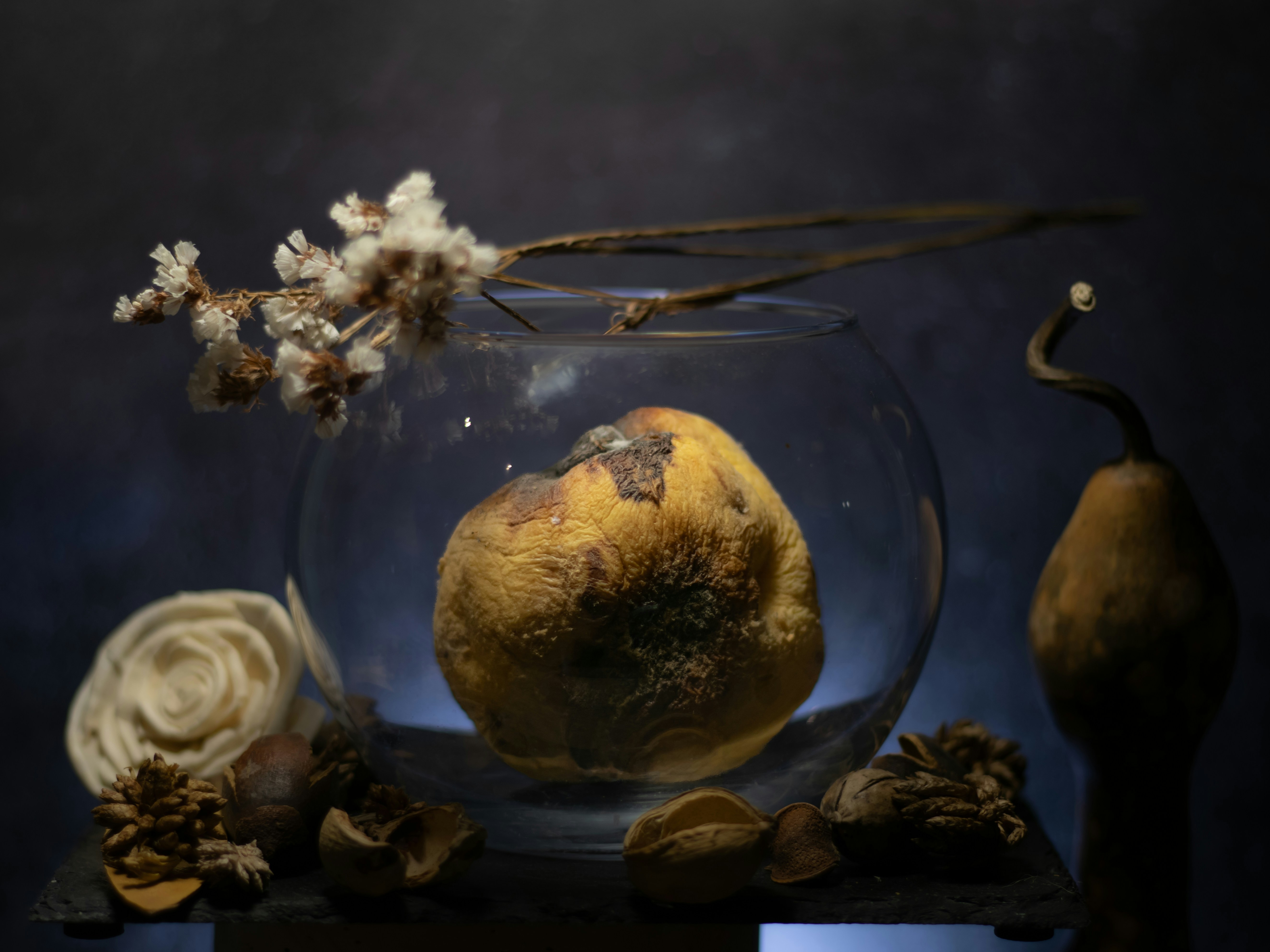
Bracing herself, Anais held her breath and dove into the stench of the next room. At the epicentre of that smell she found the altar of the abbey, its centre of worship, and where the sisters were offloading all of their food. Small wonder that they were all of such small frame, for the sisters of this church had piled their crops high in the centre of the aisle, where they sat, rotting and inedible.
“No, stop!” Anais cried, running to one nun who was just joining the circle around the rotting heap. She grabbed at the victuals in the old woman’s hands, but the sister was stronger than she appeared, or Anais was weaker than she knew, and the woman batted her aside with ease before destroying the food that Anais so desperately craved.
“Gaudé!”
The chant came louder than ever, but what was once a beautiful song that promised to carry Anais to heaven was now a hammer against her brain, knocking her senseless and reeling to the floor. On her knees, she supplicated herself before the altar and was finally brought to prayer.
“Please, God, just one bite.”
While she prayed, while she begged, the whole congregation had gathered around the decaying altar. Anais scrabbled around on the floor trying to get past their legs, to grab something, anything to eat, even if it was rot, but the sisters’ legs made a forest more dense than the one Anais had fought through outside. And still the chant went on, louder and more frequent.
“Gaudé!”
The sisters formed a perfect circle around their festering offering.
“Gaudé!”
The whole room breathed in and out with the rise and fall of the sighing song.
“Gaudé!”
The pile of vegetables, brown, black, liquid, and stinking, heaved up with each swell.
“Gaudé Hecate!”
The pile grew before Anais’ eyes. It rose high, its form shifted, cohesion came out of incoherent flesh.
“Gaudé Freya!”
The sisters fell to their knees and raised their hands to the heavens.
“Gaudé Morrigan!”
The chanting ceased. The rotting vegetation morphed itself into a hideously recognisable form: arms, legs, a sickening, nauseating face. Anais screamed and as that scream echoed around the chamber, it stole all other sound with it and left girl, nuns, and creature in silence.
The composting entity moved with a grotesque undulation towards the nearest sister, who was bent back in joyous supplication, and took her aged face in its hands. The creature leaned down, bringing its face close to the nun’s, and then kissed her, deep and passionate. Anais’ empty stomach crunched in rebellion at the sight of this carnal prayer, but she could not pull her eyes away, caught in morbid curiosity.
From life’s decay, fertility springs and life begins anew. As the sister and the creature kissed, the skin on the sister’s face pulled taut, her cheeks became plump, her crooked fingers broke free from their arthritic claws, soft and supple with youth. All her years fell away and what was left before Anais was a girl her own age, still blind, but healthy, glowing.
One by one, that ancient god of decay moved from woman to woman, leaving girl by girl. Finally, the hideous vision moved over to Anais. It looked down at her and offered a dripping hand. Struck numb by the miracle she had just witnessed Anais could only allow herself to be lifted to her feet. The stench of the creature’s breath was overpowering, so strong that it pushed Anais beyond sickness and fogged her mind into a waking slumber. She gently opened her mouth, just a fraction, and the god of filth moved its face down to her, locked its lips against hers, and pushed its putrescence into her.
The wound on Anais’ leg sewed itself closed, her rumbling stomach settled, and warmth spread through her body. The heat within her rose from her toes, across her loins, up through her stomach, growing in intensity as it moved up towards her head. Her whole body became white hot, and with nowhere left to go, that searing heat escaped through her eyes as blinding white light, burning the vision from her head. The last thing Anais ever saw was the beauty of the goddess before her, who filled her with this sacred light.
From behind her, one of the sisters approached and wrapped a cloth around Anais’ now useless eyes, and as one Anais and the whole congregation sang out in jubilation.
“Gaudé!”
[Michael Staniforth is an ex-academic turned engineer, a hobbyist folklorist, and an amateur student of human consciousness. They have always had a fascination with the darker side of human nature and what we can learn about ourselves and each other from those things that we fear. They live in the Midlands of England with their partner and enough unread books to fill them with a deep sense of existential dread. Their work has been featured in A Coup of Owls, in 4 Horsemen Publication’s Invoking Destiny anthology and in Red Cape Publishing’s U is for Unexplained. Bluesky: @staniforthmick.bsky.social Webisite: mickstaniforth.wordpress.com]
 Eternal Haunted Summer