
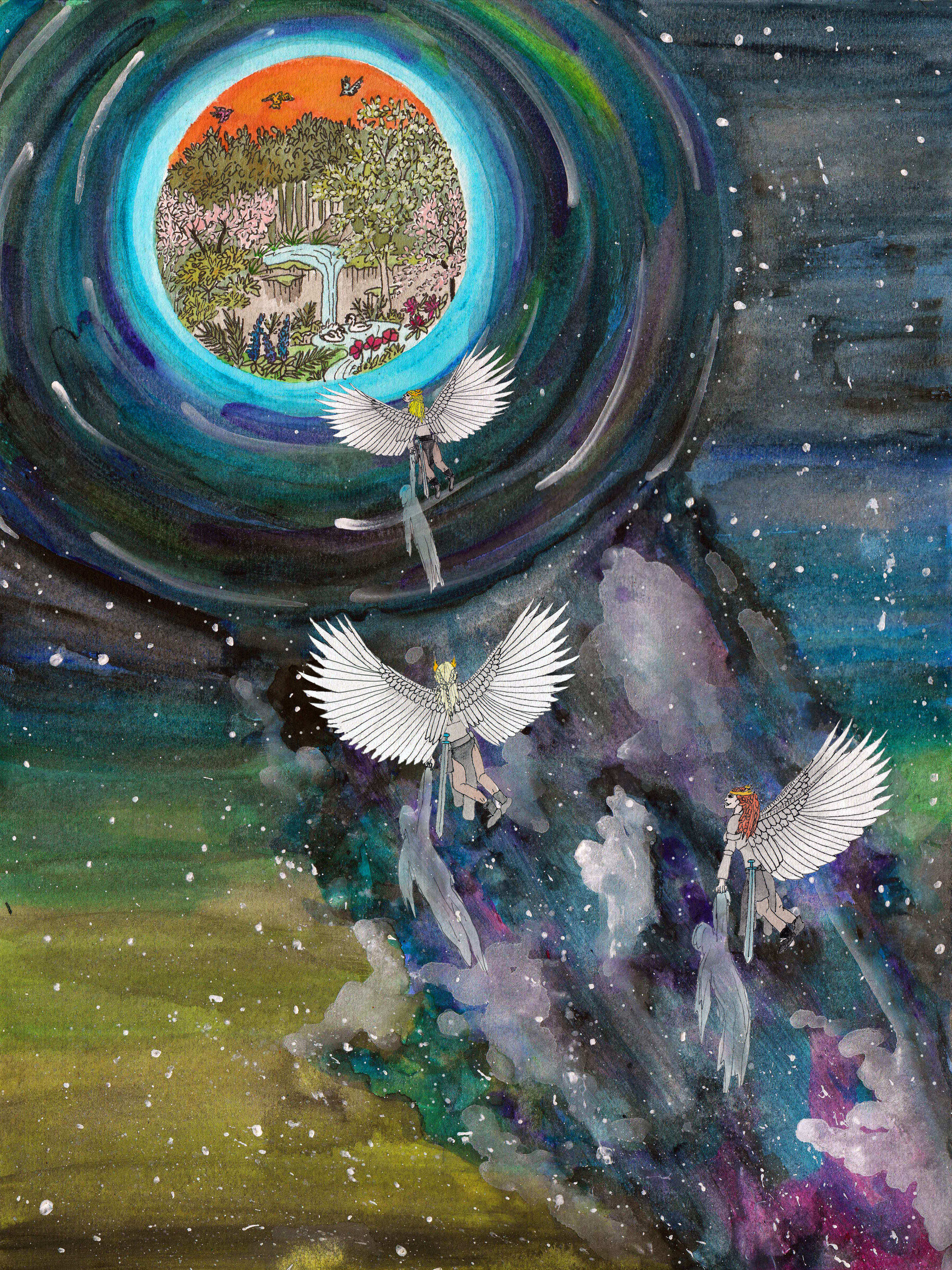
[This issue, we sit down with author Ben H. Gagnon. Here, he discusses his personal spiritual practice; his book Church of Birds; the research that went into it; and his upcoming projects.]
Eternal Haunted Summer: How do you define your personal spiritual practice? Does it have a name or is it more intuitive and eclectic?
Ben H. Gagnon: My overall interest is in stripping away the cultural conditioning that forms like a mantle on a person’s identity and acts like a lens to frame our perceptions – it also limits how we understand our observations of the natural world. My spiritual practice is to take meditative walks on forested trails that are removed from any modern sights so I can focus on my breathing and try to simply take in what I see. I go to a waterfall every day and look at the dancing eruptions of foam for 10-15 minutes at a time to help me observe moment-by-moment and remove the cognitive instinct to constantly interpret what I’m seeing.
EHS: Which Deities, powers, or other spirits do you honor in your tradition?
BG: I don’t relate to specific deities or powers, but I do believe there are unknowable energetic spirits that come and go in our lives. They may be attracted to us at times because the path we’re on resonates with their own history, and they can act as guardians or guides to reveals stories from the past that they want to be told. I believe we often experience this kind of interaction as unexplained coincidences that seem to confirm that we’re on the right path.
EHS: You released Church of Birds: An Eco-History of Myth and Legend through Moon Books. First, congratulations! Second, why Moon Books? Did you approach them with the idea or did they come to you?
BG: I approached Moon Books because of their interest in similar esoteric topics with an emphasis on the nature religions and pagan beliefs.
EHS: How does an “eco-history” differ from a regular history text?
BG: My book focuses on how our distant ancestors were guided by a set of beliefs that arose from their deep ecological awareness and understanding of how the natural world works. They saw cycles within cycles in contrast with the western world’s artificial perception of time as a straight line going onward and upward, a perception that intrinsically disrespects the knowledge and capabilities of our ancestors. The word “eco-history” is meant to convey that early human history, long before the Abrahamic religions, was shaped by an intuitive understanding of how humans fit into the ecological realities of their surroundings. For example, ancient myths show it was once common knowledge that migratory birds carried seeds – our ancestors correctly perceived that large and diverse bird populations were an indicator of bio-diversity and bountiful resources. (Modern science finally caught up with this knowledge in a 2016 study published in The Royal Biology showing that birds are a “vector of seed dispersal.”) The sites of early human habitation and location of ancient capital cities has an extremely high correlation with the confluences of two or more bird flyways, producing high populations and a wide diversity of birds.
EHS: In Church of Birds you discuss the influence of birds on human spirituality, with numerous Gods and culture heroes appearing in avian form. What do you think is one of the best examples of this real-world influence on our sacred stories?
BG: The fact that divine birds are found in ancient artwork and myth across dozens of cultures dating back at least 40,000 years represents the most profound evidence that birds held a special meaning in human spirituality. Perhaps the most elegant story is found in the Finnish epic Kalevala, which describes swans carrying human souls on a cosmic winter migration along the Milky Way. Their destination was a paradise known as Tuonela at the northern celestial pole, where circumpolar stars turned around the hub of universe, where souls were healed and rejuvenated before returning with the swans for their next life the following spring. This story was the origin of the myth about storks carrying infants.
EHS: What sort of research went into Church of Birds? Long walks outside? Big stacks of books? Conversations with folklorists and mythologists?
BG: All of the above. Unfortunately, the discipline of anthropology simply does not perform cross-cultural studies to gain insight on the shared qualities of human nature, so I spent years reading books about dozens of ancient and indigenous cultures to find myths and religious texts relating to birds. Long meditative walks in nature helped me see through the eyes of our distant ancestors. I also contacted several authors, including shamanic practitioners, for deeper conversations. For several reasons I couldn’t include the latest bird migration maps in the book, but I studied them closely along with the earliest sites of human habitation to demonstrate the extremely high correlation between the archaeological record and the busiest bird migration corridors and largest seasonal grounds in the world.
EHS: What bit of folklore or history did you absolutely have to include in the book?
BG: The anchor of the book is the section on how so many ancient cultures celebrated the cycle of life and death by involving the entire community, which I believe was a brilliant way to handle the trauma of such events. In England, France, and Ireland, a mix of direct and circumstantial evidence suggests that several thousand people gathered for feasts at huge U-shaped enclosures made from stone walls as part of communal burials in late autumn. The gatherings coincided with huge flocks of birds taking off on their fall migrations, enabling the souls of the dead to be carried up to the heavens. I can only imagine how comforting it must have been for people to come together for feasting, music, and dancing to celebrate the continuum of life as birds carried the souls of loved ones beyond the horizon to a place of healing and rejuvenation. It is undisputed that dozens of cultures linked birds with the conveyance of souls to the afterlife, and there is considerable evidence that communal autumn burial rituals associated with bird migration occurred across numerous cultures.
EHS: You are also the author of People of the Flow, a metaphysical novel about megaliths, sacred sex, and mysticism. What inspired your novel? And are you planning to write more fiction?
BG: I was fascinated by the rituals that once took place at megalithic temples and thought the best way to convey the drama of those long-forgotten events was through the eyes of characters who were excited to explore the meaning of sacred sites in Ireland such as Brú na Bóinne. As a novel of historical fiction, it was also a way to celebrate the incredible Celtic Revival of the late 18th and early 19th centuries, a movement that revived the history, folklore, and myths of ancient Ireland while simultaneously saving the Gaelic language. It was also a good reason to visit Ireland and explore part of my own heritage.
EHS: What other projects are you working on?
BG: I’m working on a science fiction novel based on the idea that a Museum of Earth Studies has existed for a million years inside a self-sustaining dome buried on the dark side of the moon, hosting advanced cultures who study and enjoy the history of humankind. They invite selected humans to come and learn amazing things about human evolution and history. It’s modeled on the approach taken by Jules Verne, who told stories of incredible journeys while educating readers about modern science and compelling theories along the way.
EHS: Which book fairs, conventions, or other events do you hope to attend in the foreseeable future?
BG: I’ve made public presentations at a number of venues in the past around the New England area, but unfortunately there are no specific fairs, conventions, or other events that I’m currently planning to attend.
 Eternal Haunted Summer