
[This issue, we sit down with the creative team behind Weird Fiction Quarterly. Here, Scott J Couturier, Chris Karr, Shayne Keen, and Sarah Walker discuss how the journal got its start, what goes into creating each issue, some of their favorite weird fiction, and their upcoming projects. Eternal Haunted Summer has been privileged to feature Couturier, Keen, and Walker in multiple issues — including the current Summer Solstice 2024 edition. So, after you finish this interview, be sure to check out Couturier’s short story “The Rose Bush” and Walker’s poem “Night Garden.”]
Eternal Haunted Summer: To date, seven issues of Weird Fiction Quarterly have been released. Congratulations! Why a literary journal dedicated to weird fiction? What inspired you to launch this endeavor?
Shayne Keen: Russell Smeaton started Weird Fiction Quarterly (from here on out WFQ) as a way to prove that you can publish something good yourself, fast and cheaply. He did the covers on the first three issues (and on the 6th) and invited friends of his to contribute. We were all among the first contributors and invited. Those first issues were pretty bare-bones and stripped back, just stories and a cover by Russell.
Chris Karr: As Shayne mentioned, all credit for this concept goes to Russ. I’ve known Russ for well over a decade now, given that he was one of the most prolific contributors to The Pnakotic Atlas. I served at times as a reader / light editor for him as he was getting his own writing career running — I was and remain a big fan of his Bryan the Cat stories — and when he launched WFQ, he invited me, and ended up publishing my first non-academic writing. When life threw him some curveballs and he had to hand it off to us, it was an absolute no-brainer to keep the work going. I felt like he captured lightning in a bottle with the format, and each subsequent installment has proven that correct.
Sarah Walker: Yes, Russell Smeaton had this amazing idea for a flash fiction quarterly and started the magazine as mentioned. I have been in a few books alongside Russell and he invited me to contribute to Weird Fiction Quarterly. I also have loved and followed Russell’s art and writing for ages and knew he’d done something special with WFQ, so when he asked for us to take over when he had some stuff to take care of, we all were excited to help.
I definitely agree with Chris, Russell caught lightning in a bottle with Weird Fiction Quarterly!
Scott: Russell gets all the credit; like the others, I’m a longtime fan of his fiction and artwork, and received an invitation to contribute to the first issue. As to your question “why,” all of us are pretty adamant fans of weird fiction as a genre, and we all enjoy seeing communities of writers prosper. It’s true that every issue of WFQ gets better, so to experience that investment returned tenfold with the quality of the material…let’s just say it’s a labor of love.
EHS: What goes into putting together an issue of WFQ? About how long does it take and who on the staff is responsible for which elements?
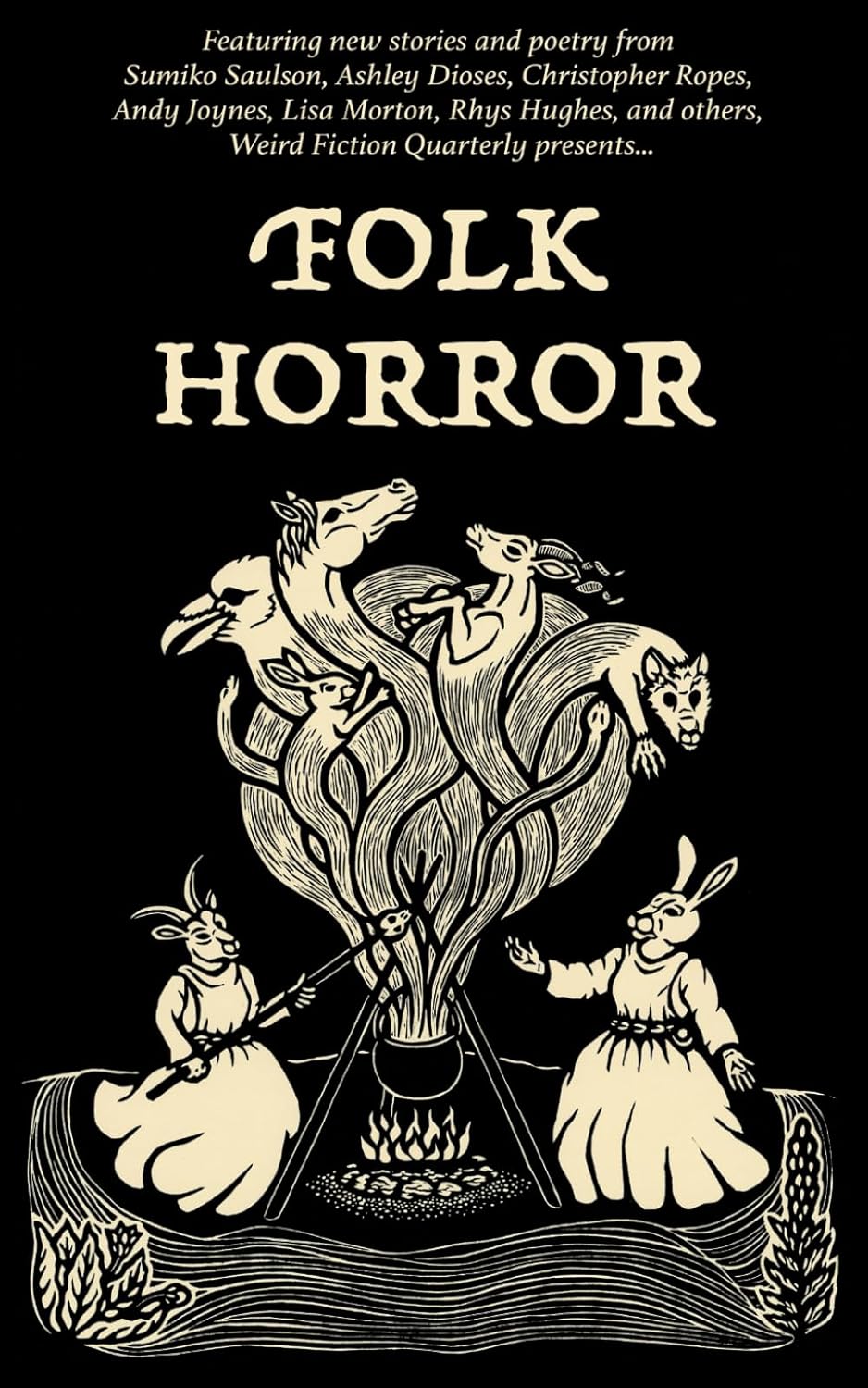
Shayne: Putting together WFQ, because we are quarterly, is pretty much steady work. There might be a week or two here when an individual member of our team doesn’t have much to do, but somewhere behind the scenes someone is always working on part of it. As far as who’s responsible, Scott and I are the first readers and if we both like a story it generally will get in. If we are tied or if there’s a conflict of interest we defer to Chris and/or Sarah to make a decision. A lot of behind the scenes stuff goes on, but for my part I generally help the writers if their submissions need some work, arrange the order of the ToC after we have all the stories in, and write the first draft of the back copy. I also talk to the Ducks who are responsible for what names go on the cover and help translate that into human speech. I wrote an introduction for the Folk Horror issue. I just do what I figure needs done a lot of the time.
Chris: Scott, Shayne, and Sarah do the valuable work when it comes to curating, editing, and improving submissions, but behind the scenes, we’ve also built a good deal of supporting legal and technology infrastructure that has streamlined the publishing process significantly. One of the unique challenges dealing with installments with sixty or more contributions four times a year is first getting their stories published and in front of readers, but we also have contracts for each contributor to sign each time, a system that calculates the royalties we owe each author, and fulfilling our requirements for providing electronic contributor copies, as well as offering at-cost author copies.
Our next challenge we’re looking to tackle is building a suite of tools that will help our contributors more effectively market their contributions to their respective audiences, so that we can sell more books and get our authors paid as well. We’re really trying to put together a sustainable model that does right by both ourselves as publishers and our authors as well. After Amazon and the various online stores take their cuts, we pay 75% of those remaining proceeds to authors as royalties (the remaining 25% to be used for operational costs) and we offer an up-front advance (that may vary by installment) to our authors as a way to signal that we’re serious about making sure that writers are fairly compensated for their work.
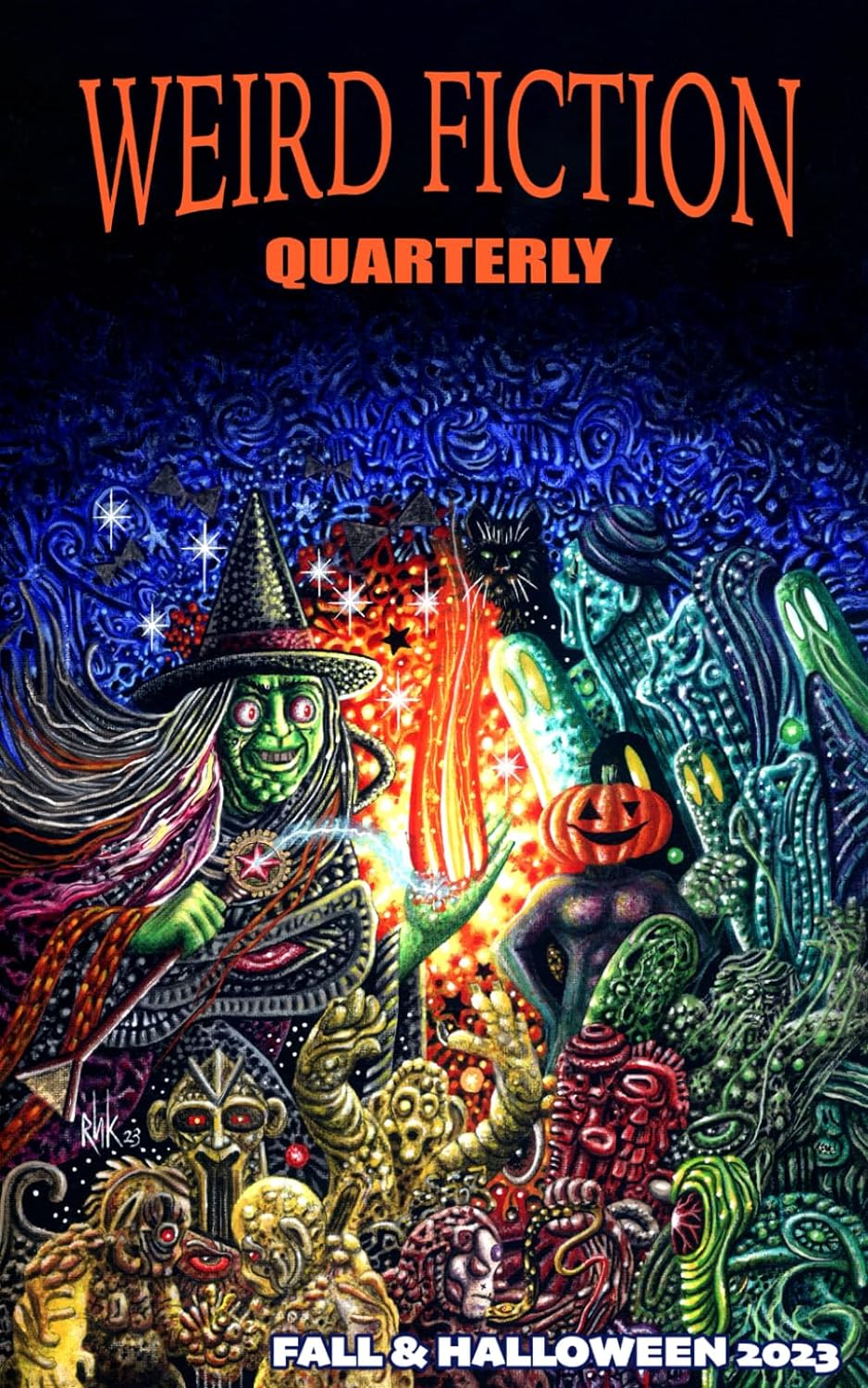
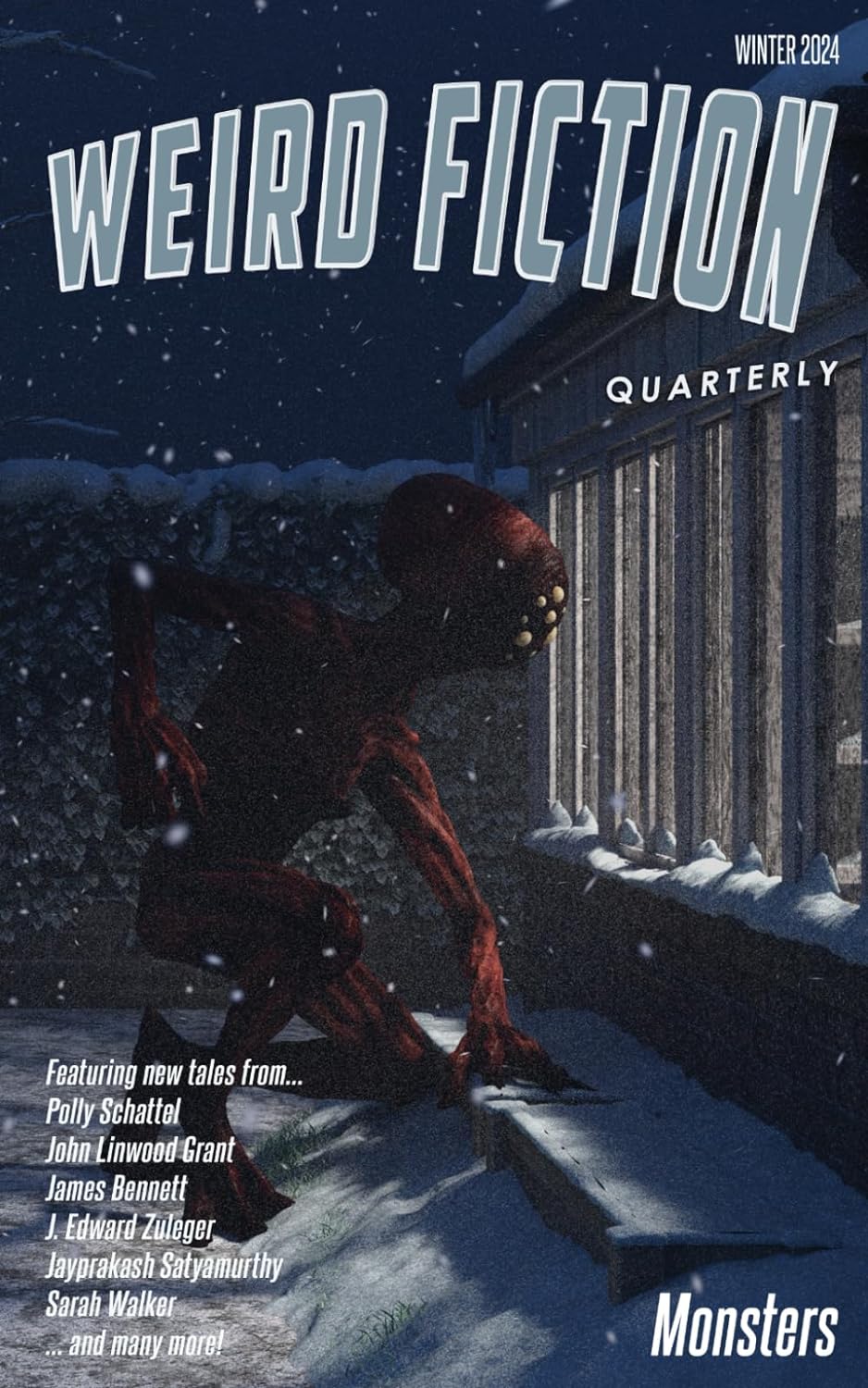
Sarah: As Shayne and Chris both mentioned, putting together these issues is a ton of work! Shayne and Scott have done amazing editing work while Chris has used his computer wizardry to help automate the process. I edit some, but the majority of it is done by Scott Couturier and Shayne Keen. My abilities tend to be in more artistic jobs like doing the illustrations for stories. Some I paint, some are digital, some are ink, and most are combinations of multiple medias. I am also working on finding new and amazing artists to feature on the cover, as well as wrangle new writers and beginning work on the single author chapbooks coming soon from Weird Fiction Quarterly!
Scott: One thing I enjoy about working on WFQ is the compartmentalization of tasks. Shayne and I handle the submission process, then Shayne figures out the TOC while Sarah works up the artwork for each issue. Meanwhile, Chris is busy with a dozen tasks, not the least of which are marketing and formatting. Then of course, we’re all contributing fiction too; things can get a bit hectic behind the scenes (in a good way). I’m responsible for providing the final copy edit of the contents, which means standardizing punctuation and grammar throughout (though I try to maintain regional spellings, as our authors come from all over the world). I’ve worked as a content and copy editor for many years, and really appreciate being able to use my skills on a project as personal as WFQ.
EHS: WFQ features stories of exactly five hundred words. Why that flash fiction format?
Shayne: That was Russell’s vision from the beginning, and as they say “if it ain’t broke don’t fix it.” We also accept poetry now (which Russ did not do) and that has a different set of rules, but still the max limit on poems is five hundred words.
Chris: I believe the five hundred-word format comes from the H. P. Lovecraft Film Festival’s micro-fiction contest, where Russ submitted some of his earliest stories, and won a few along the way. I believe a number of the contributors for the first WFQ were other contestants in those contests, and he carried forward that 500-word format that they were already familiar with.
Sarah: Yes, it was Russell’s idea as well as the Lovecraft Film Festival’s format. I also think that five hundred words is a sweet spot for many tales. It allows for some build up but not so much that tension is lost. It guarantees a punch to the reader (to be effective). It’s been fun as well to play with this idea for many of our bigger authors who normally write four hundred page novels. With so much nasty in the world right now, I feel like Russell created a place where writers and artists get a chance to play a bit! We all want to support that!
Shayne: I had no idea that Russ got the idea from the HPLFF, you learn something new every day!
Scott: It’s all Russell’s fault! But beyond that, it makes you a better writer to hone in on successfully conveying an entire story (introduction, build of tension, apex of horror or other denouement) within a precise format of five hundred words. Also, there’s a rhythm developed by successions of stories of exactly the same length, which makes WFQ fun to read. Lately we’ve broken that up with poetic contributions, only serving to further diversify each issue.
EHS: The most recent issues have been themed. Are you planning to continue with themes and, if so, have you selected them?
Shayne: We kick around themes a lot, we’ve had several suggestions from our writers that might become the themes of future issues. There were always themes though, the first year was Winter, Spring, Summer, and Fall.
Sarah: Yes. We have always had themes and will probably continue this. It gives folks a mark to aim for.
Scott: The theme for each issue provides a jumping off point for the imagination. I’m always surprised by where I end up, which is part of the appeal. WFQ should be fun for both the writers and readers (not to mention editors).
Q: Where can readers find WFQ?
Chris: The best place to find us is on our website at weirdfictionquarterly.com. There we announce updates, and provide links to places for purchase. We’re currently distributing physical copies via Amazon and Barnes & Noble, and readers can fetch electronic copies at Apple, Google, Amazon, Barnes & Noble, and Kobo.
We’re also working to be sure that our contributors have copies that they can sell in-person when they’re visiting various conventions and shows.
We’ve also been known to publish some stories on our website. Last year, we celebrated Yule with The 13 Days of Weird Flash, where we republished stories that had appeared in the year’s volumes. If I can stir up enough contributor interest, I’d like to do the same thing once more this year.
Finally, in addition to our four annual paperback installments, we’re also working on getting an annual omnibus edition out to readers that collects the year’s volumes into a larger premium hardcover format for folks who would like to get caught up that way. I’m overdue in getting that out this year, but subscribe to our newsletter or join us on one of the social media sites (Facebook, Twitter, Bluesky, Mastodon) for an announcement when that will finally be ready.
EHS: In addition to WFQ, which other weird fiction novels, novellas, stories, and poems do you recommend?
Sarah: I recommend anything by Gemma Files (there’s a reason she keeps winning Stokers folks!) along with Rebecca Allred, John Langan, and Scott Couturier in fact! If you haven’t read Matthew Bartlett yet, do it! You won’t be disappointed. If you’re wanting some Weird dark poetry, try Adam Bolivar, Ashley Dioses, and KA Opperman. Want to really squirm? Paula Ashe is the most amazing for hard horror.
Or maybe you want something Lovecraftian, weird and a little more classic Lovecraft? Then check out anything by David Barker. Especially his work with Pugmire. I also am a big fan of Peter Rawlik. He does wonderful tales based on Lovecraft’s world and his books always cheer me up. Great weird meta horror can be found with Gordon White, and really he writes some stuff that will crawl under your skin and refuse to leave.
John Howard writes more traditional horror. His character development is stellar.
It is frustrating, as I know I am forgetting many worthy people! Manuel Paul Arenas for instance. He does both poetry and short stories and they are fantastic!
There is a kind of Renaissance of weird going on right now and I promise you there is something for everyone out there!
Scott: Focusing on classic weird fiction, I recommend (for the seeker beyond Lovecraft) the work of William Hope Hodgson, especially his novel The House on the Borderland. Also Stefan Grabiński, a Polish writer and temporal contemporary of Lovecraft, whose work is just now coming into full translation in English. The collection The Dark Domain is an excellent place to start. For stories of superior strangeness, decadence, and dreadful beauty, look no further than Clark Ashton Smith; his complete fictional works, restored to the original drafts, have recently been released in a six-volume series by Nightshade Books. Another writer who deserves significant attention is C. L. Moore, who wrote some of the most terrifying and ingenious stories ever published in Weird Tales. Her Jirel of Joiry is the original sword-wielding warrior woman, while her spacefaring Northwest Smith tales prefigure so much modern popular culture it’s hard to believe they were written in the ’30s. The titular character even became the model for Han Solo. I’ll stop myself there, but I could definitely go on!
(Okay, one more. Arthur Machen is incredible: The Three Imposters, The Great God Pan, and The White People are essential reading.)
Shayne: One of the reasons why I feel so incredibly lucky to be in this position is that my favorite writers of the Weird happen, for the most part, to be regular contributors to WFQ or have been guests at least once! I love the works of Christopher Ropes, Melanie Crew, Jayaprakash Satyamurthy, M. Ennenbach, Jay Sturner (who isn’t writing right now but I do hope he comes back to it), my cohorts Sarah Walker, Chris Karr, and of course Scott Couturier. I love the writing of Polly Schattell and James Bennett and John Linwood Grant all of whom are making waves and ripples right now. I think Glyn Owen Barass, Andy Joynes, Simon Bleaken, and Sumiko Saulson are all wonderful writers everyone should read! Erica Ruppert does heinous wonderful things with the weird and you, Rebecca Buchanan, are also top-notch! I can’t just list everyone who appears in WFQ, but touch a name in the ToC and I guarantee I love their work!
As far as people who haven’t appeared within the pages of WFQ so far, I love the works of Zin Rocklyn, Brookelynn Warra, Paula Ashe, and Brian Evenson. Matthew M. Bartlett just announced a new omnibus and I’m very excited for that. His work, like John Langan’s, is already classic in my opinion. Again, with the fear of repeating myself Russell Smeaton is a big literary and artistic love and I dig Duane Pesice’s stories a lot, his early Planet X anthologies are a part of the reason so many of us know each other (waves at Sarah).
As far as poets go I really like Opperman, Dioses, and both the Arrington sisters Chelsea and Hayley …here I go again naming people we regularly publish, but seriously I could fill up a whole page with current writers whose work I really adore.
As far as the classics go I love Robert E. Howard, Clark Ashton Smith, Michael Moorcock, Arthur Machen, and C.L. Moore! Billy Martin/Poppy Z. Brite is one of my favorite writers of all time! His early books did so much for me it’s not quantifiable. So much good stuff out there to read from any time, so much of the best is just Weird as hell!
Chris: I’ll keep it short and plug Jeff VanderMeer as one of my favorite contemporary authors working in the weird tradition. One of my favorite online places for some of the most creative weird fiction out today is the SCP Foundation, and especially the Antimemetics Division pieces by qntm.
EHS: Which book fairs, conventions, or other events do you hope to attend this year? Either on your own or as part of WFQ?
Shayne: We’ll be at NecronomiCon Providence this year. I’m looking forward to meeting so many folks I “know” online but not in real life. I’m already nervous about it!
Chris: We also have a number of authors around the country showing up to various pop-culture and horror conventions. We had a decent number of authors earlier this month signing at StokerCon.
Sarah: Some of our writers were at Stoker and all of us are going to NecronomiCon! I will be on the stop motion panel as well. Come by our table and say hello! We will have books, art, and more 🙂
Scott: We are NecronomiCon-bound! Beyond that, no other traveling plans this year. But very much looking forward to Providence, and meeting so many writers and artists I’ve gotten to know via social media over the years.
EHS: What other projects are you working on?
Shayne: I’m putting together a short story collection, but WFQ is the main thing I have going on right now. On other fronts Scott and I are also currently working on the third Nefarious Foodie album, which is also a great time. The only writing I’m really into doing right now is flash fiction, most of which is exactly five hundred words :).
Sarah: I am still working on finishing up my first full-length novel with the help of some good friends up here in the Pacific Northwest. I am not sure where I will be publishing yet, but the story is based on folk horror, legends, and alien life forms.
I also have a number of cool projects I am part of, including having two of my stories in the upcoming collection of short stories from Demagogue Press where each story written was based on the art of the brilliant artist Steve Graziani. Adam Bolivar and David Barker are also involved in this upcoming anthology, so keep your eyes peeled! There is a Kickstarter that will go live this September, and the title is Art Born Words, so keep on the lookout for that. The art is gorgeous. It is a collection of Graziani’s etchings from over the last 40 years. It is going to be a really special book!
I am also finally getting ready to do the Kickstarter to make the Experimental Files anthology a reality. This will be a charity anthology (all profit goes to Autism Works) celebrating the work of Gemma Files! The Kickstarter will launch this upcoming October due to some scheduling conflicts, but it’s on its way! We also have John Langan writing the foreword and WFQ will be publishing it. I will have some art in it, and there might even be a surprise guest artist!
We also have some big surprises coming soon from WFQ, including a couple of planned single-author illustrated by me chapbooks from some incredibly talented writers. We will have more on that soon.
Scott: Currently I’m in the process of revising the contents for my second collection of weird fiction, tentatively titled From Weir. I just recently sent the manuscript for my second poetry collection, Nightmuse: Poems of Speculative Darkness, to my publisher at Jackanapes Press, with an estimated release date either late 2024 or early 2025; I’m on the edge of my seat to see what artwork editor, designer, and illustrator Dan Sauer comes up with. Meanwhile, my first short story collection, The Box, will be transitioning to a new publisher. This updated edition, due out next year, will be revised and feature three new mini-stories, which I still need to get working on. Meanwhile, I push myself to write at least one story a month, and poetry as it decides to come. My thoughts are finally turning to a novel I’ve had on the backburner for some years, with an aim to completing it by 2026. A novella of mine is (tentatively) also coming out soon, in a venue I can’t name yet …. So, I’m writing a lot! On the music front, Shayne and I are in a band together (Nefarious Foodie), and we have a new album due out later this year.
Chris: I’m looking forward to dusting off The Pnakotic Atlas and giving it a facelift and overhaul before this year’s NecronomiCon. I say that every summer before the show, let’s see if I’m successful this time.
 Eternal Haunted Summer