
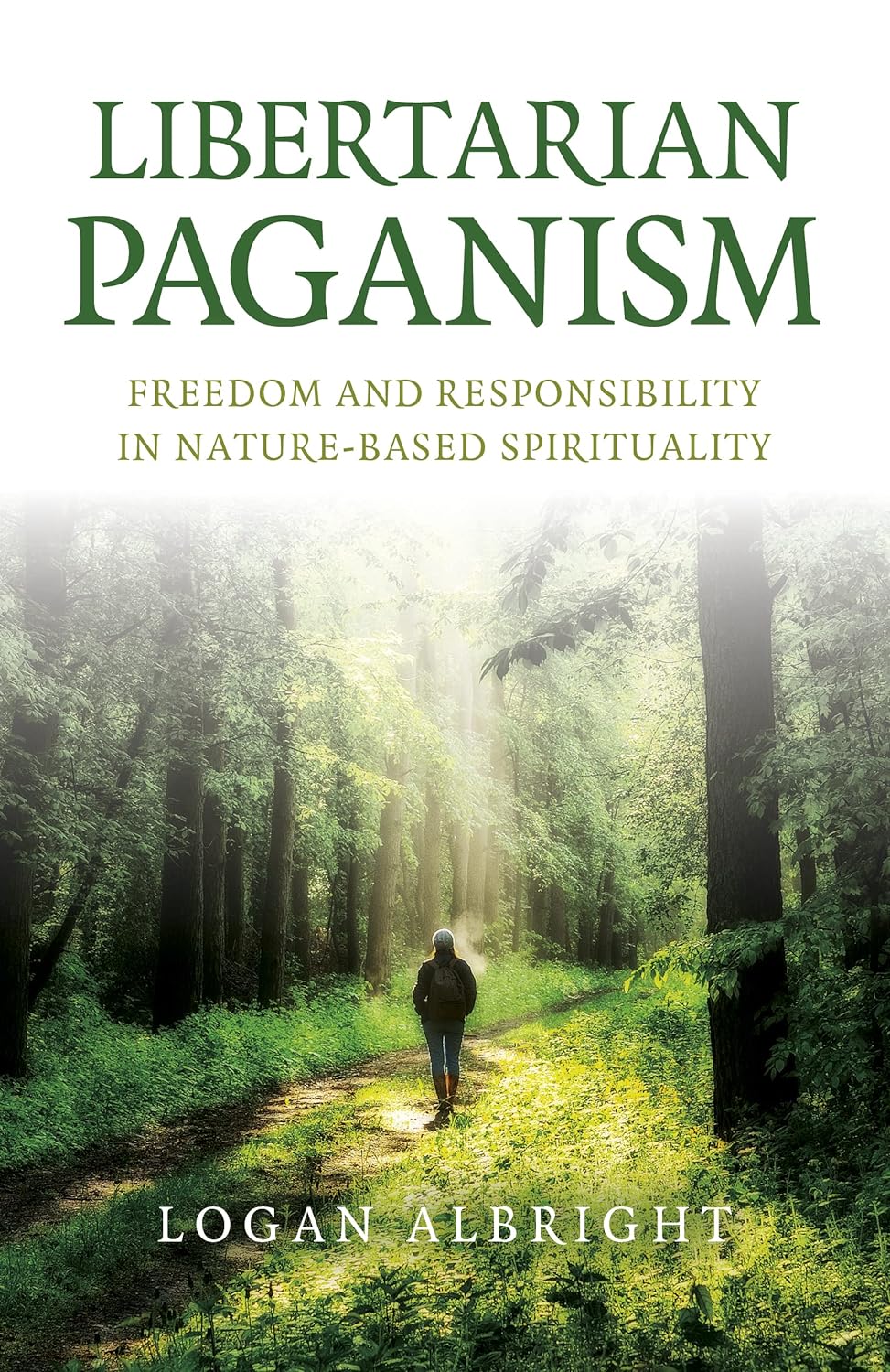
Title: Libertarian Paganism: Freedom and Responsibility in Nature-Based Spirituality
Publisher: Moon Books
Author: Logan Albright
Pages: 224pp
Price: $17.95 / $8.99
Libertarian Paganism: Freedom and Responsibility in Nature-Based Spirituality by Logan Albright sets the tone with the cover art, which features a lone figure on a path through the woods. This is the author walking his path, or perhaps the reader walking their personal path. It’s the perfect metaphor for someone who sees his paganism as an expression of individuality rather than a collective identity such as an ethnic culture.
In the Introduction, the author points out similarities between paganism and small-L libertarianism as a philosophy, including: 1. Individualism; both are non-dogmatic with respect for individual choices. Both groups are full of noncomformists. 2. Third way; the author writes that people in the USA are expected to pick a team, either D or R, which means half of society will hate them. Libertarianism does not adhere to left or right but only freedom versus authoritarianism. Paganism can also be seen as a third option for those presented with a choice of Christian or atheist.
In Chapter 1, the author defines his terms. He makes it clear he is talking about libertarian philosophy, not the Libertarian Party. He identifies various sects of modern paganism. Albright goes over the origins of liberalism and how the word libertarian was coined to express older forms of liberalism after the term liberalism shifted meaning. He details different kinds of libertarians.
In Chapter 2, Ethics, the author compares pagan and libertarian ethics. He focuses on Wicca’s “an ye harm none, do as ye will” and the Libertarian Non-Aggressive Principle. Rather than explore other basics of pagan and libertarian thought, the author takes a detour into Satanism, presented as a kind of atheism.
Several of the chapters are like this, starting with a topic from which the author veers toward the end. For example, chapter 7 is supposed to be about diversity but is mostly about the evils of collectivism and the tyrannies of the 20th century, although the author does point out where he is speaking of his own opinions, where he speaks of the orthodoxy of the Libertarian Party or of pagan organizations. There is a whole chapter in which the author conflates a pagan world-view with Kabbalah, which is expressly Jewish and therefore not pagan.
Some of the starting points in the book seem oddly dated for such a recently published book. For example, in Chapter 4, the author starts with an overview of the political affiliations reported in the classic book Drawing Down the Moon, which reported a high percentage of anarchists among pagans of that era. Albright then writes about political views that pagans and libertarians hold in common, such as being in favor of freedom of religion.
Despite those drawbacks, this book is definitely worth reading for anyone interested in both paganism and libertarianism. It yields a lot of food for thought. Some of the of discussions in the book even prompted me to discuss things with my gods. The book is written for the general reader in clear, non-academic language. It’s one of a kind in examining the intersection of these two philosophies. I recommend it for anyone interested in the topic.
[Erin Lale is the author of Asatru: A Beginner’s Guide to the Heathen Path. She writes the Pagansquare blog Gnosis Diary: Life as a Heathen, and writes and edits fiction and nonfiction. Her website ishttps://www.erinlaleauthor.com.]
 Eternal Haunted Summer