
[Welcome to our first Special Feature! While Forests Haunted by Holiness has included many interviews with authors and reviews of books over the last two years, this Special Feature marks the first appearance by a guest writer. Below, please find the haunting, apocalyptic tale of survival Iron, Cold Iron by Jennifer Lawrence.]
Iron, Cold Iron
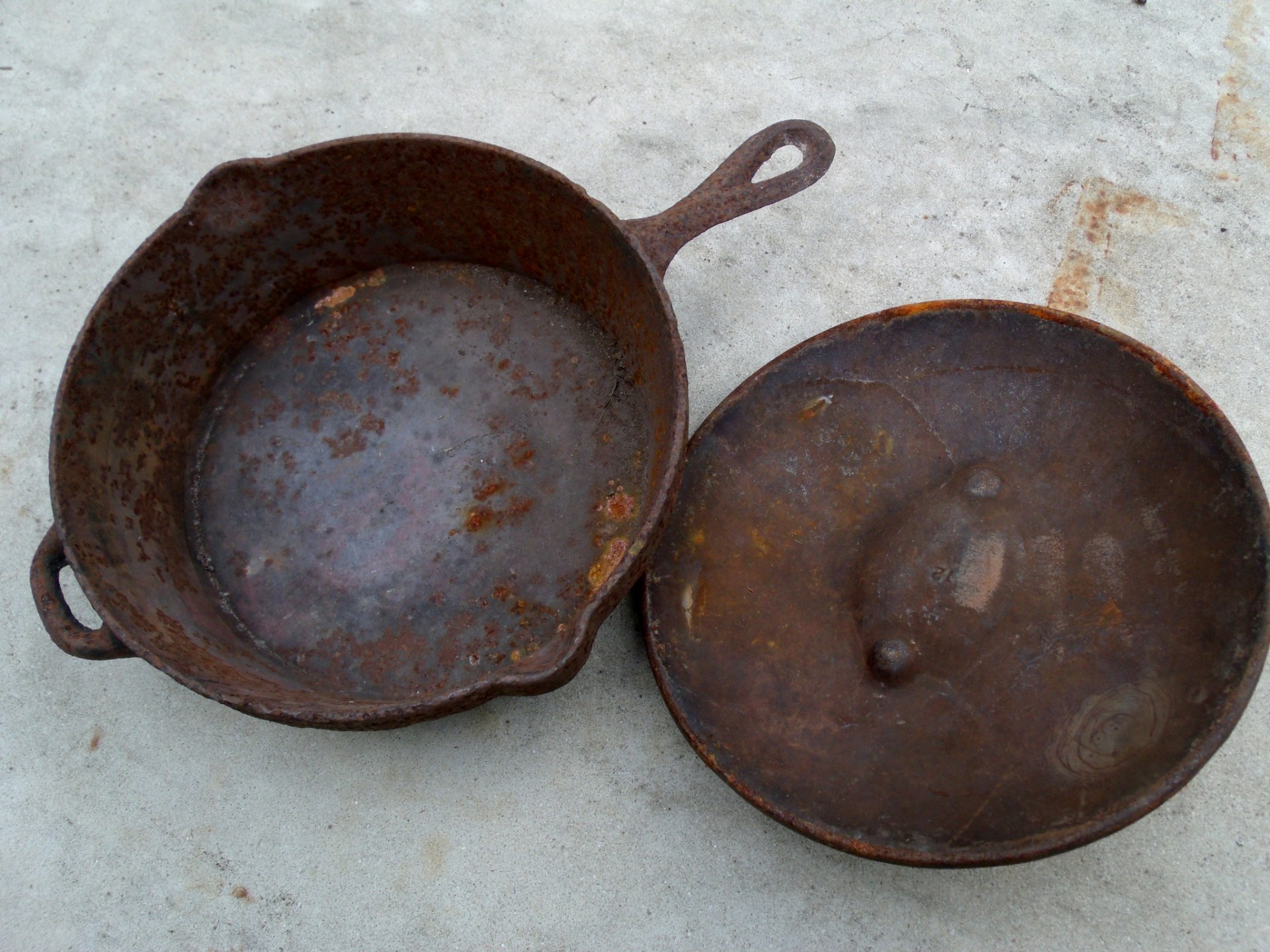
Finally found Mom’s old cast-iron skillet today. The thing is huge, as big across at the top as a standard-size pizza pan. I dragged it home with me, staying out from under the brilliant greenery that was the new leaves on certain trees — oak, ash, apple, blackthorn, hawthorn, rowan. Also went circumlocutiously, staying far away from Royal Street and Gentry Lane. Too close to the end of April to take the chance, really.
When I got home, I set the pan down and hung up my coat, making sure it was still turned inside-out when I hung it up. I had originally thought to make the walk over to Mom’s house — and it had to be a walk, cars don’t work anymore and bicycles move too much like prey animals; I can’t begin to imagine how horrific it would be if one caught me — to get the pan to add to my wards, but now I’m not so sure. So far, the horseshoes and railroad spikes at every window and door (and sink drain and foundation crack and space under the floorboards) seems to be doing the trick, so maybe I’ll keep it as a weapon, instead.
They came back to this world in the third week of March, or thereabouts; I’ve read that the vernal equinox (as well as autumn equinox and the two solstices) aren’t really days that are special to Them, but it was close enough to that date to take note of.
The human population on the planet dropped to less than half within a month, then half again the month after that. From 8 billion to 2 billion, in not quite eight weeks. It was a jaw-dropping exercise in forced humility, after having thought of ourselves the world’s apex predator for so very long. We didn’t know a goddamned thing.
When I went away to college after high school, my mom was beside herself at my choice of a major. “What are you ever going to do with a folklore degree?” I can still hear her wailing, sure I was setting out onto the path to ruin and disaster.
Well, Mom … I guess the folklore studies turned out to be useful after all, eh?
Most of the people still left on the planet had decamped from the biggest cities and tried to go to ground out in the countryside. It made perfect sense, really; in London, where They had first come forth, there was nothing left but rubble, decorated with striking decorations, most of which were red. And wet, at least for that first day.
Pretty much every city or town in the world with a population of over 5K was just gone. That first night, those of us who were still alive and trying to figure out what the hell had happened got treated to the pretty sight of demolished satellites, raining down from the midnight sky like silver snowflakes. After that, it was like there had never been any such things as smartphones, or streaming media services, or cable news. Or nuclear bombs, either — the last few scanty reports that went out on that last day said that NORAD, tucked so neatly under the Cheyenne Mountains, was just gone. No highways leading into the complex underground, no tall electrical transformers in rows on the horizon, no military vehicles, no soldiers in uniforms with weapons in their hands and at their belts.
And when I say the mountain was just gone, I mean … it wasn’t there any more, as if it had been part of a pencil drawing that the artist had erased. Now there was just a hole in the mountain range, with thick forest and unpredictable weather (at least, that’s what I heard).
They first appeared in the UK, but they didn’t limit themselves to just that location for more than maybe ten minutes. People who had been watching CNN, where the President was giving a speech on an upcoming economic summit, found their news feed gone blank. It didn’t come back, either. Pirate radio stations — which had a very limited broadcast range and not much of an audience, not to mention they tended to disappear after a day — reported that the only thing remaining in D.C. was the cherry trees and the Potomac. No White House, no Congress, no Washington monument, no Lincoln monument, nothing.
But the cherry trees, yeah, those were thriving. They covered the entirety of what had been the city before, and the birds went berserk at all the nectar. The bees loved the pollen. When the cherries themselves came in, the squirrels and rabbits and birds and raccoons and possums were going to be in hog heaven.
The animals seemed to have come through the world’s uprooting just fine. Cows and swine found their fences had disappeared, the barns gone, but all the farmland they had only seen at a distance was theirs now. Mostly.
It was less than a week after it all happened that I first started seeing foxes scuttling through the streets of Portland. The coyotes came back in numbers too great to count. Then the wolves, and the lynx, and the cougars.
Then the bears.
Dogs went feral, and the cats that wove through the night-time streets like shadowy ghosts increased their numbers — squared, maybe cubed.
The last living person I saw here in the city was over three months ago, and since then, nothing but animals. The trees and herbs, vegetables and weeds, water lilies in the city’s ponds and every other green thing, right down to the English Ivy growing over the walls of all the brownstones in Georgetown, were thriving. They had taken over the city in only a few weeks, with no people left to trim hedges or mow lawns or remove young saplings that had self-seeded from their mother trees a year or two back.
The silence was deafening.
There wasn’t much to hear other than insects chirping and birds singing their midsummer songs, and the occasional howls of feral dogs and wolves, or the yipping of coyotes. No traffic sounds, no airplanes going by overhead, no more police and fire sirens. It made sense, of course; most of the things that had caused those sounds were gone. Electricity had gone out by the second day; fortunately, Grandma and Grandpa’s house was big enough for all the supplies for all her hobbies and all the old appliances — if you could call them that — she had from when she was much younger and newly married. Yarn for knitting and crocheting, fabric for quilting, wax and wicks and molds to make candles with. The garden behind the house was immense, and the apple and pear trees and blackberry and raspberry bushes, and strawberry plants offered up a lush buffet of ripe fruit; jar upon jar of peach preserves, brandied apricots, grape jelly, orange marmalade, canned peas and green beans and corn chowder and all sorts of other food, enough for years. There was homemade wine, big canvas bags of potatoes and onions and other root vegetables, five-pound bags of salt, and big, well-sealed crocks of flour and oatmeal and sugar, and plenty of flats of canned veggies and fruit, all stacked down on grandpa’s sturdy shelves, and stashed in the drawers beneath.
No meat, of course, not after the electric went out. But I was practically vegan by the time I finished college anyway; the only things I missed were honey, ice cream, and bacon. A week after the Arrival, or the Return — whichever it was — a cow from one of the dairy farms wandered into the neighborhood, and I went out with a bucket of steel-cut oats to see if I could get it to come back with me. It followed quite placidly, munching on the oats rather than turning up her nose at them as I half-guessed she might (being steel-cut and all … I guess that meant she was a real cow, then), and I settled her in the old tool shed by the garden. The butter churn and ice-cream maker that Grandma’s grandmother had given her were still in the cellar, too, and I figured out how to use them — trial and error.
I made my own bread in the Ben Franklin stove that was a part of the old house, and other food on the pot-bellied iron stove. Preventative medicine, maybe. I was lucky that Grandma’s mother had grown up during the Great Depression; Grandma had never thrown anything away that still had use to it, and in the months since the Return, I’d found everything from a sock darning egg to a foot-treadle non-electric sewing machine, to large metal tubs complete with wringer and washboard for the laundry. And of course, there were lines strung in the back yard for drying things under the sun, although that wouldn’t work as well come winter. I had three separate hand-crank can openers, and grandma’s recipe for homemade laundry detergent, and her soap-making supplies. I had several axes, mattocks, hatchets, wedges, sledgehammers, and machetes; I didn’t need chainsaws or their like.
So at night I would light the oil lanterns and candles, and crawl into the big bed with the wrought-iron headboard and footboard, under a thin sheet while it was hot, then — as autumn neared — on the big old quilts Grandma had made. Then I would take one of the nearly infinite number of books in my grandparents’ library, and read til I fell asleep.
All in all, I was pretty well set here; there was an old well in the back yard that still pumped cold, crystal-clear water, and I milked the cow every day; the milk wasn’t pasteurized, but people had survived a long time without that process. I had over thirty cords of wood piled up along the fence at the far side of the yard, and any number of trees not meant for firewood — blackthorn trees with dark, juicy, but bitter sloes; hawthorn trees with berries on them, which I let fall into buckets on the ground, but never touched or cut the trees themselves; ornamental broom in the flower beds at the sides of the house.
You know, in the end, I think what killed most people weren’t the inhuman weapons wielded by those who had returned, or curses thrown at midnight, but plain old common rudeness.
Every parent, every grandparent who ever cautioned their smart-mouthed kids and teens, chastising them about their manners … well, I’m sure some of them knew why good manners are important.
There’s a lot to be said for good manners, and living an old-fashioned life.
I saw one of Them the other night, just before bedtime. Not from a far distance, not so far that you could think you’d seen a meteor descending to earth, light as air, graceful as a swan. Not so far away that you couldn’t make out much more than a blur, a flash of silvery light. No, he — I think it was a he — stood right outside the gate of the wrought-iron fence that surrounded the house, looking in through the windows that weren’t heavily curtained. Too close, really; when I covered my eyes and screamed, I honestly couldn’t tell whether it was from sheer horror at something so inhuman and alien, or rapture at his beauty. They might have been the same thing, for all I know. His hair was long and silver, and his eyes were the lambent yellow of a tiger or jaguar or other great hunting cat. I can’t remember any details of his clothing, or even if he wore any, or describe him in any other way than “dangerous”.
I turned away as quick as I could, drawing the curtain. I didn’t want to see any more; I wasn’t sure I could survive a second look.
Grandpa’s father built this house before the turn of the 20th century, when some of the old ways were still quite useful. Once cars started filling the city streets, and horses were phased out, there wasn’t much of a need any longer for farriers to make horseshoes. Nonetheless, his anvils and all his tools still rested in the back porch off the kitchen; Grandpa had loved his father too much to get rid of them.
There is a great deal of iron in this house, and scattered around this spacious yard, and I am grateful for every bit of it. I never thought I’d need to be grateful to my ancestors — grandfather’s father, my mother’s grandmother, all of them — for that. So far they have kept me safe, even when I creep out of the house and yard to go scavenging through the remaining stores for canned goods, matches, lye, cans of shortening, and things like safety pins, twine, and new washcloths. I always left payment behind on the counter for what I took, and it was usually in silver; grandpa’s brother had been a coin collector.
And it was very, very important to me that no one still in the city — not humans, of course — thought I was a thief.
I first started leaving bowls of cream and a plate with oatcakes out on the small square of sidewalk just past the fence in my back yard at Lammas, or Lughnasadh, to use the old name. The cream and oats were always gone the next morning.
I expected nothing for it. No return, no reimbursement. They were gifts, and it was bad manners to expect a return for gifts.
Sometimes in the night, I would wake up thinking I had heard voices — vague, velvet soft, dreamy, lilting; once in a while, stern and commanding. I heard it well enough one night to be able to tell it was no dream, though I couldn’t make out the words. Still, I knew what was said; they were asking for the gift of some small trinkets in the house: spoons from Grandma’s silverware set, an ivory cameo that had belonged to grandpa’s mother, a very old violin that was reputed to have been created by Nicolò Amati, although there was no proof.
Always, I told the voices the same thing: I cannot give you what you ask for; I would, were it mine, but the house and the things in it do not belong to me, but to my family. And this was truth; though my grandparents had always meant to leave everything to me — seeing that I was their only grandchild — they had never gotten around to making out their wills before the day of the Return.
It’s funny, in a way. It used to be at least a reasonably common topic of discussion to talk with my friends about what we would do if there was a nuclear war (disintegrate in the blast wave, most likely), or government collapse, or a much worse pandemic, or alien invasion, or even a zombie holocaust. Some of those ideas were possible, and some were ludicrous.
But no one ever thought the end of the world would come about at the hands of elves.
[An accomplished poet and short story writer, Jennifer Lawrence is the author of Fire on the Mountain, an urban fantasy fae adventure; Black Pinions, a magic-fueled tale of justice and revenge; and two collections of devotional poetry, Listening For the Voices and In Their Company. Her books are available online and through independent bookstores.]
 Eternal Haunted Summer