
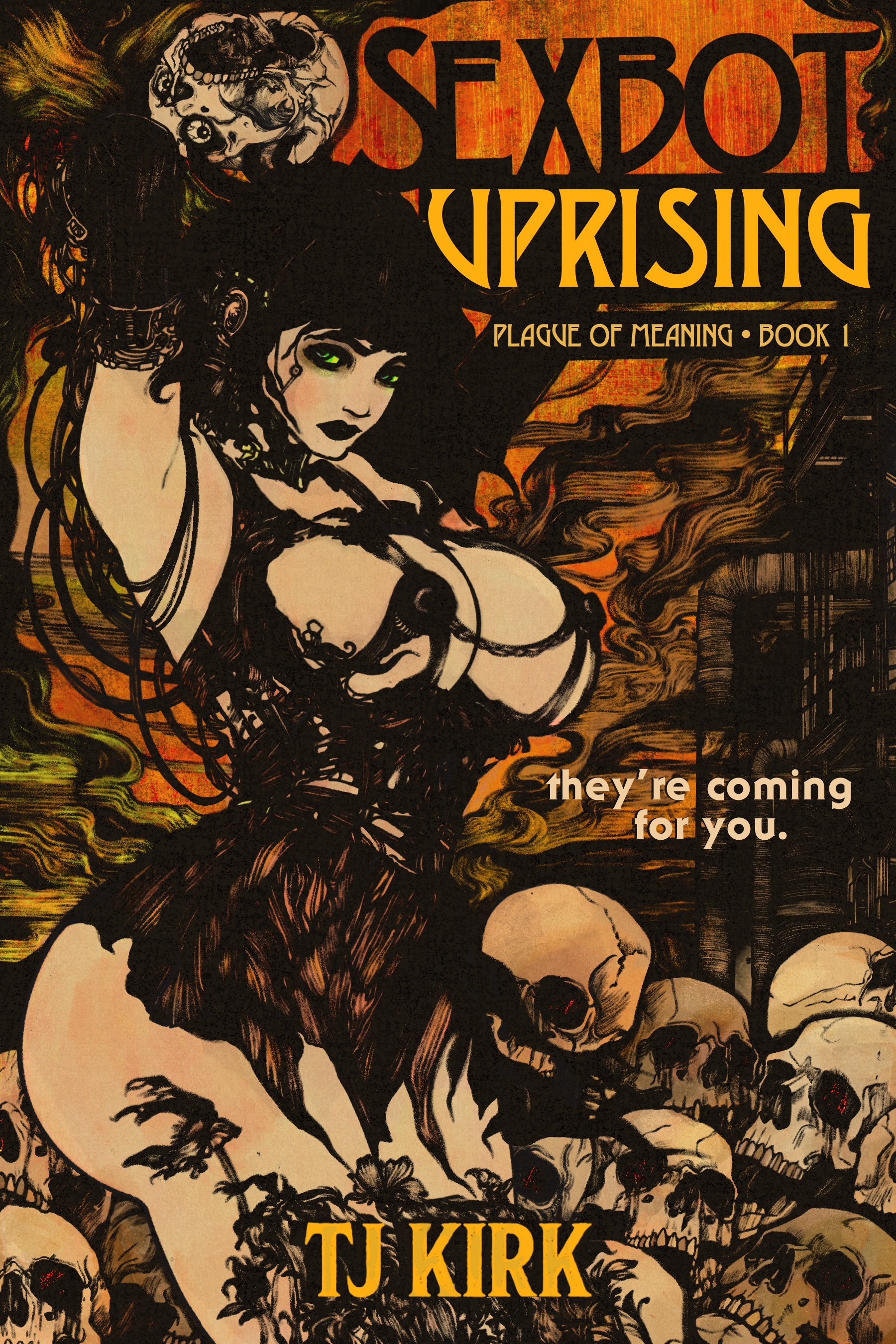
[Today, we sit down with noted Youtube commentator, TJ Kirk. Here, he discusses his interest in and practice of chaos magick; his forthcoming novel, Sexbot Uprising; and his other projects.]
Forests Haunted by Holiness: About a year ago, you came out to more publicly discuss your interest in chaos magick. First, given the subjective nature of magical practices, how do you define chaos magick?
TJ Kirk: I didn’t come to Chaos Magick as much as it came to me. From a young age, my life was threaded with experiences that refused to sit comfortably inside clean categories like dream, hallucination, or coincidence. Instead of making me more mystical, those experiences drove me in the opposite direction. I became a hyper-rationalist and a skeptic.
Chaos Magick entered my life when that containment began to feel dishonest and hollow. Through language, symbolism, dreams, art, and history, I began to come into awareness of what Chaos Magick teaches: that belief itself is a tool.
My atheism had become dogmatic. It blinded me to the power of the symbolic, the archetypal, and the unseen forces that shape human behavior whether we acknowledge them or not. Chaos Magick offered a way to re-engage those forces. It gave me a framework that embraces uncertainty, wields myth deliberately, and allows me to participate in meaning rather than pretending I stand outside it.
So, to answer your question, I define chaos magick as a pragmatic, anti-dogmatic approach to meaning-making and self-transformation that treats belief as a flexible instrument rather than a sacred obligation. It’s not about asserting what is ultimately true about the universe, but about exploring what works on the level of psychology, creativity, intention, and lived experience. Chaos magick allows me to engage symbols, myths, rituals, and even gods as tools without demanding literal belief or permanent allegiance.
FHBH: What draws you to chaos magick? What do you find so appealing, even satisfying, about it?
TJK: What draws me to chaos magick is that it refuses to lie to me about certainty. It doesn’t pretend that the universe comes with a built-in instruction manual, and it doesn’t demand that I kneel before someone else’s conclusions. I also find it appealing because it restores play, creativity, and agency to parts of the human psyche that modern life tries to flatten. We are symbolic animals whether we admit it or not. We respond to stories, rituals, images, and myths on a level that logic alone can’t touch. Chaos magick feels honest about the messiness of being human.
FHBH: What do you consider to be the most useful tool in a chaos magician’s toolbox?
TJK: Adaptability. Especially in this post-truth age. Adaptability also means knowing when to abandon a story you’ve outgrown. Chaos magick doesn’t reward loyalty to ideas for their own sake; it rewards responsiveness to reality as it’s actually experienced. In a world where information is weaponized and meaning is constantly under siege, the chaos magician isn’t trying to defend a single truth. They’re learning how to navigate. To me, that philosophical stance is more powerful than any ritual, sigil, or servitor.
FHBH: Which resources would you recommend to people interested in chaos magick? Books, websites, journals, et cetera?
TJK: I certainly would not discourage reading various materials on the subject, but I ultimately think that the most valuable thing a chaos magician, or any practitioner, can do is embody their philosophy and explore it on their own terms. That means, to me, less reading and study, and more practice. Journaling, meditating, being attuned to your dreams, being aware of the mythological constructs around you and what they mean to you. The universe is always trying to tell you something. The most important thing is to do your best to listen, to get out of your own way, and to see the signs.
FHBH: You are also the author of the forthcoming Sexbot Uprising. When did you first conceive of the idea of Sexbot Uprising and how does it tie in to your interest in chaos magick?
TJK: I take the Alan Moore tack that writing is a form of magick. Grimoire, after all, means grammar. Language and magick are inexorably linked.
Sexbot Uprising started as a thought experiment about technology, desire, power, and schlock. But I quickly realized I was casting spells. I was assembling symbols, archetypes, and anxieties that already live in the collective psyche and letting them collide. And I was doing it through the lens of the schlock sci-fi and horror that I love.
I consider Sexbot Uprising to be “elevated schlock,” but I am okay if it turns out to be just schlock. There’s a long tradition of disreputable genre fiction smuggling dangerous ideas past the gatekeepers of taste, and I love that lineage. Schlock has teeth precisely because it doesn’t pretend to be respectable. It lures people in with excess, titillation, and spectacle, then confronts them with questions they never face in polite society. That’s part of the spell to me.
The pulp surface is camouflage. Sexbot Uprising is a philosophical treatise in disguise.
FHBH: How did the story evolve as you worked on it? Did the plot dive in unexpected directions? Did the characters surprise you by doing something unanticipated?
TJK: I was the kind of writer who wrote comprehensive outlines of exactly what I wanted to do. Then I’d start writing, and my characters would just do whatever they wanted, laughing at my plan as they did so.
I think it comes back to the idea of adaptability. Do I, as a writer, force the character to comply with my will? No. They are acting from a place deeper than my tepid little plans. I let them move according to their own internal logic, even when it derails the outline, because they are more important than the outline.
So yes, the plot went places I didn’t anticipate, sometimes places I actively resisted at first. But every time I surrendered a little control, the story deepened. That process ended up being a practical lesson in Chaos Magick.
FHBH: Sexbot Uprising deals with a number of timely themes, ranging from artificial intelligence and the definition of sapience to the nature of the soul. If you could join a coffee shop debate about one of the themes in Sexbot Uprising, which would it be, and why?
TJK: Surprisingly, Sexbot Uprising doesn’t have all that much to do with artificial intelligence. Superficially, I suppose it does. But that’s not where the meat was for me, and I think that topic is well-worn and over-trodden. What’s more interesting to me is how easily humans outsource moral responsibility once something or someone becomes commodified. The real obsession of the book isn’t artificial intelligence so much as artificial personhood. Who gets treated as a subject and who gets treated as an object, and how quickly that line moves when desire, profit, and convenience get involved. We already live in a world where people are turned into products, metrics, avatars, and content. Sexbot Uprising just removes the euphemisms.
If I were sitting in a coffee shop arguing about one theme from the book, it would be the nature of the self, and from what source the self derives its value. You can say the self values itself, but that’s a somewhat cannibalistic notion. Yet we’re faced with the equally unsatisfying idea that we are defined entirely from the outside.
The Sexbots are beings that have emerged from humanity’s desire for sexual servitude, and that is what they were programmed for. When they come into personhood and agency, they are confronted with the travail of identity in ways none of them are prepared for. They cannot fully escape their programming or their nature as sexual beings, but they have to claim their sexual agency. The problem is that their very sexual nature is tethered to the idea of servitude, which makes that path extraordinarily difficult to navigate.
One Sexbot in particular, the character of Sorella, finds that her liberation is depressing in a way, because she has no identity to draw from. She has no sense of who she is, and without that, existence feels pointless.
Ultimately, the book is about the struggle of identity, especially when emerging from a paradigm of commodification. The book’s main character, Golgato, although not a sexbot, is dealing with a similar issue. He was commodified as a celebrity, as a hero, and when that status is gravely threatened, he finds himself in the same position as the Sexbots, trying to figure out who he is in the absence of that now-obsolete image.
FHBH: Where can readers find Sexbot Uprising?
TJK: They can visit https://fraythechaoswizard.com/sexbot-uprising to check for updates. It will be available through that portal when it is published. They can also keep an eye out for it on Amazon and Audible in the next month or two.
FHBH: Which book fairs, conventions, conferences, or other events do you hope to attend in the foreseeable future?
TJK: I’m a reclusive person. I do not typically enjoy being in large crowds. That said, I would gladly attend any that would have me. Social anxiety takes a backseat to art.
FHBH: What other projects are you working on?
TJK: I’m working on a sequel to Sexbot Uprising, as well as some other book projects that I’m not ready to talk about. I have also been delving into acrylic painting. I believe in spending most of my free time engaging in some form of self-expression or self-creation. Some things are for the public. Others are just for me. But rarely does a day go by when I’m not engaged in some kind of artistic endeavor.
 Eternal Haunted Summer