

[Today we sit down with author Thea Prothero. Here, she discusses her personal Heathen practice; her new book “Pagan Portals: A Guide to Pilgrimage”; and her upcoming projects.]
Forests Haunted By Holiness: How do you describe your personal spiritual practice? Does it have a name or is it more intuitive and eclectic?
Thea Prothero: My spiritual practice is Heathen. Although I acknowledge other gods and have followed other spiritual practices in the past, this is the one that fits me.
FHBH: Which Deities, powers, or other spirits do you honour in your practice?
TP: That is between me and the gods. I will say that I have a primary deity, and I work closely with the Vaettir that inhabit the land.
FHBH: Pagan Portals: A Guide to Pilgrimage is forthcoming through Moon Books in November. First, congratulations! Second, why a book about pilgrimage? What is it about pilgrimages that draws you to that subject?
TP: Thank you for the congratulations! It all seems a bit surreal in a way as I finished the book well over a year ago.
I have always walked and have found walking to be a great source of comfort to me over the years. I think I have always been going on pilgrimage, I just didn’t know that’s what it was, and anyone who follows an alternative spiritual path will probably know, most established pilgrimages are very Christian or mainstream religion-based. When I completed my first acknowledged pilgrimage, i.e. one that was established, I realised what a minefield it was for anyone who doesn’t follow the traditional faiths of the world. I wanted to share my own experiences and help others like me to find the way.
FHBH: A Guide to Pilgrimage is available through Moon Books. Why that publisher? Did you approach them with the idea, or did they come to you?
TP: I have had a good relationship with Moon Books for many years, starting when I worked for Pagan Dawn, and I used to review their books on a regular basis. I admired their conscious choice to promote the many branches of paganism and offer guidance to people who follow alternative paths.
FHBH: What sort of research went into A Guide to Pilgrimage? Long discussions with other pilgrims? Lots of personal experience?
TP: It took me nearly four years to write the book, because that’s how long it took me to be able to express in words the power of the pilgrimage I write about in the book, and the experience I had when there.
I did some research on religion and some historical, and I spoke to many people of many different faiths, some of whom are in the book. Primarily it is about my own personal experience.
FHBH: Your first chapter is dedicated to the history of pilgrimage, where you note that humans have been visiting sacred sites for more than three thousand years. What is the most fascinating or unusual or arduous pilgrimage route/site you discovered in your research?
TP: I believe that it is actually probably longer than that, but because there are no written records, we have no physical evidence. I think the most fascinating aspect of pilgrimage is what would be defined as the most ordinary to many people. For example, my good friend Graham, who is in the book, spends time each year in Glastonbury where he has found his spiritual heartland; he likes to walk barefoot, especially when climbing the Tor. This seems relatively simple, but the spiritual balance this gives him is profound. A pilgrimage is not necessarily about the physical journey, but the effect this journey has on the person.
In my research, I found that the pilgrimages taken in the Middle Ages, and written about by Chaucer for example, were extremely arduous and dangerous. The pilgrim would spend months away from their home and in some cases would be lucky to make it back. I am thankful we don’t have to do this anymore.
FHBH: Among the pilgrimage sites and routes that you discuss are Camino de Santiago in France and Spain, and Graceland in the United States. Do you see a difference between “sacred” and “secular” pilgrimages? Do you think people experience them differently?
TP: It’s the intention of the pilgrim that is important, not whether the pilgrimage route is an established secular or sacred route. If the pilgrim experiences a metaphysical or profound change because of their pilgrimage then the place they achieved this doesn’t have to be either sacred or secular, as long as it is to the pilgrim.
Everyone experiences pilgrimage differently to others. It’s a unique experience.
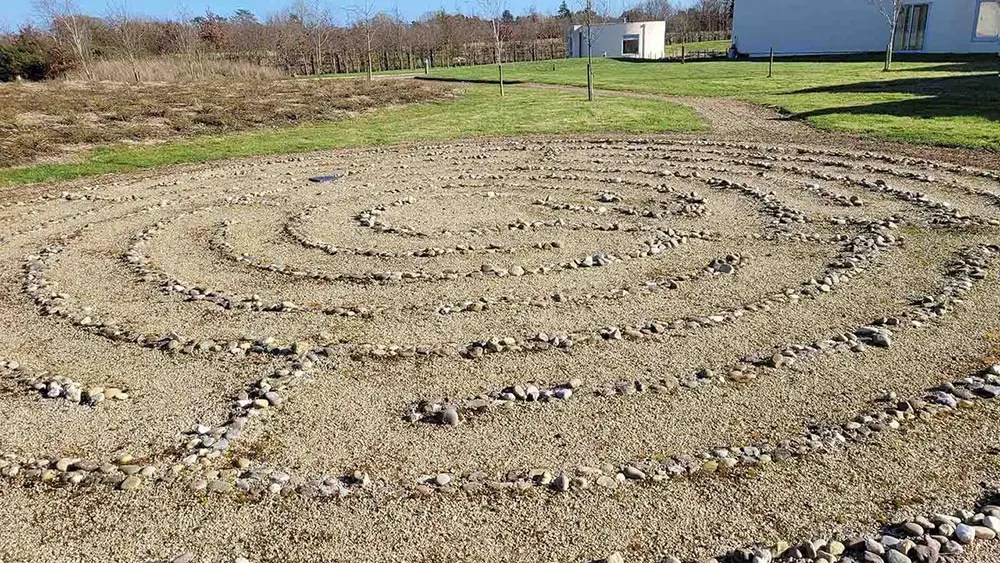
FHBH: You also devote an entire chapter to labyrinths and mazes. What are some of your favourite examples from literature, mythology, and real-world experience?
TP: As Eimear Burke (OBOD chosen chief) says, a labyrinth is symbolic of a pilgrimage journey and that’s why you find so many in churches.
The one that clearly sticks in my mind is at Solas Bhride in Kildare, Eire. I had gone on a pilgrimage in memoriam to my grandma, who was devoted to St Bridget. I had presented the Centre with my Gran’s rosary with her St Bridget token on it. It was extremely emotional, and I was supported by one of the nuns, who suggested I spend some time walking their labyrinth. When I reached the centre, I felt a deep sense of calm and knew my Gran was at peace.
Of course, who doesn’t love a good story, and the myth of the minotaur is one of my favourite stories, one that I have told to my children over the years. Have written extensively about it in the chapter you mentioned.
FHBH: What advice can you offer to those who are considering a pilgrimage of their own?
TP: Buy my book! Lol. The most important aspect of pilgrimage is to find the place you want to go. Focus on that to start with, and don’t be put off by how impossible it may seem. If it’s meant to be, it will happen.
FHBH: Which book fairs, conventions, or other events do you hope to attend in the foreseeable future?
TP: I am doing the Moon Books podcast shortly and also a radio show on Halloween called Fika with Vicky, where I will talk about my book, but also about the macabre. And I am reading one of my ghost stories!
I am doing a book signing at Elements of Avebury in Wiltshire, on the 7th December. In case you don’t know, Avebury is the biggest stone circle in the UK. Well worth visiting.
FHBH: What other projects are you working on?
TP: I have just handed in my second manuscript which I finished a month or so ago. It’s about Heathenry, and I am working on my next book as we speak.
I also write folk horror and ghost stories and have one being published in the journal called the Silent Companion at Christmas time. I have a story in Moon Books’ next issue of their magazine Moonscape, which is due around Christmas as well; this is also a ghost story.
I have a blog on substack which is totally free and I usually put up content every week, and it’d be great to have new subscribers: heathenpilgrim.substack.com
 Eternal Haunted Summer