
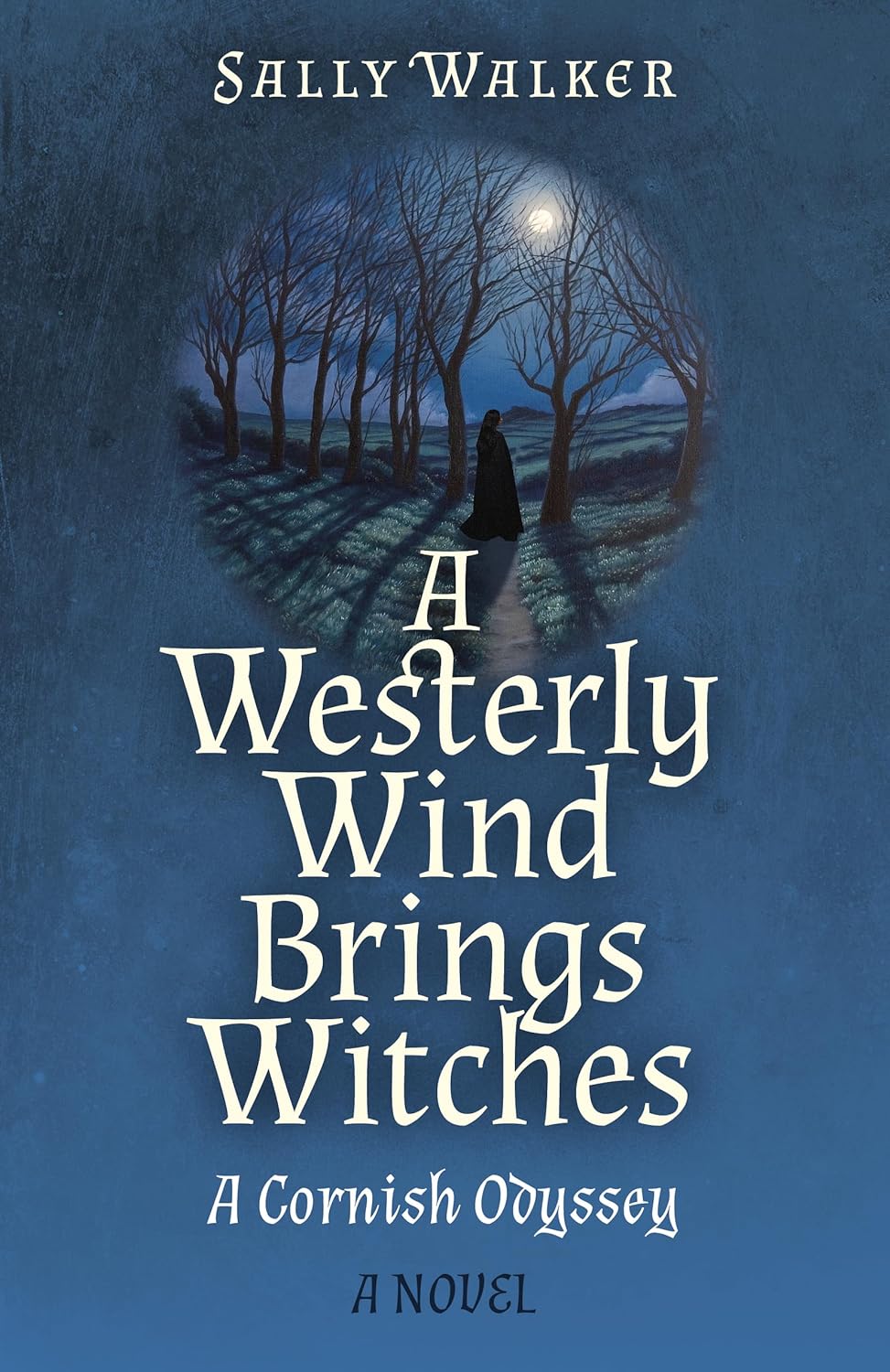
[Today we sit down with Sally Walker, an eclectic/nature-oriented Pagan and author of the brand new novel, A Westerly Wind Brings Witches. Here she discusses her personal spiritual practice, her writing, and her upcoming projects.]
Forests Haunted By Holiness: How do you define your personal spiritual practice? Does it have a name or is it more intuitive and eclectic?
Sally Walker: West Cornwall abounds in pagan festival events and moots, while small local pagan groups pop up all over the place, – the Neolithic sites can get pretty packed on a full moon! I’ve belonged to several covens over the years as well as following my own personal practice, usually late at night in front of an open fire.
I don’t presume to define myself as Wicca or a specific category, and have been inspired by many spiritual giants, but at the end of the day we do have to follow the slight twists and deviations of our own individual path, always seeking that which truly resonates with us.
FHBH: Which Deities, powers, or other spirits do you honor in your practice?
SW: I spend a lot of time out in nature, often alone, and it’s then that I feel the presence of the Earth Goddess which leaves me in awe and joy. There are many smaller but magical presences which also make themselves known, like the rook on a ruined chimney stack or that old wise-faced grey seal that pops up near me when I’m in the sea – I just know this selkie soul is the guardian of the secret enchanted creek where I swim!
FHBH: Your novel “A Westerly Wind Brings Witches” is being released by Moon Books in April 2024. First, congratulations! Second, how did this book come about? Did you approach Moon Books with the idea or did they come to you?
SW: Thank you, Rebecca, it comes out on April’s Fool Day – another of those little cosmic joke…
As you found yourself, pagan publishers are thin on the ground, and a Big Shout for Moon Books, they’ve been really supportive since my first tentative query a while back.
Witches have shapeshifted from being depicted as wicked warty hags to the bewitching fantasy figures (sissling in sex appeal!) which the media is currently enamoured with. But still largely silent about the commonal-garden variety of real witches amongst us. I wanted to write from my own experiences as a member of a long-standing moon group, celebrating the old festivals and gathering every full moon for ten years.
Admittedly though, A Westerly Wind brings Witches is not without its own mischief, as Moira’s coven are far from glamourous or properly behaved, in fact they’re very human – warts and all!
FHBH: I really like your protagonist, Moira Box. How did you come up with the character? And did she change over the course of the book in unexpected ways?
SW: We live in a culture of selfies and celebrities, and many of us just don’t fit into that mould. Being small and mega average myself, I’m easy to overlook (and I must confess to having felt a tad peeved on occasion as I watched men rushing to gift free bread to the loved lovelies swanning it on the lake…) so I can certainly sympathise with Moira. I guess I worked out some of my own niggles as poor Mogs grew into a healthier selfhood and gained a little more maturity as her story developed. She soon took on a life of her own, and I felt quite proud of her in the end for her gutsy refusal to be put down and put upon, plus the way she took all that magical mayhem in her stride, with just the odd ducky fit!
Moira Box is my heroine because, in a world of pretty privilege, kindly honest souls with homely faces tend to go unnoticed – and I didn’t want to do the same.
FHBH: What sort of research went into “A Westerly Wind Brings Witches”? Long hours at the library? Long hours online? Lengthy discussions with scholars and academics?
SW: I first studied the history of the witch trials back at university and have carried on researching since then.
FHBH: “A Westerly Wind” deals with the Burning Times, when women, wisewomen, and witches were targeted for persecution, torture, and death. Which resources would you recommend to those interested in the Burning Times? And which historical tidbit about that period did you absolutely have to include in the book?
SW: A few decades ago, articles and films about the Burning Times were perhaps a smidge on the sensationalist side, bordering on female genocide by Church and State. As historical information has come to light however, a slightly tempered slant has emerged; more as a consequence of the way women were defined and treated by sixteenth and seventeenth society, rather than a war against women per se (Purkiss 1996 pp.11,16). But nevertheless, an estimated 80% of witch hearings were of females (Scarre & Callow 2001), and surely this is one of history’s most abominable crimes against women?
The phenomenon of witch persecutions was undoubtedly a diverse one, but arose in an era when women were subject to tight control and, for the majority, denigrated to a lowly position. Additionally, this was a time of repeated crop failure when survival became increasingly harsh for the peasant population (Behringer 1999, Parker 2018). Impoverished old women, without male financial support and protection, put considerable strain on parish charitable funds and often made serviceable scapegoats (Miguel 2003), especially during the famine of Tudor England in the 1590s where A Westerly Wind brings Witches takes place. Alongside this, the young Hannah Greene is inadvertently caught up in rival jealousies, family conflicts and community politics; another common occurrence during the witch craze hysteria which swept Europe and then the Americas (Scarre & Callow 2001).
That tidbit that knocked me sideways was The Homily of the State of Matrimony, apublished sermon preached annually from every pulpit throughout England,
Nature hath made women to keep home and to nourish their family and children, and not to meddle with matters abroad, nor to bear office in a city no more than children or infants.
Its misogynistic opinion is pretty standard stuff for its time (Thurston 2001 pp.42–45):
Woman is a weak creature, not endowed with strength and constancy of mind; therefore they be the sooner disquieted, and they may be more prone to all weak affections and dispositions of mind, more than men be (Anglican Library). And so it goes on.
Just imagine having to sit silently through that infuriating sermon every year! The Wisewoman in the novel, Martha Herrington (long of tooth and rather sharp of tongue), frequently finds it hard to button her lip, and gets herself into hot water when she doesn’t…
FHBH: You list a number of real locations in “A Westerly Wind,” such as the Boscastle museum of witchcraft. Did you get the opportunity to visit any of the places in the book yourself? If so, which was your favorite and would you visit again?
SW: Cornwall gets into your bones! Even before moving to Cornwall in my 20s, I use to holiday here each summer – so I’ve visited all the usual (and off the beaten track) sites and am now on repeated repeats. My childhood was spent playing in the streets of an outer London suburb, where wildness and seascape were sadly lacking, and from a young age I craved natural spaces. So I never take this ancient land of moor and shore for granted, especially enchanting nooks like Boscastle’s quaint little witchcraft museum.
The prehistoric menhirs, stone circles, fogues and dolmen, which abound in the west country, lend a compelling connection to the distant past and, when the sea mist is rolling in, an uncanny sense that our ancestors are close at hand here. But it is the ocean, ever-changing in colour and mood, which has become central to my wellbeing, and I feel blessed to live in a county which is ringed by coastal footpath on three sides. Most days I walk down to the cliffs, or cycle to a local cove where I swim (delightful in summer and invigorating in winter!)
FHBH: What advice can you offer to other authors who are considering writing a witchy novel?
SW: Yes, we do need to get out there! When you have something to say, please don’t hesitate to say it. I felt driven to write about the Burning Times, and totally gripped in my quest to find the lost voices of all those women (and some men) (and countless poor moggies!) who were so brutally silenced. Plus, a tongue-in-cheek enjoyment of my own life as a witch in this zany modern world.
Advice? Write from the heart – that’s the 1 % inspiration, the rest is the 99% hard editing. Perhaps the odd writing course might help speed things up, I tried to go it alone and definitely learnt the long-winded way from all my own mistakes.
Please don’t be afraid to write from the wound. Collective wounds deserve to be treated with full respect as the writer dives deep down into historical atrocity, but we can perhaps take our own piddly pinpricks more lightly, laugh at ourselves a little, and have a lot of fun along the way!
FHBH: Which book fairs, conventions, or other events will you be attending in the foreseeable future?
SW: Ahh! This is all new to me and, rather than running screaming into the night, I’m trying to take it gently, one small step at a time. This is (hopefully) career number four, after primary school teaching, nursing and children’s worker in a Woman’s Refuge. The other night I dreamt I was climbing up a vertical mountain – what with all the tech stuff that’s how it’s feeling at the moment, everything is kicking off so quickly, and my to-do list very long. This week’s task is to create an author website…
FHBH: What other projects are you working on?
SW: I have a collaborative project with a photographer/artist friend, aiming to come out next year. Will post nearer the time.
Thank you so much all for reading this, and Rebecca for the beautiful Eternal Haunted Summer. Think we’re all on the same track:
Wild winds whipping up
long gone feet dancing still
amongst the last stones standing.
A May wind tangling
ribbons of missing memories,
tempting wives to whisper old tales,
peeping into a forgotten fogou,
– where a lost lore waits
to be reborn.
A Westerly Wind brings Witches, p. 223
A Westerly Wind Brings Witches by Sally Walker, published by Moon Books, available on Amazon, Barnes and Noble, and collectiveinkbooks.com
References
Anglican Library, The Homily of the State of Matrimony sermon available at: www.anglicanlibraries.org – Homilies, Book 2, Homily 18
Behringer, W. (1999). ‘Climatic Change and Witch-Hunting: The Impact of The Little Ice Age on Mentalities’, Climatic Change, (43), pp. 335–351.
Miguel, E. (2005) ‘Poverty and Witch Killing’, Review of Economic Studies, 72 (4), pp. 1153–1172.
Parker, G. (01 Jan 2018) History and Climate: The Crisis of the 1590s Reconsidered, in Climate Change and Cultural Transition in Europe, E-Book, Publisher: Brill.
Purkiss, D. (1996) The Witch in History: Early Modern and Twentieth-Century Representations. Abingdon: Routledge. p.8
Scarre, G.; Callow, J. (2001) Witchcraft and Magic in Sixteenth and Seventeenth-Century Europe (second ed.). Basingstoke: Palgrave.
Thurston, R. W. (2001) Witch, Wicce, Mother Goose: The Rise and Fall of the Witch Hunts in Europe and North America. Edinburgh: Longman. pp. 42–45
 Eternal Haunted Summer