
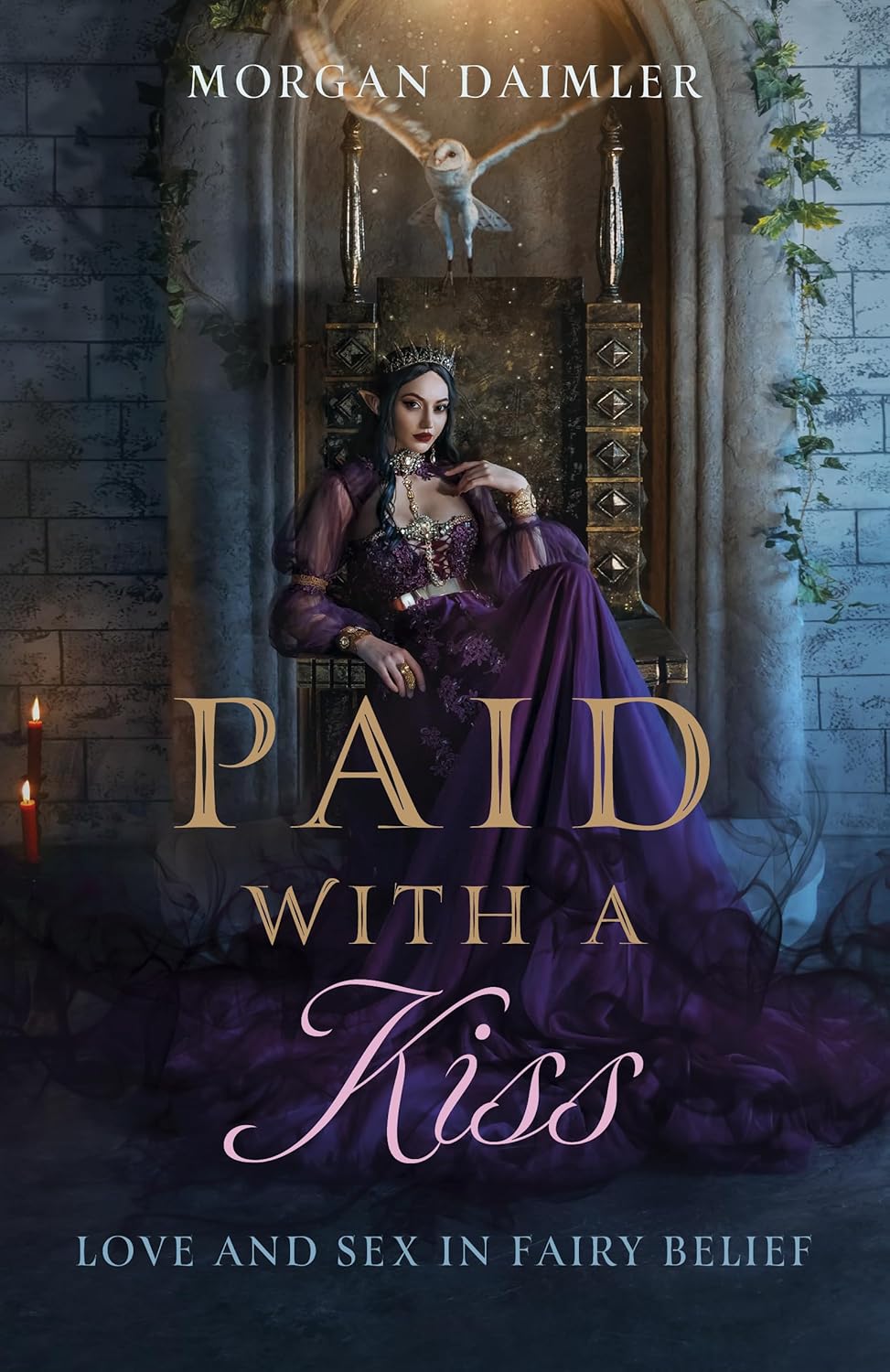
[Today, we sit down with fairy witch, author, and scholar Morgan Daimler. Here, they discuss their newest book, Paid With a Kiss: Love and Sex in Fairy Belief, as well as the research that went into it and their upcoming projects.]
Forests Haunted By Holiness: Paid With a Kiss: Love and Sex in Fairy Belief is set to be published by Moon Books at the beginning of May. First, congratulations! Second, why are you releasing this book with Moon Books? Did you approach them with the idea or did they come to you?
Morgan Daimler: I approached Moon Books with the proposal for the book, which had a different title at the time. I was confident that Moon would be interested, but had a couple other publishers in mind if they decided to pass on it. Luckily for me they decided to move forward and the book found a home without any drama.
FHBH: Second, why a book focused on love and sex in fairy lore? What drew you to the subject?
MD: Ultimately the reason I wrote it is because questions on the subject are the most common ones I get, but the backstory is a lot more complicated than that, really. It started when I was at a conference at Ohio State University in 2019 and someone asked the keynote speaker, Chris Woodyard, if there were nonbinary or asexual fairies in folklore, to which she admitted there wasn’t a clear answer. It piqued my curiosity and I started digging into the subject myself because I wanted to know. This eventually led to me submitting to a special edition of the journal Revenant and writing a 5,000 word article for them on fairies, gender, and sexuality across western European folklore. That article was cut at the last minute, but it inspired me to keep digging and expanding the work. I started joking it was my unintentional dissertation on fairies, sex, and gender and that eventually resulted in a 15,000 word manuscript — which is when I realized that this could be a full book. And I knew already at that point that there really wasn’t anything else on the market which dug into these topics in any depth. So I decided to go for it.
FHBH: There is a lot of misinformation out there about fairies, sex, love, and gender. Is there one piece of misinformation that you find to be particularly problematic? That you wish would just go away already?
MD: Honestly the misinformation that bothers me the most, which is an artifact of modern pop culture-influenced fairy belief, is the idea that fairies are always tiny and winged. Obviously people are free to believe what they want and lots of people don’t believe in fairies at all, but across most of history the beliefs in fairies always included a wide range of possibilities when it came to size and appearance, from small to giant, from human-like to animal; never wings though until pretty recently. I just wish people could approach these ideas with more of an open mind instead of putting the concept into such a rigid, small box. Fairies really don’t fit well into any sort of limited view.
FHBH: What sort of research went into Paid With a Kiss? Big stacks of books? Long hours at the library? Discussions with other practitioners and scholars?
MD: All of the above. I tried to leave no stone unturned when it came to researching this, so I was digging through a lot of academic books, online articles, ballads, and other primary sources, and talking to a wide range of people. I researched how gender, sex, love, and fairies had been understood across various specific cultures historically, how those views changed with the Victorians, and how they are expressed in modern fiction. I ended up including a chapter on modern ideas around these concepts which looked into spirit marriages and the way witches in particular engage with this.
So it really was everything, from academia to fiction, from historic accounts to modern experiences. I tried to be as thorough as possible to cover the subjects completely.
FHBH: Were there any resources, such as books or primary source materials, that you wanted to consult, but could not?
MD: I think I was pretty lucky in that respect, because I was able to access such a wide range of material. There were a handful of articles I wasn’t able to find myself, but they were shared with me by friends. I’m deeply grateful that I’m connected to such a good group of people on social media. I also had the advantage of having studied fairies for a long time before this which gave me a good feel for where to look for sources.
FHBH: Was there one particular piece of information — an old folk practice, a ballad, a linguistic curiosity — that you just had to include in the book? If so, what is it, and why?
MD: There was an account I ran across of a man in England who had a Fairy Queen as his lover and the story went that she had nearly killed him during sex by inhaling, shall we say, at the height of things?. And nearly pulled his soul out of his body accidentally. I knew I had to find a way to work that in because it was such a fascinating anecdote and really demonstrated the way that this subject balances between alluring and dangerous. I like including something where the human was almost killed through no ill will of the fairy’s, just the opposite in fact, because in many stories its either all presented as malicious or all as positive. I liked the story itself of course, too, but I knew it was one that needed to be shared in this book to give a wider picture.
FHBH: Which book fairs, conventions, or other events do you hope to attend in the foreseeable future?
MD: I’m presenting a paper at an online conference through the University of York in June; I’ll be talking about witches, wise women, and fairies in Irish folk belief, which will be fun. Later this year I’ll also be presenting at the Ancestral Pathways conference, talking about the benefit of dangerous fairies. I’m not attending Octocon (Ireland’s biggest scifi/fantasy convention) this year, but hope I might be able to next year. I usually keep a lot busier than this, but decided to keep my schedule light this year.
FHBH: What other projects are you working on?
MD: I just wrapped up a book on the Wild Hunt, also through Moon Books, and that’s in editing now. I had hoped to be able to work on my next novel — I love writing fiction, it’s my fun writing — but so far that keeps getting sidelined by various other projects with deadlines. I have a book on folkloric witchcraft under contract with Moon and that’s next on my agenda after I finish up some shorter projects, which include a chapter in a book on Green Women, an article for Pagan Dawn magazine, and a book on Macha that is being written as a work-in-progress on the Moon Books blog site.
 Eternal Haunted Summer