
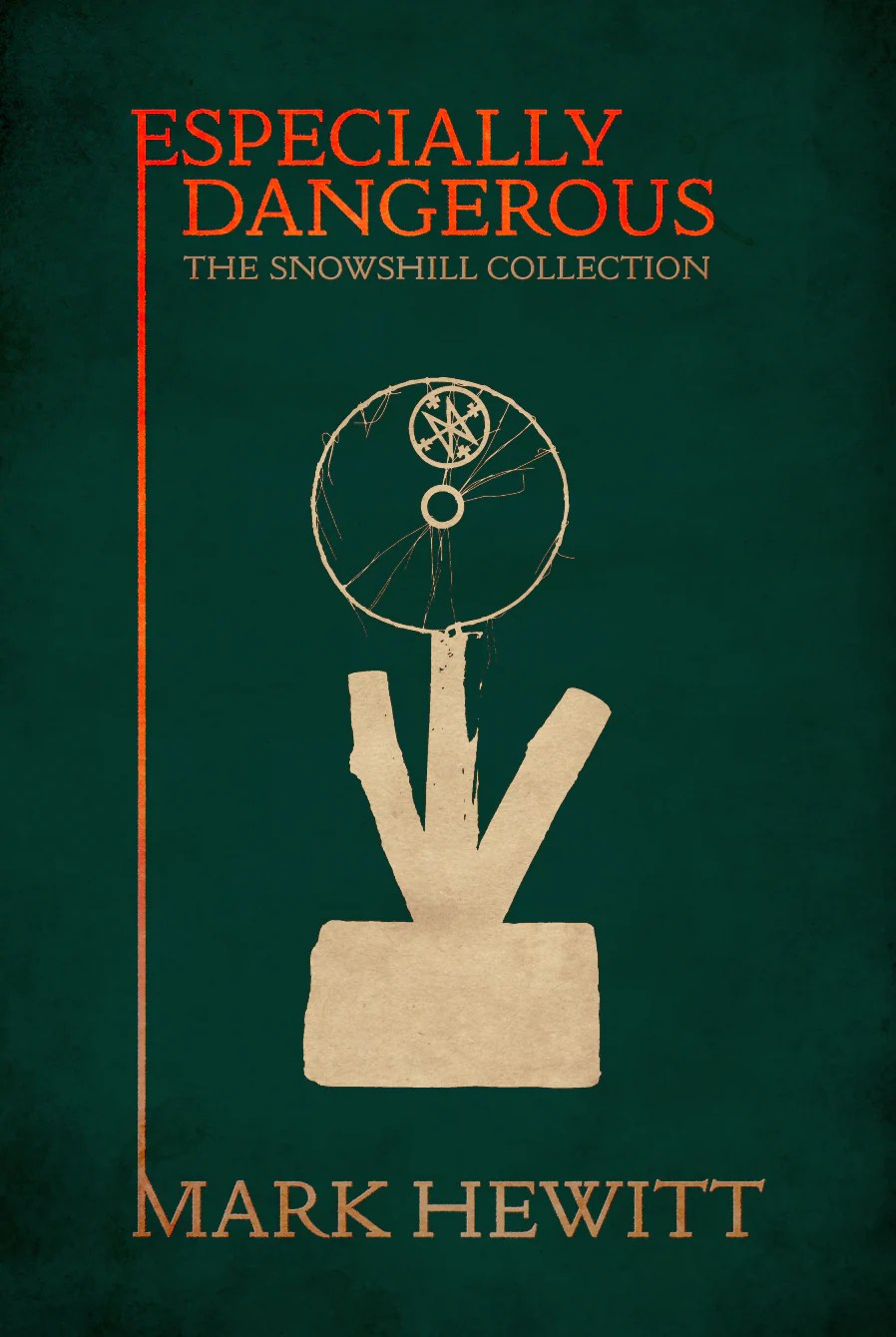
[Today we sit down for an interview with Mark Hewitt, scholar and author of Especially Dangerous. Here, he discusses the research that went into the book, his work with the Museum of Witchcraft, and his upcoming projects.]
Forests Haunted by Holiness: How do you define your personal spiritual/magickal practice? Does it have a name or is it more intuitive and eclectic?
Mark Hewitt: It’s certainly an eclectic mix! I grew up amidst the peculiar background of both Catholic and Church of England schools, so my early religious experiences were firmly framed by Christianity. Although I had a historical interest in magic from a young age, this didn’t develop into a practice until my very late teens, and I didn’t begin to seriously apply myself magically until my late twenties when I was introduced to Chaos Magic and the work of Phil Hine, Julien Vayne, and Gordon White. However, whilst enthusiastically entangled with CM, I’ve always retained a deep love for early modern magical cunning practices. I also have a keen interest in dabbling with divinatory systems, such as Tarot and Lenormand, as well as Geomancy and the wider magical applications of its sixteen figures.
FHBH: Do you honor any Deities or spirits in your practice? Or follow the teachings of particular practitioners?
MH: For the past five years the bedrock of my practice has been ancestral work, which has been mediated primarily by St Cyprian, who is honoured and thanked alongside my ancestors of both of blood and practice. There are also several spirits of time and place I have ongoing relationships with, and having been involved with CM for some time, I’ve bothered my fair share of deities! However, these are usually quid-pro-quo relationships for services rendered.
In terms of practitioners that inspire me, I’m certainly keen to evangelise for Dr Alexander Cummins whose work has been a huge inspiration.
FHBH: You recently released Especially Dangerous: The Snowshill Collection through Hadean Press. First, congratulations! Second, why Hadean Press? What drew you to that publisher?
MH: Thank you! The manuscript was initially with another publisher, but sadly there were issues regarding communication and I decided to part ways with them. I’ve been a fan and customer of Hadean Press for a long time, but was prompted to approach them by Peter Mark Adams. I’m very grateful to both Peter for the push and for Erzebet at Hadean for agreeing to work with me to publish the book.
FHBH: For those unfamiliar with the topic, what is the Snowshill Collection?
MH: The Snowshill Collection is the collective title to an assemblage of objects originating from a room known as the Witch’s Garret in Snowshill Manor. Snowshill is a grand Cotswold house which was renovated and restored throughout the early 1920s as a home for the vast collection of Charles Paget Wade; architect, artist, and craftsman. Wade’s collection concentrated on craft itself, and was arguably a reaction to the rapidly changing world of the early 20th century. He was particularly keen to preserve and showcase examples of good craftsmanship, so the collection is incredibly broad, ranging from Georgian costume, Napoleonic-era bone carvings to Samurai armour and early bicycles!
However, he created the Witch’s Garret at the top of the manor and dedicated it entirely to the theme of magic, and this is where the objects that make up the collection once belonged. They range from the wondrous to the mundane, and featured as props for Wade’s dramatic tours of the house he would give to visitors he took a shine to.
These objects are made all the more remarkable by the narrative journey they embarked on once they came into the hands of Cecil Williamson, creator of the Museum of Witchcraft in 1965. Following Wade’s death in 1956, the National Trust became responsible for the property. Without the physical presence of Wade to provide context for this element of the collection, the contents of the Garret took on a sinister reputation, and the desire to display, interpret or safely allow visitors into the space within the National Trust was lacking. Williamson’s museum was close by in Bourton-on-the-Water at this time, and he was invited to take a look and express an opinion. A deal was made and he was loaned several items from the Garret. Yet, not long after they left Snowshill, Williamson purposefully changed their identities, creating new histories and usages for them: a descriptive obfuscation that was not discovered until the early 1990s. The book investigates the myriad of motivations that may have been behind Williamson’s actions by exploring his background and own magical practice.
FHBH: How did you come across this story? And how did you go about investigating, compiling information, setting up interviews, and so on?
MH: I first visited the Museum of Witchcraft in the late 1990s whilst on holiday in Cornwall, and it’s been the place of repeated visits ever since. That first visit was perhaps the main catalyst for becoming involved in magical practice. The link to Snowshill was made around 2006, when I first visited the property with my partner. At the time, the National Trust staff were incredibly hesitant to acknowledge the existence of the Witch’s Garret, and it only made me want to know more!
Firstly there were two essays on the subject that were published in The Cauldron, which formed the core of the project. Sadly, due to full-time work commitments, the book was researched and written over ten years, but I was lucky enough to be granted sabbatical leave to pull everything together in early 2022.
In regards to research, I was initially helped by the then custodian of the Boscastle Graham King, and as time progressed I was lucky that excellent biographies of Wade and Williamson became available. Writing the book became an excellent excuse to approach academics and magical practitioners I’ve long admired, and everyone I contacted were incredibly generous with their time and insight. It was clear from the start that the project had it’s own momentum and rhythm, and a huge part of the process was learning when to sit with an idea and when to commit to following an avenue of research.
FHBH: What part of this entire saga did you find so strange, so odd that it was (almost) unbelievable? Strange but true!
MH: The most frustrating thing about this project is the single loose thread I couldn’t tie off, which is essentially the smoking gun that provides the title for the book. Following Williamson being loaned the collection in 1965, he penned a note to Snowhill stating that the objects had belonged to “an especially dangerous black magician” and that they required “to be burnt on a certain night”. Despite considerable archival searching from both myself and others, this letter is still missing. However, it’s existence, contents and provenance is vouched for by both Prof Ronald Hutton and Dr Louise Fenton, so thankfully we can rely on their reliable testimony for the time being! I’d love to be able to see this final piece of the puzzle. It wouldn’t change the conclusion, but the completist in me wants that itch to be scratched!
FHBH: How does the creation and ultimate fate of the Snowshill Collection tie in to the larger history of occult practices in England?
MH: This is a difficult question to answer because I argue that the collection itself forces us to readdress our fundamental relationships with the material we utilise magically. The transformations Williamson bestowed upon the collection went on to inspire magical practices based upon these new narratives, which prompts us to question of whether or not this knowledge renders these developments useless; what is true when it comes to animist inspired practices? I hope that through presenting the story holistically, by examining the characters of both Wade and Williamson, exploring their personal, social and cultural contexts, as well as presenting modern developments in ontological, epistemological, and magical thinking, that the work provides both a full history of this fascinating collection, and a guide as how to approach material culture as magicians.
I also want Williamson to be understood and discussed more broadly than he currently is. Aside from the excellent biography by Steve Patterson, a history of his museums by Rupert White, and a handful of insightful essays by Peter Grey and others, Williamson isn’t celebrated or acknowledged for his contributions to our shared magical history. He’s certainly (as Prof Hutton would express) “a bit of a rogue”, but without Williamson, our understanding of magical material culture and cunning practices would be much poorer.
FHBH: If someone is planning a trip to the Museum of Witchcraft and Magic in Boscastle, but only has a short time for a tour, what items should they absolutely see?
MH: Well, I might be biased, but the Snowshill Collection for a start! There’s an awful lot to see and it punches way above its weight considering the footprint of the building. However, my personal whistle-stop tour would include the three Lenkiewicz paintings, the Abaddon Cauldron, the Eldermans/Richel Collection, and Jake Stratton-Kent’s personal spirit pots. I’d also point out some of my favourite charms, curses and hilariously judgemental Williamson caption cards, too.
FHBH: Which book fairs, conventions, or other events do you hope to attend in the foreseeable future?
MH: I imagine I’ll be at one, if not both the Welshpool Occult Conferences this year, and hope to make it up to the Northern Occult Conference too. I’d also love to make it over to the Berlin Occult Conference at some point in the future, but 2026 is already looking incredibly busy, so I think the latter event might be slightly optimistic!
FHBH: What other projects are you working on?
MH: I’ve currently several longform essay projects on the boil, but these are unlikely to be substantial enough to become books and will likely be published on my Substack. These are all a pretty mixed bag and range from a multi-part series considering Rocky Horror as a modern mystery initiatory experience, and a piece on the paintings and magical thinking of the artist Robert Lenkiewicz. I’m also working on an essay about some local folklore, and I’ve a lot of ideas surrounding the figure of Robin Hood which I’m itching to have a proper sit down with. Always busy, never enough time!
 Eternal Haunted Summer