
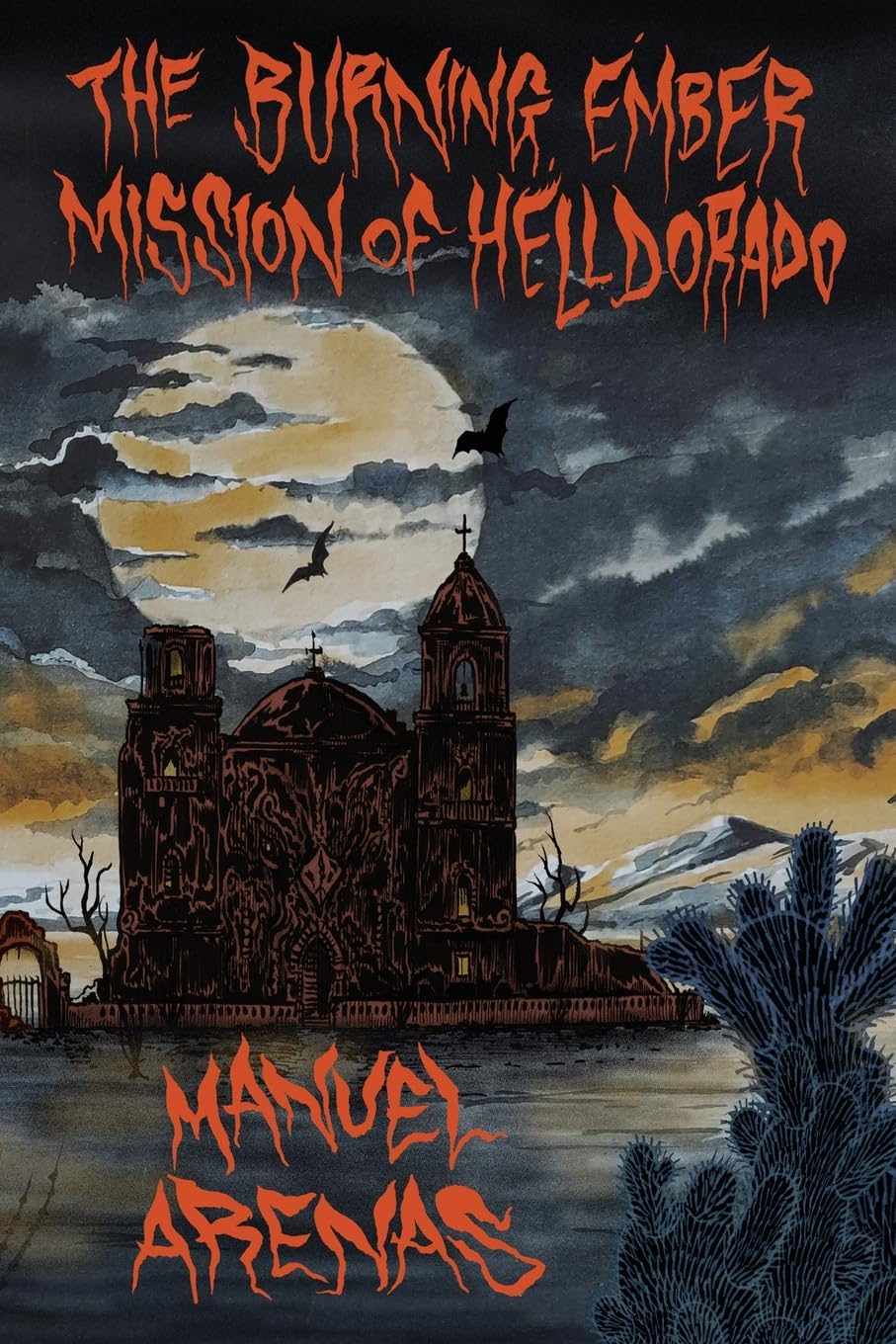
[Here, we sit down with poet and Gothic storyteller, Manuel Paul Arenas. We discuss his new release, The Burning Ember Mission of Helldorado; the nature of southwestern Gothic; and his upcoming projects.]
Forests Haunted By Holiness: You recently released The Burning Ember Mission of Helldorado through Jackanapes Press. First, congratulations! Second, why Jackanapes Press? What do you find appealing about that publisher?
Manuel Paul Arenas: Jackanapes Press published my first collection, Book of Shadows: Grim Tales and Gothic Fancies, and I had such a good experience with them. Jackanapes Press is really a one-man show, with Dan Sauer being the man behind the curtain, as it were. He is the editor, graphic designer, illustrator, etc. Because of this he only publishes a small number of books per year, and they tend to lean towards his taste which, fortunately, happen to converge with mine. Also, I know the other authors and poets in the Jackanapes stable and we all support one another, do beta reads and read throughs, write blurbs and introductions. It’s a real family environment.
FHBH: Helldorado has been described as southwestern gothic. What does that mean? What distinguishes southwestern gothic from other types?
MPA: Well, I will tell you what is isn’t: cowboys versus (insert supernatural threat here), LOL! This is always the expectation I get from folks when I tell them about it.
Seriously though, I am a lifelong fan of Gothic Horror and have read most of the major texts and seen the classic films, and I just wanted to see some representation of the Latin community. I am of Puerto Rican and Spanish ethnicity but I lived in Mexico for a few years in my teenage years and was fascinated by their culture. The way they see death, their celebration of the macabre.
I recall one too-sunny day in Los Angeles in the mid-1990’s, I was on a bus, just looking out of the window, when I saw a couple of Latina Goth girls hanging out on a street corner and I was fascinated by the way the were dressed, which was in a classic Romantic Goth style, but with a traditional Mexican spin, using some of the vivid colors and vintage fashions. It set off a spark in my mind, although it took a few years before it gelled into a coherent aesthetic.
The stories in this book have many of the traditional Gothic tropes: a haunted abbey, ghosts, an imperiled heroine, a dastardly villain, supernatural threats, black magic, etc. but it all takes places in the Sonoran Desert, with a Jesuit mission in place of an abbey.
FHBH: What sort of research went into Helldorado? Long hours at the library? Long conversations with folklorists?
MPA: Some of it was research at the local library and online. Some of it was traditions I recalled from my sojourn in the 80’s. I recall reading a story by Spanish author/poet Gustavo Adolfo Bécquer from his Leyendas collection entitled “El miserere”(1862), about a haunted monastery, which definitely influenced the phantom monks in the title story of the Burning Ember Mission.
Another source of inspiration was some of the classic Mexican Horror films of the Golden Age, which transposed the European Gothic atmosphere of the Universal Monster films to the haciendas of Mexico and featured local ghosts and monsters like La Llorona, or the Aztec Mummy.
Also, I was inspired by the old Roman Catholic mysticism of my upbringing, and the art and imagery of the old missions of Mexico and the southwest. The Burning Ember Mission makes specific reference to La Misión de San Xavier del Bac in Tucson.
FHBH: Language plays a very important role in your stories, even down to the characters’ names. What was the most fun you had with a piece of word-play in your writing?
MPA: Honestly, I am embarrassed to say that the biggest chuckle I got was from a couple of bawdy jokes; a bad pun and a double-entendre. Both are delivered by Diego, Ba’al Zwartenberg’s servitor and which are probably a bit blue for inclusion here.
FHBH: Helldorado includes the title story, but also a selection of other gothic tales and poems centered around the culture and folktales of the American southwest. How did you decide which to include? Were there some that you had to leave out, but hope to publish later?
MPA: My original intention was to just publish the title story as a chapbook, because it was too long and the subject matter too niche for most anthologies. To fill up the book a bit, I decided to add a couple poems; then my dear friend author/poet Scott Couturier convinced me to include another poem, as well as “Feretrina,” both of which had previously been rejected when submitted to various journals. After some coaxing, I cleaned them up best I could and sent them in for inclusion even though I had already submitted the manuscript to Dan Sauer, and he accepted them. I am glad now that he did, because already I have gotten feedback from friends on their partiality to “Feretrina.”
I have a few other Helldorado tales up my sleeve. One of which is a direct sequel to the Burning Ember Mission (an excerpt of which appears in this collection as the prose poem “Zwartenberg the Necromancer”. I have a period piece called “The Hell of Mirrors”, which was first published in the first issue of Penumbra, from Hippocampus Press, that tells my version of the origin story for the urban legend “Bloody Mary”. It doesn’t have the Latin focus of the other tales, though, so I thought it might seem out of place. I also have a King in Yellow story which is a retelling of the Robert W. Chambers story “The Yellow Sign”, which takes place in Helldorado, but I had submitted it for an Arizona-themed anthology so I didn’t want to have any conflicts there. Lastly, I have some other unfinished stories that I hope to have done for the sequel, if and when that ever happens.
As far as the subject matter, some of it was original, like the anthropomorphic rooster and Feretrina, and most of the rest was inspired by the legends and mythology of Mexico, like La Santa Muerte, and the tlahuelpuhchi in “Altagracia’s Lament”.
FHBH: Among these tales is “Feretrina,” which you describe in your introduction as a “mystical coming of age story” with elements of revenge. The story is particularly popular with women. Why do you think that is? And what elements do you consider essential in both coming of age and revenge tales?
MPA: It tells the tale of a young woman, whose original name I never give, as she goes from being a wide-eyed innocent orphan to a supernatural avenging angel, which is when she is given a name. She goes through suffering and loss to emerge stronger and triumphant over her oppressors, which I think is what is attractive in the tale to women. Despite being literally abused and oppressed, she never yields and is rewarded, in a way, in the end. She attains another level of consciousness, as an emissary for La Santa Muerte. It was purposefully written like a fairy tale, and has that type of language and imagery. Some might scoff at the comparison but there are precedents for this sort of thing where an avatar of Death becomes a sort of supernatural mentor, like in the Grimm Brothers tale “Godfather Death”, although that tale has a very different message from “Feretrina.”
FHBH: Helldorado features illustrations by Mutartis Boswell. What drew you to his work? And what was your collaboration like?
MPA: I had originally asked my friend Dick Kelly to do it, as he did a great job on a chapbook I did some years ago for my Yuletide poem, “Greetings from Krampus”. He did some copper etchings and it looked amazing. Unfortunately, he had some personal business to take care of and the project stalled, so after a couple years I relieved him of the responsibility and offered it to Mutartis, whose penchant for the grotesque and the diabolic I thought would go well with the text. I was right! He enjoyed being in the world so much, he made multiple illustrations (most of which made it into the current book, but not all) and we even talked about doing a book trailer using a slideshow of the many fantastic illustrations but we had technical difficulties that tanked that idea. Even so, I had a great experience working with him and we still send one another Christmas cards and brainstorm about ways to promote the book both here and in the UK, where he is from.
FHBH: In addition to your own work, what other examples of southwestern gothic do you recommend?
MPA: Honestly, I haven’t read much that I was impressed with, although there are a few Latin authors who are doing novels in that vein that I have yet to explore, like Mexican Gothic by Silvia Moreno-Garcia, or Vampires of El Norte by Isabel Cañas.
FHBH: Where can curious readers find your books?
MPA: Both my Book of Shadows and The Burning Ember Mission of Helldorado may be ordered from Jackanapes Press, as well as major book retailers like Amazon or Barnes & Noble. I also contribute regularly to the journals Spectral Realms (poetry) and Penumbra (short stories and non-fiction), both from Hippocampus Press, as well as Weird Fiction Quarterly, which specializes in flash fiction.
FHBH: What other projects are you working on?
MPA: I have a spoken word project with my friend Peter Kulikowski called ShadowScapes, where I recite poetry and prose and he composes music to accompany it. Our first album is a collection of selections from The Burning Ember Mission and can be found here: The Burning Ember Mission | ShadowScapes. We plan to make some more recordings in the near future, possibly using poems from the Book of Shadows.
I also have a follow-up to Book of Shadows called Magic Lantern which is a collection of poetry and prose that is presented like the old Phantasmagoria shows of the 18th and 19th centuries with tales of ghosts, devils, and bogies of all stripes.
Lastly, the folks at Weird Fiction Quarterly are experimenting with chapbooks by regular contributors and I presented them with a collection of my early writings and lyrics from my old band, The Dark Young, which they accepted. However, both this and Magic Lantern probably won’t see publication for some time, but they are definitely next in line as far as my creative projects are concerned.
 Eternal Haunted Summer