
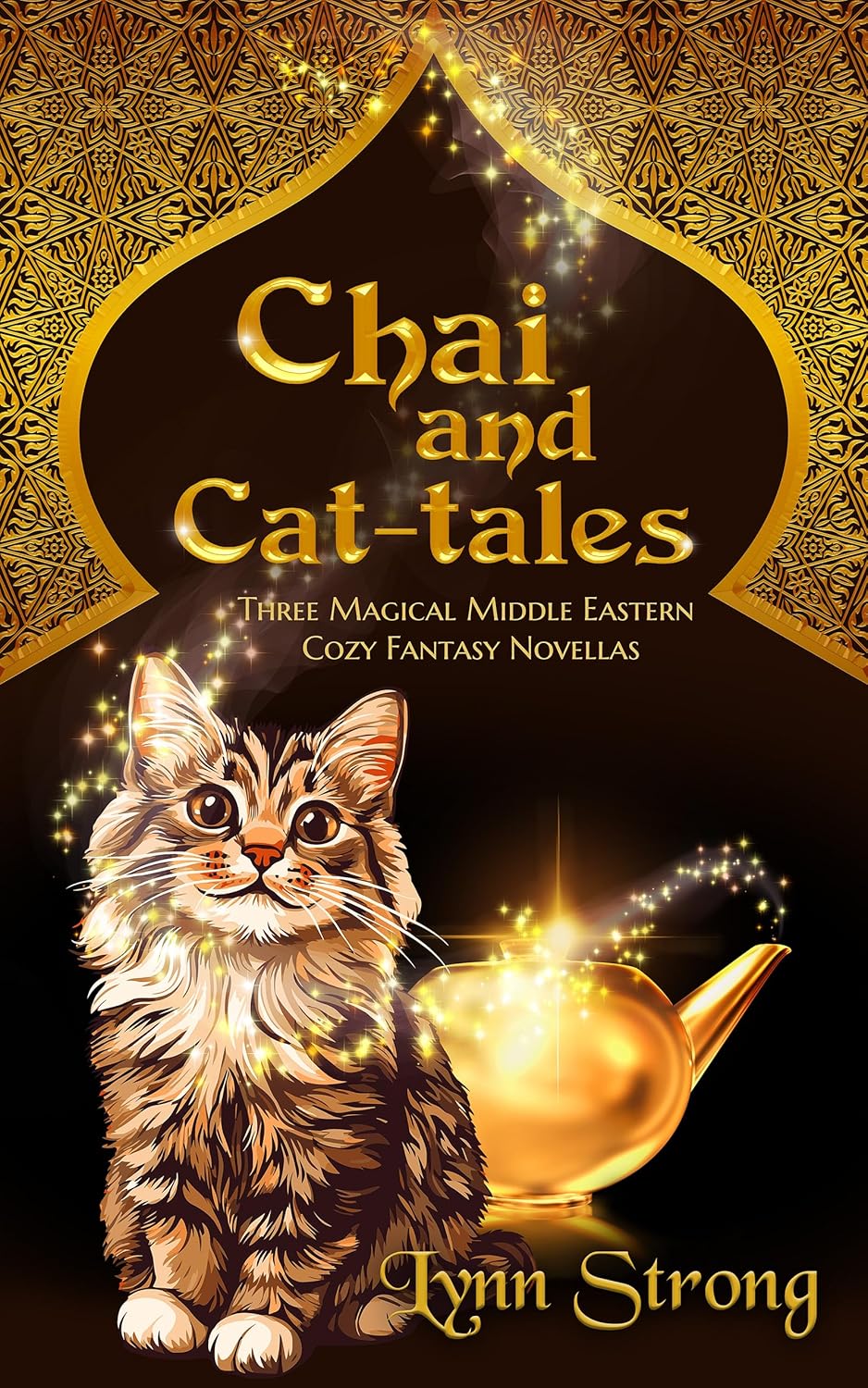
[Today we sit down with cozy fantasy author, Lynn Strong. Here she discusses her novella collection Chai and Cat-Tales; her short story in Wyngraf’s Cozy Romance Special 2024; the importance of diverse representation in speculative fiction; and her favorite cozy fantasy authors and books.]
FHBH: Why do you write?
Lynn Strong: I write because I can’t not write. 😀 My first “book” was about six pieces of typing paper folded in half and stapled together in the middle with a story about a mouse who wanted cheese, written when I was four. But also, I write because I’ve been a creator all my life, and becoming severely disabled as a result of Long COVID has meant I can no longer sew, knit, cook and bake, dye, sing, or most of the other artistic media that require some combination of vision, breath, and ability to sit upright for more than three minutes. I can write on my tablet one finger at a time when there’s nothing else I can do, and when I can’t see that much I can talk to my tablet. Writing is the most disability-friendly creative outlet I have.
FHBH: You recently released Chai and Cat-Tales, a collection of three cozy stories set in a fantastical Middle East. First, congratulations! Second, how did you come up with the idea for the Catsprowl?
LS: Absolutely no shade to the people who write “insert magitech espresso machine into European fantasy,” but a lot of people do write that already. A lot of my author friends write that! So I figure I will let the people who like writing that do that. And I will flip some different tropes like pancakes. 😀
From the very first, I knew I wanted this fantasy world to be set outside Europe, in an amalgamation of Mughal and Persian cultures and ancient Egypt. I haven’t seen very many cozy fantasies set outside the Shire-type places, and I wanted to write a story where Middle Eastern and South Asian medieval fantasy doesn’t have to have poisoned daggers and backstabbing and evil viziers. (I have a vizier in one of the WIPs. He’s ferociously dedicated to Propriety. That doesn’t make him actually a villain, though, and he is absolutely not plotting any coups; he would be appalled by the very thought.)
I also wanted to kick some litterbox sand in the general direction of late stage capitalism. There are a lot of books where the setup is “outsider comes into a not-wealthy neighborhood, infuses cash, and lives the small business owner fantasy.” Again, I am not trying to cast shade on anyone for whom that is their fantasy, I am not here to yuck anyone’s yum! A couple of my favorite series run on that model. But when it comes to the stories I am able to tell, I personally am too disabled to even pretend I can fantasize about “physically hard work and gentrification and small business capitalism through muscular bootstrap-lifting that may also involve digging up a chest of gold.”
So I have a world where the ungentrified neighborhood is beloved just as it is, and they cobble together a life that works with whatever blend of trade and haggling and mutual aid works for them. My fantasy is not that Cinderella runs off to the palace and abandons her community, and it’s also not that Prince Charming comes to the community and capitalisms everything shiny and gentrified. It’s that the neighborhood is already a good place exactly as it is, including the struggling, because everyone struggles with something. The fantasy is mutual aid in whatever way each of the neighbors can contribute, whoever you are, even if you have limits and what you can share is cuddling and purrs. (Gods and goddesses all, I wish I lived in that world.)
In Priye’s story, Shai Madhur is the gently wise priest who helps Priye accept that there are other ways to be valuable than to hunt for her food, and shares with her a cup of sweet milk with a side order of anti-capitalist mutual aid. But in Shai Madhur’s own story, he doesn’t have the answers to his own problems; the generosity that helped Priye is tied into the source of his own struggles. He’s so focused on giving away everything that comes into his hands that he’s got several unexamined anxieties about whether he himself is worth anything if he suddenly can’t give food to someone who needs it. So another part of my counteracting-the-solo-hero-with-bootstraps fantasy is how to recognize when you’ve given all you can and when you need someone else’s perspective and assistance too. (I love the scene where Shai Madhur cooks a tiny festival meal for the mice and prays over it very sincerely to ask the mice to eat the festival meal and leave the rest of the granary alone. The mice are delighted by the festival meal… but then they nibble on the rest of the granary too, because they’re still mice. In a Hero’s Journey his one-man-against-the-laws-of-nature prayer would have been powerful enough to work miracles. This is Gail Carriger’s Heroine’s Journey model, though: Everyone does better with help from their friends.)
One of my early readers is from India, and when she was commenting things like “omg too real” and “I know that auntie” and “yep, sounds like my family” and “I feel like this was written exactly for me,” I was delighted and honored.
And I was also thrilled when I’ve gotten similar feedback from folks who were saying “yeah, words are hard, Priye! I wish everyone were as clear about what they want as cats are,” and “I’m not sure I’ve ever seen a story where the fat person gets eagerly, happily chosen as the wanted and desired body type before.”
FHBH: What sort of research went into Chai and Cat-Tales? A big stack of books? Hours talking with a feline companion?
LS: Some of both! Bubastis / Per-Bast / the city I’m calling Tel-Bastet is a ruin now, but waaaaay back in the day it was the City of the Cats where Bastet the cat-goddess had annual festivals and thousands of cats were mummified for their journeys to the afterlife. I thought “so hey, what if the art with cat-headed people was less mythological and more neighborhood gossip column?” (Also I am a gamer, and catfolk are just fun to have sniffing around the corners of your imagination.)
Werewolves are well known, but a contagious body horror isn’t terribly cozy. So I thought cats might be the cozy fantasy equivalent, except that these aren’t “infected human” werecats the way werewolves are. My catfolk are always catfolk; they can shapechange from small cat size to humanoid-but-animal-headed figures like the ancient Egyptian art, plus more whiskers and fur because sandstone is just not conducive to carving whiskers and fur that last four thousand years. At that point I knew Bubastis was where I wanted to set the center of the story-world.
Except I needed more languages than ancient Egyptian, and I needed people not to immediately think of the tech level of 3000 BC when seeing names like Neferet. I’m leaning on parts of Arabic and Sanskrit in order to build the linguistic frame for a multicultural fantasy world where the language of sophistication doesn’t go to French or Latin, it goes to Arabic and Urdu and Hindi and Persian, but ancient Egyptian is still regarded as “ancient” here too. The societal level is somewhere around the 1400s to 1600s, which is old from our point of view but nowhere near as old as ancient Egypt was, which adds layers of history and culture changes within the story-world too.
I’ve talked to people from all over the world and researched the heck out of what I didn’t get the chance to see when I was mobile and sighted. I’ve lived on three continents myself but never spent as much time in the Middle East as I wish I could have, and now that’s not an option. Doing this research has been a great opportunity to meet friends and scholars and historians from around the world. But even if I had had the chance to visit Egypt while I still could, Bubastis is currently a pile of rocks, and I need a thriving medieval city. So I’m starting with the underlying stone bones of Bubastis and layering in magic and multiple species of catfolk and dogfolk and other not-human-but-sentient people who have other shapes, and running it forward a couple thousand years to around the 1400s-1600s, and adding in elements of Cairo and Agra and Alexandria and Baghdad along the way.
The Eldest Archivist in Najra’s story is a nod to Fatima al-Fihri, the founder of the al-Qarawiyyin library in Morocco in 1359, which is the oldest library still operating today. In a world with magic, I’m pretty sure a spirit so devoted to knowledge would have stuck around until she could have read all the books. And more books are still being written, so clearly her TBR pile is not done yet! I also love her not-summoning ritual, which does not involve fire around fragile old books and does not involve blood and entrails. Obviously the spirit of a librarian is going to be much more enticed by a cup of masala chai and a good novel!
I really am devoted to trying my best to do the research. When Nat Webb of Wyngraf needed one syllable of a name changed in “Rahat al-Hulqum” for excellent structural reasons I had entirely overlooked, I panicked, dove into 12 hours of historical research on the lineages of the Mughal and Safavid and Abbasid dynasties to come up with name and title patterns that were plausible but not actually in use by anyone, and wrote 15,000 words of side-story in order to figure out how to shift that syllable.
(Being both visually and physically disabled is not helping, of course. I’ve spent three years trying to get hold of an accessible digital copy of a reference book that’s available in print less than a mile from my house, but I can’t read print, the PDF is inaccessible, all attempts at converting the PDF to something I can use have failed, and the local university library’s accessibility specialist sent me a link that was supposed to be an ebook but actually turned out to be an authentication file locked to his personal email address. DRM is the digital dark ages on a ticking timer with a date we can’t see.)
FHBH: Chai and Cat-Tales includes three novellas, each of which features characters who are under-represented or outright ignored in traditional fantasy. How did you go about crafting these characters? Did you have their stories planned out or did the characters take the reins?
LS: A little of both? Because the Catsprowl is all about the neighborhood and the community, a lot of my characters start out as side characters in other characters’s stories, and then I get to take a closer look at them for their own stories. But I have intentionally set out to find people in the neighborhood who are people who would be someone else’s sidekick in mainstream media. People of several colors, people of several languages and faiths, people of several shapes and sizes and orientations and ways of looking at the world. (And in some cases people who are not human-type people.)
Priye showed up as part of Asharan and Rahat’s stories, the morning after Rahat al-Hulqum. Then I wondered how to tell her story, and it took me about six months to find her voice. I am usually all about the dialogue! And she’s nonverbal. So I felt out the way she thought about things, and triple translated it from pictures into words in specific registers in particular patterns. Apparently the visual origins still show through; some readers have told me it reads like a Miyazaki movie, and I love that.
I had actually written Shai Madhur’s story before Priye’s. He’s always been about loving kindness and generosity, and his god Upaja is a very carefully made intersection of several religious traditions.
(I have tried very hard not to make too-direct parallels to any specific modern religion, because I don’t want to bruise an open injury in someone’s heart when people are killing each other in the name of modern religions every day. Nobody’s killing each other over Bastet anymore, but when you get to religions within 500 years or so of now, people are still dying over that today. I’ve done a lot of research to make sure I’m not using names from actual empires or dynasties or modern religions.)
So Upaja is a god of generosity whose primary precept is feeding everyone in need. There are at least five religious traditions that went into it consciously, and probably a couple more unconsciously. Still, keeping a free donation-driven mutual-aid community kitchen running around the clock when you have at most a dozen full time priests and a lot of volunteers but the volunteers are as distractible as cats and your entire order rejects capitalism and coinage? That’s a lot of work! So Shai Madhur’s generosity is perfectly poised to offer Priye comfort and cuddles at the same time that it’s also the source of his own anxieties.
The character who’s going by Asharan in this book was the first piece of the puzzle that I had; he started out as an RPG character. He’s a glamour bard who doesn’t sing, who finds charm and healing comfort in other ways, because I flip all the tropes whenever I can. The game version was a traveling chaiwalla; then I wanted to see where it might go in fiction form, and I have a long-standing wrestling match with the narrative architecture of both Cinderella and the doomed-lover tropes in Romeo and Juliet/Layla and Majnun. Especially when folks are queer. I am so not tragically burying my gays ever, thanks.
So to flip all the Cinderella tropes with Asharan, who’s an enchanter who will make over other people Fairy-Godmother-style but who very much wanted to stay in his own place and not run off to a palace, he needed to be more anchored to his place than a wandering chai-seller. I needed a less-mobile business for him. A bath-house hit several targets on that front: You don’t pick that business up and go adventuring on the road, much less run off to a palace. It ties into the Cinderella pattern and the Fairy Godmother pattern both: bath-houses are where people go to relax and get beautifully groomed, but it’s usually not rich folks who are doing the scrubbing. And bath-houses are also associated with where queer folks have often gone to find others of like-minded persuasions. Ashar rejects the idea of anyone else serving as his own Fairy Godmother in that he insists he’s in charge of his own happily ever after and nobody needs a makeover to be wonderful and loved — but if they want some pampering, then he’s delighted to be of service.
So that leads us to Rahat, who’s the opposite of the athletic young white muscular Disney prince with confidence in spades, a fantastic dental plan, and dragon-slaying cred. The way I see it, the biggest difference between most Disney Princes Charming and Gaston is who’s holding the camera. And Cinderella’s Prince Charming isn’t even a character; he’s Cinderella’s trophy husband.
Somewhere around 2023, Celia Lake and I were in a Flights of Foundry conference where we were lamenting the lack of positive representation for fat people in fantasy, and we were both like “dammit let’s write the change we want to see in the world.”
So while Asharan is the anti-Cinderella and the anti-Fairy Godmother, Rahat/Faraj is very much Prince Charming, but he’s a different type of charming. One of my beta readers calls him Prince Squishmallow. He’s gentle and kind and anxious and gay and a very high-masking autistic, because you’re going to get masking drilled into you hard if you’re being raised to perform to expectations in a royal palace (in a way that definitely echoes what I’ve learned as a fat, anxious, queer, and people-pleasing autistic person trying to stay employed in capitalism). He’s also a prophet who’s had to be cautious about what he shares of his foresights, for very similar reasons. He’s a sweet, fat, soft-spoken scholar whose elder brothers are the muscular fighter and the charming poet and the radiantly glorious God-Emperor, so he’s learned that he himself is not the type of prince that people tend to dream of, especially by the time you add middle-aged accountant to the array.
(And you wouldn’t believe how hard it has been to find a picture of a sweet, fat, thoughtful, gently smiling brown man in historic clothing who’s portrayed as beautiful, instead of either a villain’s sidekick or a glutton or a colonizer-puppeted figurehead or so forth. I’ve found two and a half pictures that resonate with me over five years of searching, and one of them is Akbar, except that Akbar is also one of my models for his brother the God-Emperor.)
So I do love it when I get to offer Prince Squishmallow and his othered friends and family support and validation. 😀 Najra was the first person to tell him he’s the prince of her dreams; her dreams involve books and research, but they are absolutely her dreams. Asharan is the second, though chronologically the first, because Rahat al-Hulqum was the first of the stories that was finished. Kamil is his bodyguard despite the fact that he’s the prince, rather than because of it; like any former street-cat, Kamil decided you are My Person now, and claimed his person.
Then November 6 happened, and I wrote Najra’s story in a week because I needed a world where the smart, funny, capable brown woman won against the patriarchy and helped her queer and trans friends and fam along the way. I love Najra beyond all reason too. As long as I was out there writing the AU that this world didn’t give me, I decided to stick it to several sets of religious and patriarchal and royal expectations that women exist for marriage and childbirth but not for their own joy in a couple other dimensions too. So Najra is asexual as well as a smart, funny, devious book-loving Archivist-witch, and the prince of her dreams is a scholar, not someone she has any desire to marry. Her power and her wisdom are her own under her own name and skill, and I intend to let her keep it that way. And her sister Ghada is trans, and I just got done writing Ghada a romance; it didn’t make the cut for this year’s Wyngraf collection but I just submitted to another anthology and I hope it finds a home.
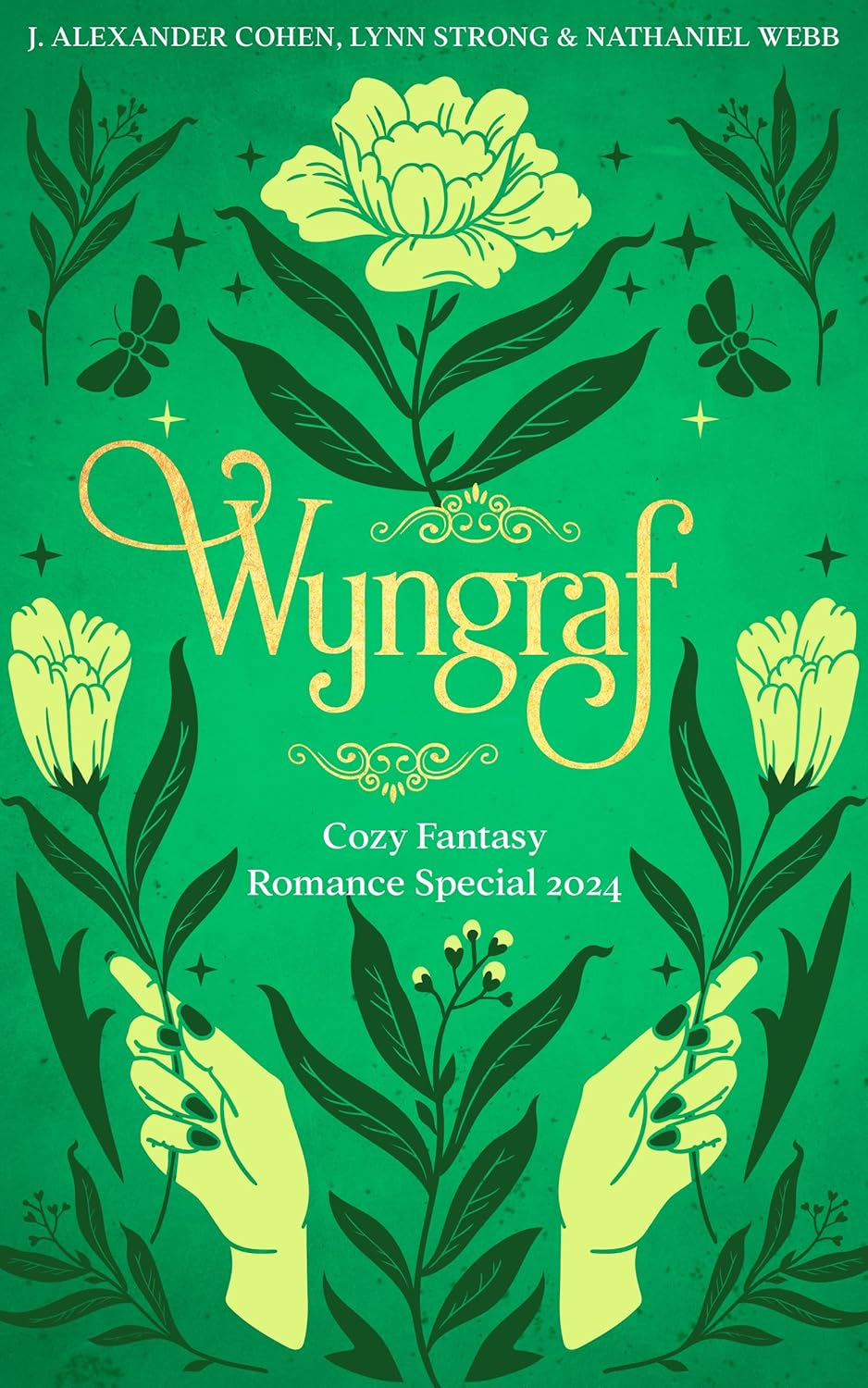
FHBH: You also have a short story in Wyngraf’s Cozy Fantasy Romance Special 2024. Congratulations! Was this an open call for submissions or were you invited? And just how yummy is that masala-chai?
LS: It was an open call, and it was the first time I’d ever gotten up the nerve to make a professional fiction submission. I’ve been a professional nonfiction writer over half my life, but this was the first time I’d actually submitted a fiction story, and I was over the moon that Nat accepted it!
I am biased, but that masala chai base is my favorite in the world, because I got to play with it until I found the notes I loved best. There’s ranges of spices in there because some batches brew stronger than others, so I taste-tested and adjusted each brewing until I liked it because the longer it simmered the better it got.
This was around 2019, when I could still stand over a stove for an hour. I can’t anymore, so I haven’t had it for about four years, and I do miss it. But I’ve also put together several fallback “can you heat water and stir something” options, because even if I can’t have the masala chai of my dreams anymore, I can still have masala chai I can manage. And I’ve talked to a lot of folks with a lot of food sensitivities and worked out a lot of variations like “substitute this milk alternative or that spice, or use osmanthus instead of black tea leaves, or if you can’t do ingredient X let’s look at what alternatives might work for you.”
FHBH: Given the current anti-LGTBQ political climate, what advice can you offer to other writers hoping to publish their own queer books?
LS: If you want to make a living at it, make sure you have a pen name and a non-American publisher with good marketing skills, and/or get very very good at quickly writing short stories that match specific calls for submission.
I can sell a short for around $300, but so far I’ve sold 2 in a year, and I’m actively in the negative on the book itself. Self-publishing has cost me over a thousand dollars more expenses than income at the moment, and I can currently afford that, but I’m a queer disabled DEIA specialist at a research institution whose top level management’s response has not been “we have your backs,” it has been “we are investigating how to comply with the current regime.”
So at -$1000 starting balance, earning $50 a month on average from short stories, $50-$80 a month from less than 100 book sales a month from the Big Zon, and $3 from every non-Amazon platform combined? If I am thrown under the bus by my workplace in the name of banishing diversity and accessibility for the new regime, this is not going to be a financially sustainable alternative source of income unless someone like Gail Simone gives me a Legends and Lattes-style visibility boost and it catches fire. I’d love for that to happen, but can’t hold my breath.
The advertising bind all us queer folks are in is that Facebook, Instagram, and X are all actively hostile now, Fable is AI-generating “think of the straight white guys teehee,” and TikTok is still technically illegal in the US but handed its keys to Dear Leader, at the same time that all the how-to-self-publish guides say that you must use Facebook advertising and maintain active social media presences on platforms that at best are algorithming us into oblivion and at worst are working with the fascists. I’m really hoping someone comes up with a viable alternative soon.
I don’t like that I have to sell through Amazon, but I have somewhere close to 200 sales in 2 months, and 9 sales through all the other platforms combined. I am actively losing money by not going to Kindle Unlimited with its built-in free advertising, but I want to be able to offer my work to places like the Queer Liberation Library and other bookstores too.
I have to work with Amazon to sell anything approaching even a week’s groceries. But I hope never to give Meta or X another dime or another click, if I can manage it, which means my only means of advertising is through kind folks like you (thank you again!)
FHBH: Where can readers find your books?
LS: Anywhere except Fable that Draft2Digital offers, you can find me, or here’s the list.
I’m hoping Draft2Digital adds the new Bookshop ebooks option sometime soon!
FHBH: In addition to your own books, which queer authors and titles do you recommend?
LS: I have found a friendly group of identified ace folks who are all writing cozy fantasies! Earlier today we were bonding over how we all respond differently to high-heat popular books than the general zeitgeist.
Coyote JM Edwards is a delightful person and a fellow ace who’s organizing a giveaway of cozy fantasy books in exchange for writing to representatives in support of trans rights. I describe Coffee, Milk and Spider Silk as “novella-sized Legends and Lattes for SpiderGwen fans, without the romance subplot.”
Claudie Arsenault and S. L. Dove Cooper are both writing ace and aro books and collecting up ace and aro books at the AroAce Database. Claudie has multiple series — Awakenings and the Chronicles of Nerezia are more on the cozy side, City of Strife and Isandor are less cozy (as you might guess when the first book is called City of Strife!)
Dove is writing prose and poetry fairy tale retellings, literary analysis of ace representation, and while I haven’t gotten to read The Heart of the Covenant yet, she had me sold at “for fans of mid 90s Star Trek downtime filler episodes.” I love the idea of getting to take a look at the dream-future without having to worry about when the next transporter accident is going to shift gears.
I took a look through Wikipedia’s listing of out LGBT writers and realized that lots of us indie authors should get on adding ourselves to that collection, because everyone I recognized on the list was traditionally published. There are more of us out here too, and the next time I have some spoons I’m going to try to rustle up some edits.
Big props to Tanya Huff and Xiran Jay Chao for representing fantasy writers on that list! And I hadn’t known that Gerard Manley Hopkins was one of us but I spent enough time in Wales that the rhythms of cynghanedd sometimes seep through in my prose. I love that he and Dylan Thomas figured out how to make cynghanedd sing in English poetry too.
But also, if I couldn’t use a pen name, I would not be nearly as public as I am about being a queer person, so I don’t assume that I know an author’s identity if they haven’t announced it. I also don’t want to assume that any married-to-a-different-gender person is straight because two of my best friends are bi women in straight-looking marriages who married their husbands before any other choice was legal. (Their husbands are absolutely wonderful people and they are both happy in their marriages! But I’m old enough that we didn’t all have the full spectrum of options available to us when people who wanted partners were looking for them.)
So with that disclaimer, here are some additional authors whose identities I don’t formally know but who have written cozy fantasy books I enjoy involving queer folks.
Victoria Goddard’s The Hands of the Emperor was a thousand pages of very personal wish fulfillment for me. The middle-aged ace brown bureaucrat gets to save the world through stubborn force of compassionate good government and universal basic income? Hell yes, especially right now. Her Greenwing and Dart books have both openly and closetedly queer folks in them too, set in an approximately Austen-like fantasy place-time.
Casey Blair’s Tea Princess series stands out in the “beverage cozy” genre to me because if you read the Tales of a Magical Teashop short story collection in particular, you absolutely know Casey has worked in beverage-based customer service. Everything from the mad tea-alchemist trying to come up with ways to sell an overbought ingredient to interpersonal challenges with difficult customers feels hilariously real.
Celia Lake runs the entire spectrum of representation between genders, orientations, origins, abilities and disabilities, neurodivergence, and keeping on keeping on when the world may be terrible but her competent, capable, and compassionate protagonists pick themselves up, brew a cuppa, and figure out how to keep going together. She’s written about 30 books in the same universe, and I’m like #lifegoals.
Elayne Griffith’s Whiskers and Wishes has an asexual djinn AND cats, so I knew I was going to be all over that like catnip, and Dragon Wagon Refuge has a neurospicy dwarf who prefers most animals to most people, and I wish I could introduce Priye to Cliona for all the cuddling.
To be honest I’ve loved all the books I’ve gotten at Karryn Nagel’s Cozy the Day Away sales — there’s hundreds of them, and reading is literally hard for me, but I’m making my way through them and this list will probably be a lot longer in 6 months!
FHBH: Which bookfairs, conventions, or other events do you hope to attend in the future?
LS: My personal challenge with “events” is that as a disabled person it’s a dice roll how much I’ll be functioning on a given day at a given time. So I really benefit from online events where I can be flat on my back with earbuds listening to the presentation if I need to (and I have needed to).
Even on a good day, in-person events are physically not an option for me, and the lack of community support for masking amid multiple epidemics is only one of the reasons; I can’t sit up for more than a few minutes, and movement at different depths like people walking around sets off substantial vertigo. So I’m all about the online events. It’s been pretty demoralizing watching the big cons rush back to all-in-person-only. For about three years I had equal access along with able-bodied people when everything was online, and it hurts watching one con after another shut down their inclusion.
Flights of Foundry has committed to staying online, and I’m delighted by that. Last fall’s Hearthcon was also a joyful chance to meet more folks who love cozy books, and I hope it stays online as well.
Karryn Nagel of the Cozy the Day Away sale is hoping to coordinate one of next year’s cozy fantasy sales with Hearthcon, and I’m her webmaster, so I’m hoping we can make those stars align between us!
I’m very grateful that Go Play Online NW in February and Summer Knights Online in July/August are offering multi-publisher-welcome online game conventions.
I also really depend on things like Discord and Bluesky, where people can chat asynchronously when and how we have the capacity.
 Eternal Haunted Summer