
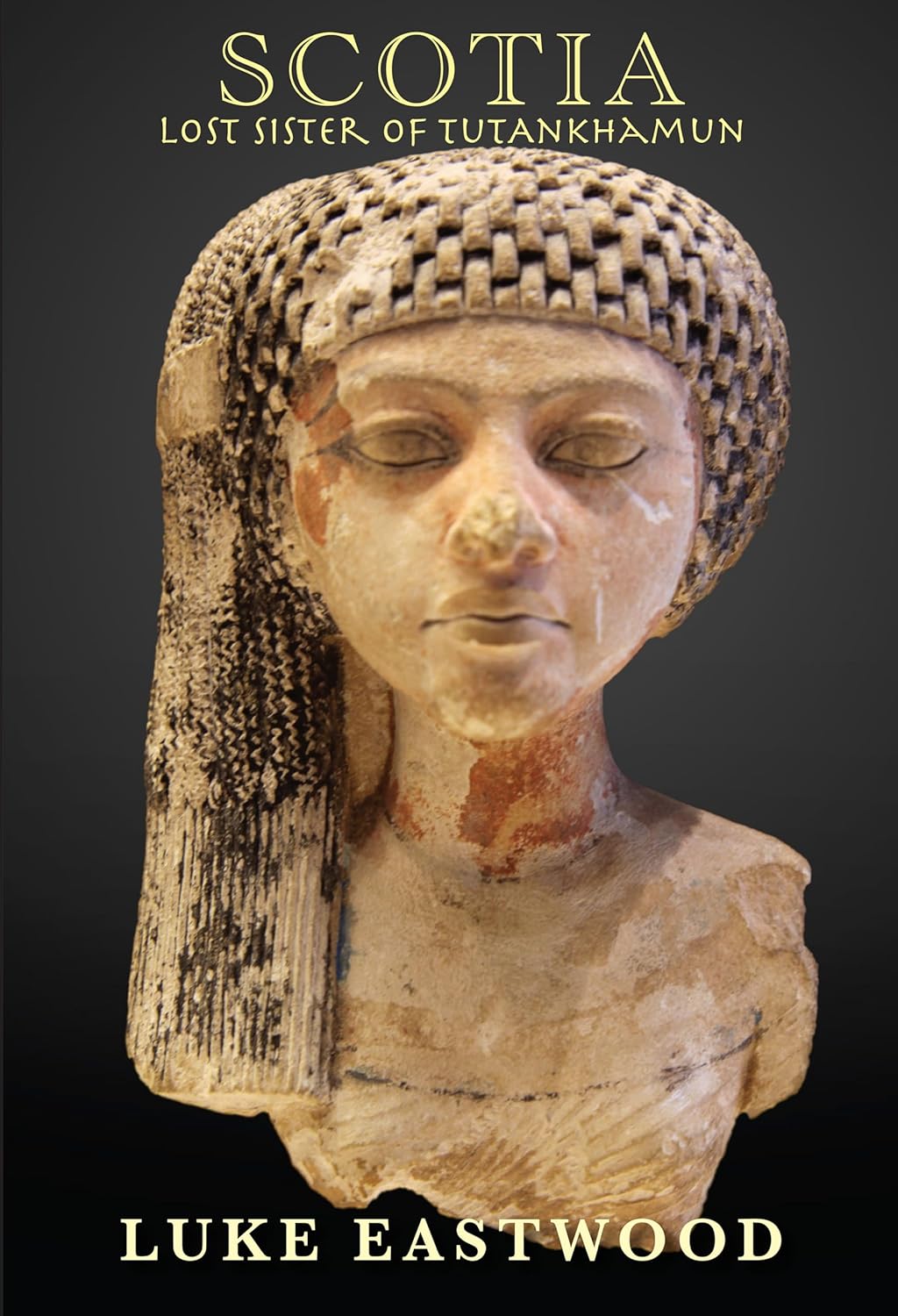
[Today we sit down with Druid gardener, artist, and author, Luke Eastwood. Here, he discusses his new book Scotia: Lost Sister of Tutankhamun; the research that went into it; and his upcoming projects.]
Forests Haunted By Holiness: You recently released Scotia: Lost Sister of Tutankhamun. First, congratulations! Second, why a book about Scotia? What drew you to tell her story?
Luke Eastwood: I think I first heard the full story, so to speak, when I met Elena Danaan who created the obelisk memorial (2014) with stonemason Bill Leen, which is located on the road close to her grave. Later on I was working on Kerry Folk Tales with co author Gary Branigan which led me to write my own condensed version of the legend. I used to drive past that obelisk every day on the way to work and it led me to visit the site on many occasions. I am not sure exactly why, but I felt inspired to dig deeper into her story, as details of her real-life Egyptian identity came up. There seemed to be some kind of serendipity going on, as she kept coming up randomly, so I felt that I really ought to do something about it.
It’s a story that has been all over the internet in recent years, but often with minimal detail. The actual story of what happened to Meritaten/Scotia is quite complicated and interwoven with religious and political intrigue and a quite shocking number of deaths in her 18th dynasty family. It was quite a difficult project for me to complete, but I think it is a really important story and important part of both Egyptian and European history.
FHBH: Egyptian history is filled with strong and important women. Why has Scotia been overlooked for so long?
LE: Her story was very much accepted in the pre-modern era, but from the 1800s onwards it was dismissed as fabrication and fantasy. I think academics just didn’t believe that an Egyptian queen could have just left Egypt and made it to Scotland and Ireland by ship. For that reason she has been overlooked, but of course she is in fact the daughter of another more famous Egyptian queen — Nefertiti. The evidence of the last fifty years is not conclusive, but points to the real possibilities that she did come to Ireland and is buried here.
FHBH: What sort of research went into Scotia? Big stacks of books? Long discussions with scholars in the field?
LE: Yes indeed. I spent about three years on this book, initially some discussions with friends and colleagues and then looking through the Irish texts. From there I got the old Scottish texts of Fordun and Bower, but it was the Spanish and Egyptian end of things that took most of the hard work. I was fortunate that some archaeologists and historians helped me out with pointers and certain books I should look at. As someone who is not an Egyptologist or a respected academic I knew that I would need to back up everything with as much evidence as possible.
FHBH: What one fascinating historical tidbit did you absolutely have to include in the book?
LE: I think there are so many fascinating elements to this story that it’s hard to pick one key thing. However, I think the work of Thor Heyerdahl is vital in proving that the Egyptians could have sailed to Ireland and beyond if they so wished. His 1970 replica, Ra II, proved that Egyptian vessels were seaworthy and could manage immense ocean voyages.
FHBH: The Amarna period was a complicated time in Egyptian history. Which resources would you recommend to those who want to learn more about it?
LE: For me the most important work on this period is Cyril Aldred’s Akhenaten: King of Egypt. This is quite old now, but still the seminal work on this ruler and the Amarna period in my opinion. Obviously visiting the city would be the best possible resource. I am a big fan of Dr Justin Sledge (Esoterica You Tube channel), who recently visited the ruins of Aketaten in Egypt, which is accessible on a Nile cruise. I’d love to do the same if I ever get the opportunity and I would suggest that anyone visiting Egypt should include this place on their itinerary.
FHBH: Which book fairs, conventions, or other events do you hope to attend in the foreseeable future?
LE: I’m not a big networker. I haven’t done any events for over six months (apart from my book launch at Huntington Castle), but I guess it’s something that I should pay more attention to. I am hoping to do a few events later in 2025, but mostly so far I seem to be doing video interviews. I have never actually attended a book fair and I don’t hang out with authors and industry people in general, but perhaps I should do more of that? I’ve gotten a lot better at public speaking over the years but it is not something that comes naturally to me. I am quite shy in large crowds. I feel a lot more comfortable in small groups or one-on-one.
FHBH: What other projects are you working on?
LE: I have another book started, but it’s a long-term on and off project, connected with sacred sites, so it might take some time yet to finish it. I produce Pagan Ireland magazine four times a year, so that takes up quite a lot of time and energy and that’s a long-term commitment. I am still interested in art, and I’d like to get get back to some painting soon. I retired from making music professionally in 2022, but I’d still like to make time for more of that, just for fun though. I am working on a Japanese garden currently, and I do gardening for a small number of clients too, so I’m generally very busy. It’s hard to juggle many interests so I tend to pick up and drop things for a period of time — I feel that books might be dropping into the background fairly soon, for a while at least , so that I can spend more time on other interests.
 Eternal Haunted Summer