
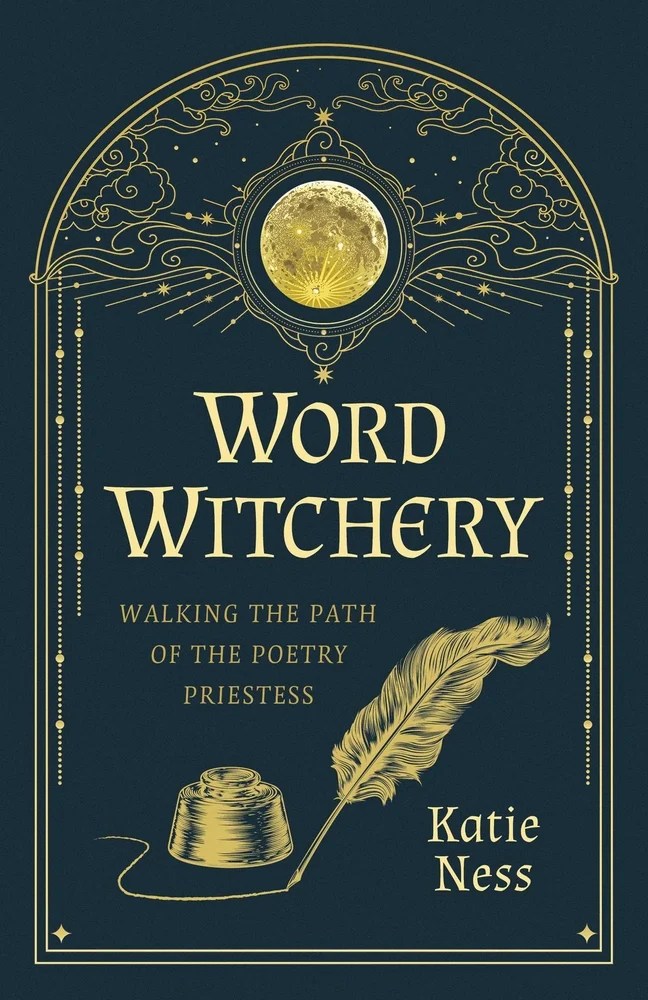
[Today, we sit down with witch and author, Katie Ness. Here, she discusses her personal spiritual practices; her new book, Word Witchery, and the research that went into it; and her upcoming projects.]
Forests Haunted by Holiness: Which spiritual tradition do you practice? Does it have a name or is it more intuitive and eclectic?
Katie Ness: I would describe my spiritual path as that of a hedgewitch — someone who walks between worlds and tends the threshold where the seen and unseen meet. Traditionally, a hedgewitch is a woman who lives on the edges of a village, just beyond the hedgerows and bordering the woods, straddling both community and the wild unknown. She moves between these realms with ease, carrying the wisdom of the earth, the spirits, and the liminal places. Hedgewitchery for me is deeply intuitive and rooted in folk magic, ancestral memory, and the quiet, personal practices that feel like home rather than doctrine, I like to be ‘on the fringe’ of society in every sense of the way – I’m solitary but not lonely, I like a lot of alone time to contemplate the bigger esoteric philosophies but if a kindred wishes to join me for a deep chat over a cup of tea, my door is always open. A hedgewitch observes the liminal: thresholds, dreams, dusk-light places, and the subtle movements of spirit and story that weave through daily life. That is very much where my own craft lives.
A strong line of my work comes from ancestral folk magic and divination like the tarot. My maternal great-grandmother was British Romanichal, and my great-grandfather was French whilst my maternal nanna was Irish, and their folklore, remedies, and relationship to the old ways move through me in a way that feels woven into my bones. Because of this, ancestral reverence is a living, breathing part of my practice, not something abstract or distant.
My path is also shaped by shadow work, dreamwork, deathwork, and engaging with the in-between — the spaces where intuition speaks more clearly and where transformation tends to begin. These practices help me navigate both the inner and outer worlds with honesty, compassion, and depth. For this reason I have recently specialised to facilitate Yoga Nidra to be a guide like Hecate gently taking people through their liminal places between waking and dreaming.
Another layer of my spirituality comes from being initiated as a Magdalene Priestess in 2017, a commitment to serve the sacred feminine through my creativity, teachings, and how I hold space for others. This devotion expresses itself as a kind of heart-led service, honouring the feminine in all her faces — wounded, wild, wise, and whole.
As a yogini practitioner, I also bring in elements of Bhakti Yoga, especially chanting mantra and honouring the goddess through sound and devotion. This blends seamlessly with my hedgewitch practice, rooting my magic not only in ancestry and earth, but also in breath, vibration, and spiritual presence.
Overall, my tradition doesn’t fit neatly into one named path — it is a living weave of folk magic, ancestral work, liminal exploration, priestess devotion, and yogic mysticism. Is it eclectic? Perhaps .… Some like to call me that – but if you look deeper, just over the margins of what you think you see, you notice that all these seemingly separate praxis are just different names for the same energy – connecting with the threshold. It has been deeply coherent since I was about thirteen, because every thread leads me back to the same place: the sacred, the intuitive, and the beautifully in-between.
FHBH: Which Deities, powers, or other spirits do you honor in your practice?
KN: In my practice, I honour a constellation of goddesses whose qualities shape both my magic and my daily life. Hecate guides my work at the crossroads, illuminating the liminal spaces I naturally gravitate toward. Rhiannon’s presence brings sovereignty, song, and the power of endurance. Aphrodite, Lakshmi/Radha, and Saraswati each support different facets of my path: love and embodiment, abundance and devotion, creativity and sacred learning. Alongside them, my ancestors remain ever-present — a quiet, steady council whose wisdom I continue to lean into.
I also work closely with animal spirits. My power animal is the black leopard, a guardian of shadows, intuition, and mystery. My guardian animal is the elephant, a symbol of memory, protection, and deep generational wisdom. My shadow animal is the moth, illuminating the transformative work of moving toward what is painful or hidden. Other consistent companions include the humpback whale, okapi, and manta ray. Over the years, messenger animals have appeared and departed as needed; currently, I’m working with Horse — a childhood spirit ally returning to support inner-child healing — and the Luna Moth, who guides a blend of shadow work and death-rebirth cycles.
Nature spirits and plant allies are woven into my practice as well: the Rose of Jericho for resurrection and renewal, mugwort for dreamwork, rose for the sacred feminine, cacao for heart healing, and willow for intuition and otherworld connection.
I also build relationships with stones whose energies align with my work — labradorite, opal, Blue John stone, rhodochrosite, sunstone, larimar, and rainbow obsidian. Each one serves as an anchor, a teacher, or a mirror depending on the season of my practice.
FHBH: You recently published Word Witchery: Walking the Path of the Poetry Priestess. First, congratulations! Second, how did this book come about? Why a book about word witchery?
KN: Thank you so much. Word Witchery came from a very personal place. I’m a Libra with a lot of Scorpio and Virgo in my chart, but my Chiron is in Gemini. Anyone who knows astrology will know what a Chiron sign represents — the wound that never fully heals but becomes your medicine. Gemini is the sign of voice and expression — this is my biggest wound and challenge in life, and I’ve spent most of my life feeling unheard and therefore misunderstood in one way or another. Finding my voice has been a long, complicated journey. I’ve had moments where louder or more forceful personalities spoke over me, dismissed my intuition, dismantled my truth and coated it with their lies; backstabbed, slandered and judged me without even considering hearing what I have to say or have belittled my ideas and intelligence. And I think many women recognise that feeling of being talked over or slowly erased. I also struggle with public speaking as I’m rather introverted by nature …. So anything Gemini energy revolving around self expression and voicing ‘This is who I am, this is what I have to say, please hear me, please respect me.’ Has been a massive karmic life lesson.
Surviving an ectopic pregnancy was another defining part of this. The medical neglect I experienced left me feeling powerless, frightened, and voiceless. In the very early stages of recovery, I physically couldn’t do much — couldn’t sit up long enough to paint, couldn’t get up to do yoga, couldn’t immerse myself in my usual practices. I was mostly bedridden for about six weeks. So I began scribbling down poetry. At first it was just something to occupy the hours, but it quickly became a lifeline. It made me wonder: how far back does poetry go? And were there women who used poetry as magic, as ritual, as a form of survival or resistance?
That curiosity pulled me toward the forgotten feminine lineage — Sappho, Enheduanna, and so many lesser-known mystical women across the ancient and medieval world whose words have survived in fragments, scraps, or shards. I became deeply struck by how many powerful women of their time had been pushed into the margins by elite men and patriarchal systems. Seeking their voices helped me reclaim my own.
And then there were the years of dealing with someone’s spiteful use of words via their songs and poems against me on social media – again to silence me whilst feeding their hypocritical ego and the judgement and cruelty that came from people around my fiancé. Those past five years dismantled my confidence piece by piece. Not long after the ectopic, I believed I was stepping into a place of safety and rest while grieving and recovery, only to be met with malice and emotional volatility from people who claimed to care about me. That kind of voicelessness stays with you. The impact of that kind of bullying takes a real toll on your mental health, especially when you’re already carrying heartbreak and loss. It was dehumanising. And I’ve never received an apology. I have strong boundaries now.
But all of that taught me something profound about language — about the sacredness of breath, utterance, intention. I realised that while others may use words to harm, I don’t want to, I’m a considerate and diplomatic person with my words, even in anger I consider the whole picture and my own shadows too. We can speak truth and boundaries without cruelty. In the depth of my silence, I learned the true power of wordcraft.
So, Word Witchery rose out of wounds, healing, grief, and the ancestral echoes of silenced women. In many ways, this book was birthed from death — of a pregnancy brutally lost, almost loss of my life, of old selves, of old patterns. Like a phoenix, it came out of ashes. Writing it became an act of reclamation, and I wanted the book to offer that same possibility to anyone who has ever struggled to be heard.
FHBH: What advice can you offer to someone who wants to walk the path of a poet priestess? Steps they must take? Practices they should engage in? Stumbling blocks they can expect?
KN: I’d say that walking the path of a poet-priestess is really about learning to live in a way where your spiritual life and your creative life are inseparable. It’s not just about writing poetry or performing rituals — it’s about cultivating a presence where the sacred can be expressed through your words and your actions.
First, you need to know yourself. Practices like journaling, meditation, paying attention to your dreams, or simply spending time in nature can help you tune into your intuition and emotional depth. Without that inner awareness, it’s hard for your poetry or rituals to have real power or authenticity.
Next, engage deeply with the material that inspires you — sacred texts, hymns, mystical poetry, mythologies. Study them not to imitate, but to understand the language of the sacred so you can translate it into your own voice.
At the same time, cultivate your craft. Write regularly, experiment with form and imagery, and treat your poetry as a practice in itself — something sacred rather than just something to show others. You can even explore sound, chanting, or recitation as extensions of your work.
Ritual is important, too. Develop small practices or offerings that resonate with you, whether that’s lighting a candle, offering water, composing poems as devotional acts, or connecting with natural cycles. Ritual anchors your work in lived experience.
Expect challenges. You’ll face self-doubt, creative blocks, or periods where your spiritual practice feels dry. Others may not understand or may even push back against your path. Learning patience, self-compassion, and setting boundaries is part of the journey.
Finally, the key is integration. A poet-priestess isn’t only someone who writes or prays — she embodies the sacred in daily life. How you move through the world, how you treat others, and how you care for yourself all become part of your practice and your poetry.
FHBH: Who are some of your favorite poet priestesses, past and present, and why?
KN: One of my favourites has always been Enheduanna, the Sumerian high priestess whose hymns to Inanna are some of the earliest authored texts we have. Her voice is commanding, devotional, subtly erotic and revolutionary, she was a woman shaping theology and empire through poetry. Zhou Xuanjing, the 12th-century Chinese Taoist mystic and poet is also very interesting; her poetry explored inner alchemy, spiritual refinement, and the quiet revelations found in combining poetry with meditation to dissolve the ego. She wrote often of the moon as she believed this was a symbol of the eternal sky.
I’ve also long adored Lalla, the 14th-century Kashmiri mystic whose vaakhs — fierce, raw, ecstatic— remain some of the most intimate spiritual poems ever composed. And then there is Rabia of Basri, the 8th-century Sufi poetess whose devotion reshaped Islamic mysticism itself. Her poems on divine love, longing, and burning away the self still feel startlingly modern. Hadewijch, the 13th-century Dutch poet-mystic, is another essential figure for me: her visions and “love mysticism” wove poetry into theology, eroticism into devotion, and personal rapture into philosophical clarity. She wrote from the precipice of the soul.
Among contemporary poet-priestesses, I am continually moved by Rebecca Tamas, whose work threads ecofeminism, witchcraft, rage, and revelation. Forugh Farrokhzad remains one of my absolute icons — her fire, her unflinching vulnerability, and her insistence on women’s interior worlds changed the literary landscape of Iran forever. Pascale Petit captivates me with her mythic intensity and lyrical ferocity, transforming trauma into lush, imaginal landscapes and animal spirits. And I would be remiss not to mention Lana Del Rey, whose diary-like poetry and lyrics thread ritual, Americana myth, dream-logic, glamour, grief, and feminine archetype into something that feels simultaneously ancient and ultra-modern — a priestess of atmosphere, longing, and the spellcraft of the siren’s voice.
These women — ancient, medieval, and modern — form a lineage of poet-priestesses who wrote with the body, the divine, and the wild world as their witnesses. They remind me why poetry has always been a form of magic.
FHBH: What sort of research went into Word Witchery? Big stacks of books? Long discussions with scholars and poets?
KN: When it came to researching Word Witchery, it was honestly A LOT of everything … huge stacks of books, piles of academic papers, history documentaries, podcasts, and an entire universe of classical poetry collections by ancient women like Sappho, Mira Bai and Enheduanna, as well as anthologies of medieval female troubadours and text by Gwerfal Machain or Hildegard Von Bingen. I also had long, enriching discussions with two of close friends whose knowledge and expertise I trust — Claire Walker, an arts historian, and Bettina Joy De Guzman, a classicist and lyre harpist. Bettina actually performs an ancient Hymn-spell to Hathor on youtube which is enchanting!
It was important to me that the book was as historically grounded as possible, which is why the bibliography is so extensive. I drew from scholarly articles, established books, and the work of historians such as Dr Kate Lister and Bettany Hughes, rather than relying on surface-level sources or Wikipedia summaries.
My intention was to bridge academic fact with the magic of modern practice — to weave something rigorous yet enchanted. I didn’t want the book to drift into fluff, half-truths, or the sort of vague, whimsical ambiguity that can often appear in ‘magical’ books. I wanted something rooted, rich, and real — a work that honoured the history of women’s poetic lineages across time while offering something meaningful for witches, writers, and seekers today.
FHBH: Which one historical, archaeological, or ritual tidbit did you absolutely HAVE to include in the book?
KN: One historical and archaeological detail I absolutely had to include in Word Witchery was the tradition of incantation bowls from late antique Mesopotamia — mainly found in what is now Iraq and Iran, dating roughly between the 5th and 8th centuries CE. These humble clay bowls, often discovered inverted and buried beneath the thresholds of homes, captivated me from the moment I first encountered them. They are a rare, tangible meeting point between domestic life, women’s magic, devotion, and written spellcraft — essentially the perfect crossroads for a book like mine.
Incantation bowls were inscribed in spirals, starting at the rim and winding inward like a textual vortex, most often in Babylonian Aramaic, Mandaic, or Syriac. The handwriting is sometimes rushed or uneven, suggesting that magic belonged to ordinary people — not just trained scribes. Many bowls call upon angels, protective spirits, or ancestral forces. Some invoke divine feminine figures or guardian beings responsible for shielding a household from harm. Archaeologists note that they were used for protection, curses, uncrossing spells, and warding against malevolent entities such as Lilth demons, some of them even included crude drawings of a Lilith trapped in the vortex of writing.
What fascinated me most was how deeply relational these spells were. They read like negotiations, prayers, and poems — textual magic crafted by people trying to secure safety and wellbeing for themselves and their families. The protective, domestic, and intimate nature of the spells suggests they often served the concerns of women. In many cases, the bowls were placed upside-down as a symbolic “trapping” of harmful forces beneath them — an act both ritualistic and psychological, a literal turning of the world to restore balance.
As someone passionate about the lineage of women’s writing — especially writing as spellcraft — these bowls are extraordinary. They’re one of the earliest surviving examples of written magical intention created for everyday life, not elites or priesthoods. They show us that poetry, ritual, and protection once lived side-by-side on kitchen floors and thresholds. Including them in my book felt essential, because they embody exactly what Word Witchery is about: the power of language as invocation, as shield, as tether between the seen and unseen, and as a reminder that magic belongs to ordinary people surviving extraordinary circumstances.
FHBH: In addition to your own book, which other texts or sites do you recommend to someone interested in word witchery?
KN: If someone feels called to explore word witchery — the sacred art of writing as spellcraft, devotion, and self-transformation — I always recommend beginning with a few beautifully aligned texts. The Magical Writing Grimoire by Lisa Marie Basile is a wonderful companion, especially for those who want to blend ritual with personal storytelling and healing; it treats the written word as both medicine and magic. The Big Book of Pagan Prayer and Ritual offers a rich foundation of invocations, hymns, and ceremonial language from diverse pagan traditions — excellent for anyone wanting to study the structure, poetry, and cadence of ritual speech. And for those who want to engage with writing as embodied spellcasting through a contemporary, socially conscious lens, Poetry as Spellcasting: Poems, Essays, and Prompts for Manifesting Liberation and Reclaiming Power is a powerful anthology. Created by LGBTQ+ and BIPOC writers, it weaves magic, identity, and creativity into a living, breathing praxis of personal and collective empowerment.
Each of these works offers a different doorway into working with words as enchantment — part craft, part prayer, part liberation — and they sit beautifully alongside Word Witchery for anyone wanting to deepen their magical writing practice
FHBH: Which book fairs, conventions, or other events do you hope to attend in the foreseeable future?
KN: In truth, this is something I haven’t given much structured thought to yet. I’d absolutely love to be part of book fairs and conventions in the future, but I’m also a fairly solitary person, and as a new author I’m still finding my footing when it comes to the wider literary event world. I don’t have specific festivals or conventions on my calendar right now, and that may change as opportunities arise or my publicist gently nudges me toward the right spaces.
What is confirmed, though, is a handful of exciting things for the new year: I’ll be appearing on three podcasts, I’m in the early stages of planning my own in-person book launch at Watkins Bookshop and possibly also at Treadwell’s too, and I’m sketching out a small “book tour” that blends signings with workshops. The first leg will likely take place in my home county of Lancashire in the spring, with the possibility of bringing similar events to Glastonbury and Devon in the summer.
All of these plans, however, depend on my personal health and medical considerations, which come first — so while I’m hopeful and enthusiastic, nothing is set in stone yet. I’m moving gently, letting the path reveal itself as I go.
FHBH: What other projects are you working on?
KN: I’m working on so many beautiful things for next year.
In my writing life, I’m collaborating with another poet to complete our co-created poetry collection — an exploration of dreamy prose poems and letters. We’re also creating a series of ethereal poetry soundtracks to accompany the book, blending spoken word with atmospheric soundscapes. Alongside this, I’m developing a collection of Magical Realist–Folk Horror short stories, and I currently have two manuscripts underway with Moon Books. One is a sister-companion and expansion to Word Witchery, and the other is a stand-alone introduction to a lesser-known goddess … and that’s all I’ll reveal for now.
As an academic and researcher, I’m preparing for my Master’s degree to become a social historian focusing on the occult, magic, and folklore. I’ve just completed accredited short courses with Oxford University:
• Prehistoric Art: The Paleolithic to the Iron Age — exploring humanity’s early urge to create ritual and symbolic art
• A History of Folklore — a journey through folk customs, songs, stories, poetry, and traditional arts
• The Practice of Magic in Medieval Society — covering supernatural belief, early Christian demonology, astro-magic, necromancy, charms, and courtly magic
• Death & Devotion: The Art of Death in the Middle Ages — investigating tombs, sacred architecture, relics, saints, manuscripts, and the macabre
My dream is to become a witchy historian — someone who teaches, lives, and embodies the magical knowledge I study.
On the more embodied side of my path, I’m also an Ayurvedic Hatha yoga and wellness teacher. I recently certified in facilitating Yoga Nidra, a deeply restorative practice often called “sleep yoga,” known for evoking states of wakeful dreaming and inner journeying.
My work as a whole weaves together scholarship, folk magic, dreamwork, and yogic mysticism. I’ve studied over 100 hours with the Oxford Centre for Hindu Studies centred on yogic philosophy, tantra, the yoga sutras, the Bhagavad Gita and more. I am now available to offer lectures on yoga history and philosophy for yoga teacher trainings over the summer months.
Looking ahead, I intend to offer hybrid workshops inspired by Word Witchery — sessions that blend Yoga Nidra, sharing circles, womb blessings, anointing oils, witch-craft, poetry spells, and creative writing rituals. These gatherings will accompany future book-signing events for those who want a mystical, heart-centred, in-person experience of the magic behind the book.
There are other projects in the works, but these are the main ones on my mind’s conveyor belt!
IG: katie_wild_witch
FB: Kalyaani Temple
 Eternal Haunted Summer