
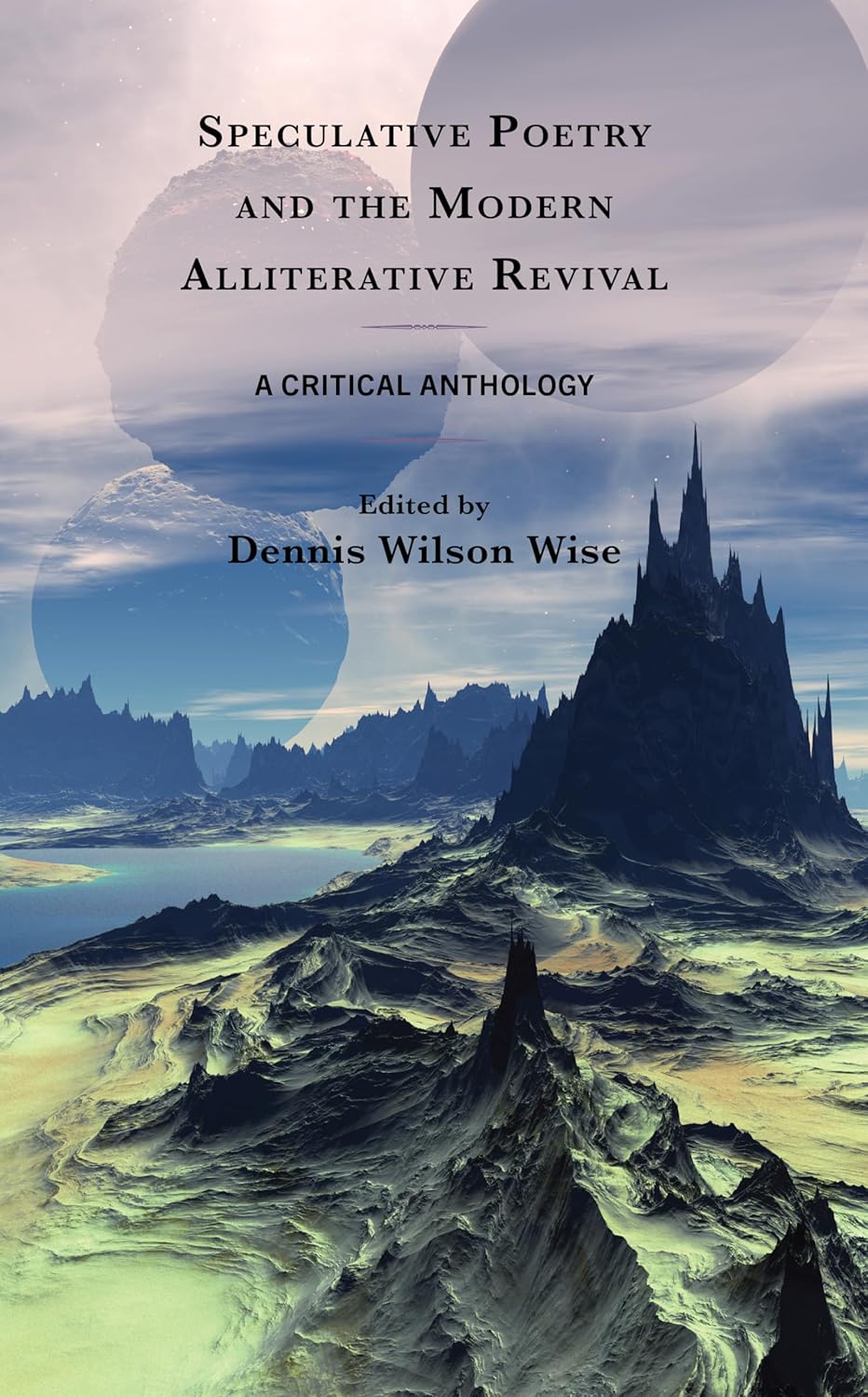
[Today, we sit down for an interview with editor Dennis Wilson Wise. Here, he discusses his work putting together Speculative Poetry and the Modern Alliterative Revival: A Critical Anthology, which features well-known and little-known poets — including Eternal Haunted Summer alumni Adam Bolivar, Math Jones, and Michaela Macha! Highly recommended to anyone with an interest in speculative poetry; alliterative verse; the history of the form; the intersection of re-enactment societies, fantasy, and modern Paganism; and learning how to write alliterative verse yourself!]
Forests Haunted By Holiness: You recently edited Speculative Poetry and the Modern Alliterative Revival: A Critical Anthology. First, congratulations! Second, why such a collection? Why a book about speculative alliterative verse?
Dennis Wilson Wise: The project owes itself thanks to me diving into a completely random research rabbit hole. After finishing my dissertation on Tolkien — this was back in 2017 — I wanted to do something a little different, so I began work on an old fantasy favorite, The Dark Border by Paul Edwin Zimmer. Well, unbeknownst to me, apparently Zimmer wrote a ton of alliterative verse, and he credited another SFF author, Poul Anderson, as a seminal influence. Now, as often as people mention Tolkien as a modern alliterative poet, nobody ever mentions Anderson, so I began to wonder why. Turns out almost nobody even knew he wrote alliterative verse. Eventually, I discovered a whole underground movement of people just like him and Zimmer.
FHBH: Very briefly, for those not familiar with alliterative verse, what is it? How is it structured?
DWW: There are several different kinds of alliterative meter across several Germanic traditions, but you can find the most famous version in the Old English poem of Beowulf. Basically, every line is separated into two half-lines by a “caesura,” which is this noticeable mid-line pause for breath, and both half-lines are connected together by strongly stressed alliterating syllables. For instance, here’s a classic instance from The Lord of the Rings:
“Arise now, arise, | Riders of Théoden!”
The strongly stressed alliterating syllables are bolded. Alliterative poetics has several other fancy rules as well, but that’s the gist.
FHBH: How did you go about putting the anthology together? How did you decide which poets and poems to include?
DWW: Decisions about whom to include were easy — I included nearly everyone. Remember, almost nobody knows this literary movement is even happening. I therefore had to show critics and readers alike just how much alliterative poetry has been written over the last 100 years. It’s almost impossible to find, too. Mostly it’s coming from research archives, unpublished fan poetry, and out-of-print novels, not to mention SFF adjacent realms of literary activity like neo-Paganism and the Society of Creative Anachronism. So I tried to include everything I could.
That said, almost immediately after the anthology came out, people started contacting me with even more poems that I hadn’t yet discovered. My friend Paul Douglas Deane is like a bloodhound in this regard. He runs the website Forgotten Ground Regained, and although he uses a broader definition of “alliterative meter” than I do, his website is another fantastic resource for collecting previously unknown alliterative poets.
FHBH: Speculative Poetry includes several notable pieces by CS Lewis, Poul Anderson, and Diana L Paxson. Most people think of them as prose writers, rather than poets. Are there other people who are most famous for their prose, but whose poetry you also recommend?
DWW: Tolkien, obviously. Sadly, I couldn’t include anything by him — his estate just doesn’t allow anyone permission to reprint. However, among the prose authors I could include, John Myers Myers and Patrick Rothfuss are great examples. Paul Edwin Zimmer, too, although he doesn’t have quite the same name recognition.
FHBH: You note in the introduction that the Society for Creative Anachronism produced an “astonishing cadre” of alliterative poems in the 1970s, and that many other works appeared in fanzines and cheap genre magazines. Is that still the case? Is the best place to find examples of the current revival on the fringes of the mainstream? Whether digital or print?
DWW: Both yes and no. On the one hand, yeah … most contemporary revivalists are sharing their work in relatively “fringe” places. Fanzines, the SCA, neo-Pagan circles (and here I’d recommend Michaela Macha’s website Odin’s Gift). There are also online journals like Eye to the Telescope and Star*Line, but actually all speculative poetry can be considered “fringe” in relation to mainstream literary culture. This is something I’ve encountered again and again in my research on fantasy publishing. The divisions in Anglo-American literary culture are real.
On the other hand, the modern revival does seem to be witnessing an upswell just about now. In addition to good mainstream poets like Amit Majmudar who dabble in the alliterative meter, my anthology’s publication has coincided with several noteworthy recent books of SFF alliterative verse. Off the top of my head, the biggest one is Zach Weinersmith’s Bea Wolf (2023), which is getting nominated for awards left and right, plus Adam Bolivar’s A Wheel of Ravens (2023) and Mary Thaler’s Ulfhidr (2023). That’s all simultaneous with my book. I’m excited to see what else awaits the movement, particularly as alliterative poetry becomes better known.
FHBH: You also note that modern alliterative poems tend to be short, compared to the epics of the past. Why is that? Have audience tastes changed? Will we ever see another great poem like Sir Gawain and the Green Knight?
DWW: Honestly, it’s just hard to find a publisher for long-form poetry. Print magazines don’t have the space, and book publishers don’t think it sells. In fact, many of my anthology’s best longer pieces never saw publication during their author’s lifetime — for example, The Nameless Isle by C. S. Lewis and Blardrengir Saga by Ron Snow. In fact, my personal favorite long poem in the anthology, Mother’s Song by the Heathen poet Math Jones, only previously appeared on a digital spoken album, not in any permanent or readily accessible print medium.
However, it’s only a matter of time before someone (and their publisher) puts two and two together. You could even argue that Zach Weinersmith is doing exactly that with Bea Wolf, and I’m sure his publisher is salivating for the sequel he’s working on.
FHBH: For those who want to try their hand at writing alliterative poetry, how do you suggest they get started?
DWW: Honestly, it depends on the kind of poet you are. In the modern revival, I often distinguish between “purists” and “impressionists.” The former group wants to resuscitate the medieval alliterative meter as closely as possible (this is Tolkien and Lewis), but other poets want a bit of medieval flavoring and nothing more. In either case, I’d recommend you consult my appendix on the alliterative meter in Speculative Poetry and the Modern Alliterative Revival, or else search out Tolkien’s or Lewis’s own essays on the subject.
What’s important to recognize, though, is that both purists and impressionists are important for the modern revival. For example, I’m currently doing a blog series for the Tales After Tolkien Society. It’s called The New Poets of Rum Ram Ruf, and one entry is entitled “Three Impressionists: Part One and Part Two”. It’s all about poets going the impressionist route and yet still producing interesting revivalist work.
FHBH: In addition to the volume you edited, which other books on speculative poetry and/or alliterative verse do you recommend?
DWW: There’s honestly not much out there. For speculative poetry, I’d recommend Suzette Haden Elgin’s The Science Fiction Poetry Handbook (2005) and Elizabeth Morris’s Ars Poetica Societatis, although the latter may be hard to find.
For stuff on the alliterative meter itself, my anthology has an exhaustive bibliography of academic resources. For books with modern alliterative verse, anybody I mentioned above is a good bet. Paul Deane also constantly updates his website, Forgotten Ground Regained.
FHBH: Which book fairs, conventions, or other events do you hope to attend in the foreseeable future?
DWW: So far, I mainly concentrate on academic conferences. The International Association for the Fantastic in the Arts holds an event in Florida every year, and I’m hoping to attend the big medievalist conference in Kalamazoo, Michigan next year.
FHBH: What other projects are you working on?
DWW: Besides my New Poets of Rum Ram Ruf series, I’m currently researching a book on the fantasy publishing industry. The initial focus will be on Tolkien (my working title is Specters of Tolkien), but only after 1977 did fantasy fiction go truly mainstream. The two editors primarily responsible for this shift are Judy-Lynn and Lester del Rey from Del Rey Books, but their story hasn’t yet been told.
 Eternal Haunted Summer