
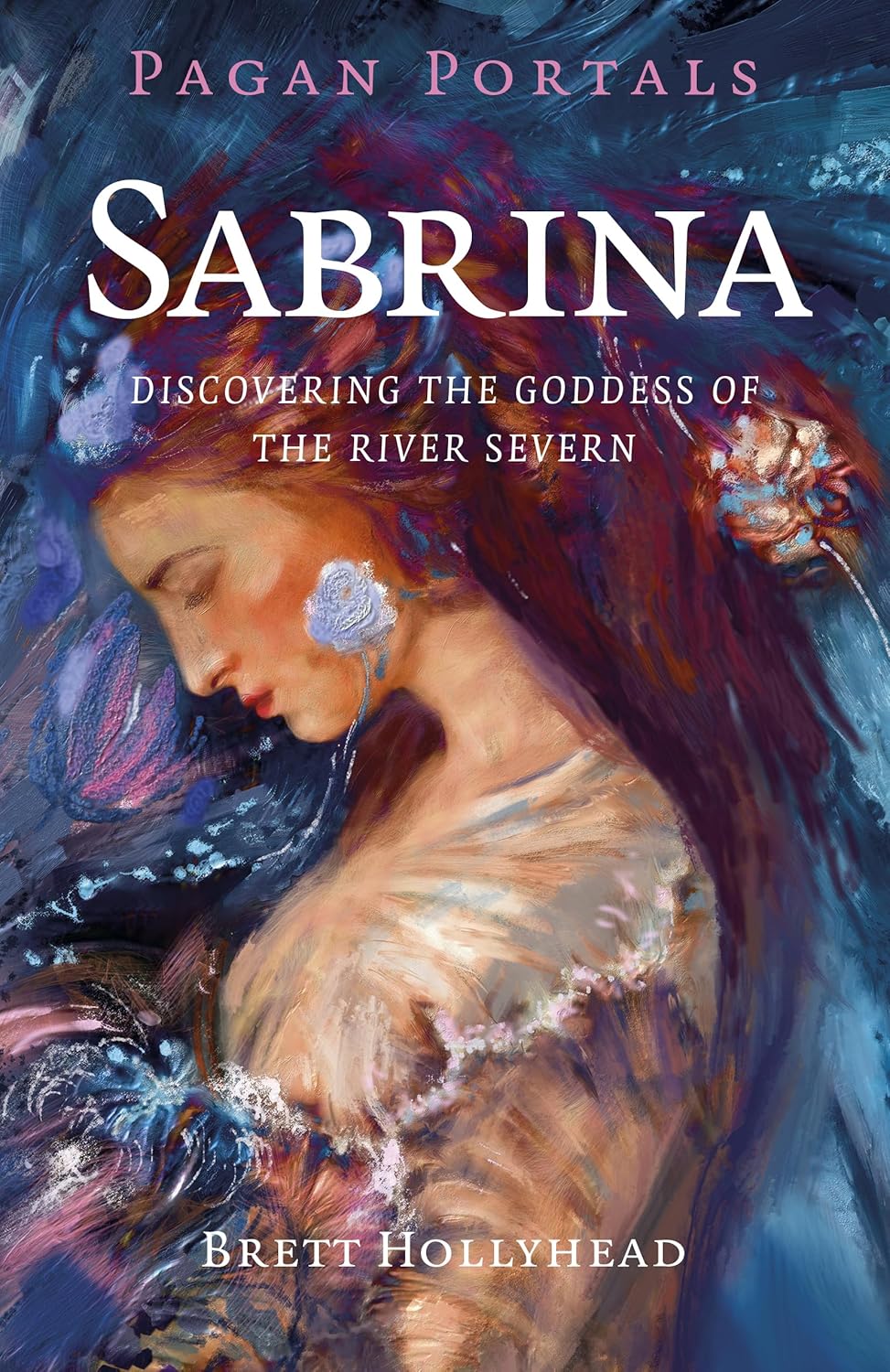
[Today we sit down for an interview with author and folk witch, Brett Hollyhead. Here, they discuss their practices as a Welsh Marches Folk Witch; their new book Pagan Portals: Sabrina; and their upcoming projects.]
Forests Haunted By Holiness: How do you define your personal spiritual practice? Does it have a name or is it more intuitive and eclectic?
Brett Hollyhead: I personally define myself as a Welsh Marches Folk Witch. My practice is very much inspired and cultivated by the traditions, beliefs, and lore of my home, specifically in between Shropshire and Powys as I grew up on both sides of the Welsh/English border. It’s very much a mixture to reflect the intricacies and complexities of the landscape in which l adapt whilst highlighting the distinctive character of the Welsh Marches. This is a liminal place where many of us can identify with the term “Anglo-Welsh” to represent the many facets of the land’s history and culture which is ultimately reflected in the magic . Mostly I will look to the practices of the Witches and Cunning Folk here which go by a variety of names and combine them with the practices of the everyday people and the lore I grew up with whilst building relationships with the Spirits and Deities that reside within.
FHBH: Your new book Sabrina: Discovering the Goddess of the River Severn will be released at the end of April 2025. First, congratulations! Second, why a book about Sabrina? Why are you releasing the title through Moon Books? Did you approach them with the idea, or did they come to you?
BH: Thank you so much; it still doesn’t feel quite real.
I wanted to write a book on Sabrina as I felt she had been a little bit sidelined compared to the popularity of other Deities within the Celtic continuum. Despite being the Goddess of Britian’s longest river and having such a profound effect on the history of both Wales and England, not many people know her stories. But in saying that, Sabrina is very much loved by the people within the Severn’s vicinity as she plays a vital role in our communities as well as shaping our landscape. You can’t go very far without seeing street names or houses named after her, boat tours displaying her image and divine status as well as various statues dotted about the place. I wanted to get her name out there as much as possible so that others could learn more about her.
I went with Moon Books because I love their Pagan Portal series which captures the vital elements of any Deity in a beautiful and succinct way. I approached them with the idea and I’m ever so grateful they said yes. They have been an absolute pleasure to work with and I really enjoy being an author with them.
FHBH: Why a book about Sabrina? What is it that draws you to her?
BH: I was born not too far from her river and I grew up with her stories; the Goddess is very much a part of me and no matter where I am I can feel her at times telling me to come home when I stray too far. Throughout history her mythology and lore is deeply entwined with the notion of boundaries and protection with her stories depicting her as a Deity who comes to the rescue of those in need of her aid. She is the source of so much life while at the same time demanding respect for her more temperamental, destructive qualities.
But the thing that draws me to her is her defiance of labels. Like water she refuses to be contained, defining her own trajectory which was extremely evident in the attitudes of the poets who used her imagery to reflect their dissatisfaction with the homogenised idea of “British Identity”. She is also very queer in nature. Although we refer to her as “she” in the contemporary when we look throughout history she has undergone various transformations with connections to the masculine-presenting Deity Nodens, the Virgin Mary, the Goddess Modron, etc. And I can guarantee in a few hundred years’ time she will change again. There is great comfort in that, especially for those who are marginalised in society who can take refuge in her presence.
FHBH: What sort of research went into Sabrina? Big stacks of books? Long hours at the library? Conversations with historians and devotees?
BH: By the Gods so much; you name it, I did it … so much so that I still shudder at the memory of staying up to 4am on most nights delving further into rabbit holes with only the smell of espresso to pull me out. I started with the lore I grew up with as well as that which is commonly associated with her, including her two origin stories, one from Wales and one from the writings of Geoffrey of Monmouth. Then I moved on to books and information kept in the archives and museums, digging deeper into archeological records and etymology. I also spoke at length with several people on different parts along the river’s course, listening to their experiences with the river Severn, which is where I came across several folkloric entities to include in the book, most of which were aquatic serpents.
FHBH: What one fascinating bit of research did you absolutely have to include in the book?
BH: I had to include how Sabrina managed to find her way into America. I found it absolutely fascinating. Many people can struggle connecting with Deities who are so localised and with Sabrina inextricably linked to the river it can be hard to convince others to take notice. But as a fluvial Goddess who represents the hydrological cycle, there is a poignant message that water connects all life on Earth and no matter where you are she can be experienced, especially in the rain. However, there is a difference when it came to her migration to America in the 19th century. A statue of Sabrina was gifted to Amherst College which then led to significant changes in the college culture, some spiritual, some bizarre, and some quite violent as the students fought over her ownership.
FHBH: If someone were to visit the area, what’s a good way to honor Sabrina? And does someone have to live on or near the river to honor Sabrina or can that be done from anywhere?
BH: There are quite a few ways you can honour Sabrina, including reading her stories and getting to know the history of her land, as well as learning Welsh to honour her Welsh legacy. If you live close to her river, taking regular visits to spend time with her and make offerings whether that be reciting poetry or heartfelt devotions as well as helping to pick up any litter that might be around.
Unfortunately in the day and age we are living in where all rivers are exploited and polluted from the greed and negligence of those in power, the best way to connect is to help the Goddess and river conservation, which is also a great way for those who don’t live in close proximity to her. This can range from using our voices in campaigning and raising awareness, signing petitions, and being conscious of our own relationships with water. In my personal craft I love to crochet and if I sell my pieces I will usually donate a certain amount to charities that support the river as my own personal act of devotion.
FHBH: Which book fairs, conventions, or other events do you hope to attend in the foreseeable future?
BH: As many as I can, hopefully. I have quite a few events lined up for this year and next including the Welsh Occult Conference, The Festival for Pagans and Witches, NorthWales Pagan Festival, Witchfest International, and the Salem Witchcraft and Folklore Festival. But I really hope to reach people outside of the Pagan Witchcraft community so I’m hoping to do a little book tour across the Severn to achieve this.
FHBH: What other projects are you working on?
BH: I have quite a few activities going on at the moment such that sleep is becoming a vague memory. I’m currently writing my second book, Magic of The Welsh Marches: Witchcraft and Enchantment from the Celtic Fringe. I’m also working on a third book proposal, as well as in my spare time teaching crochet classes, teaching workshops that combine.pole dancing and magic, and I’m also making as many crochet butterfly brooches as i can to raise money for Sparkle – The National Transgender Charity.
 Eternal Haunted Summer